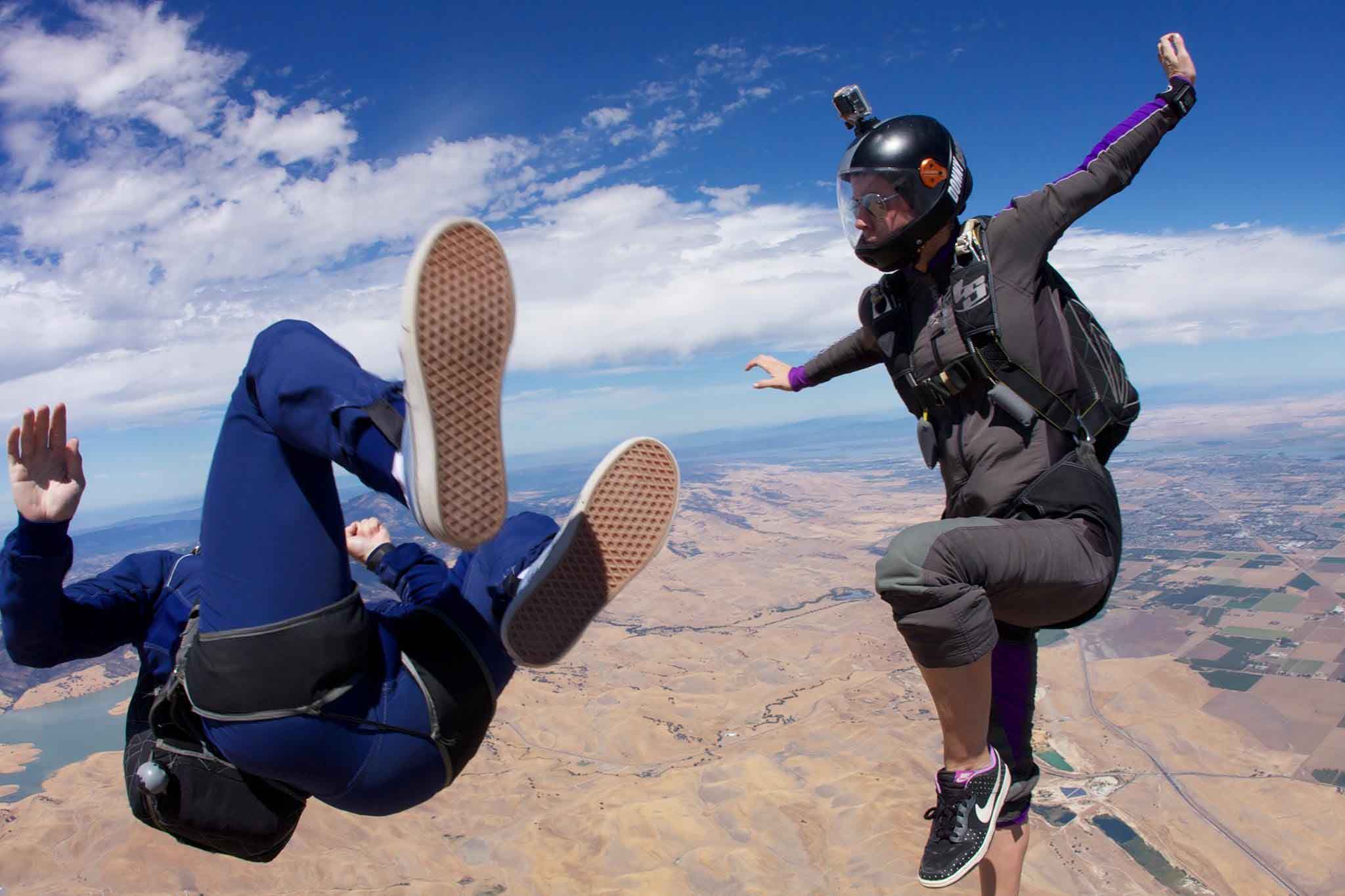




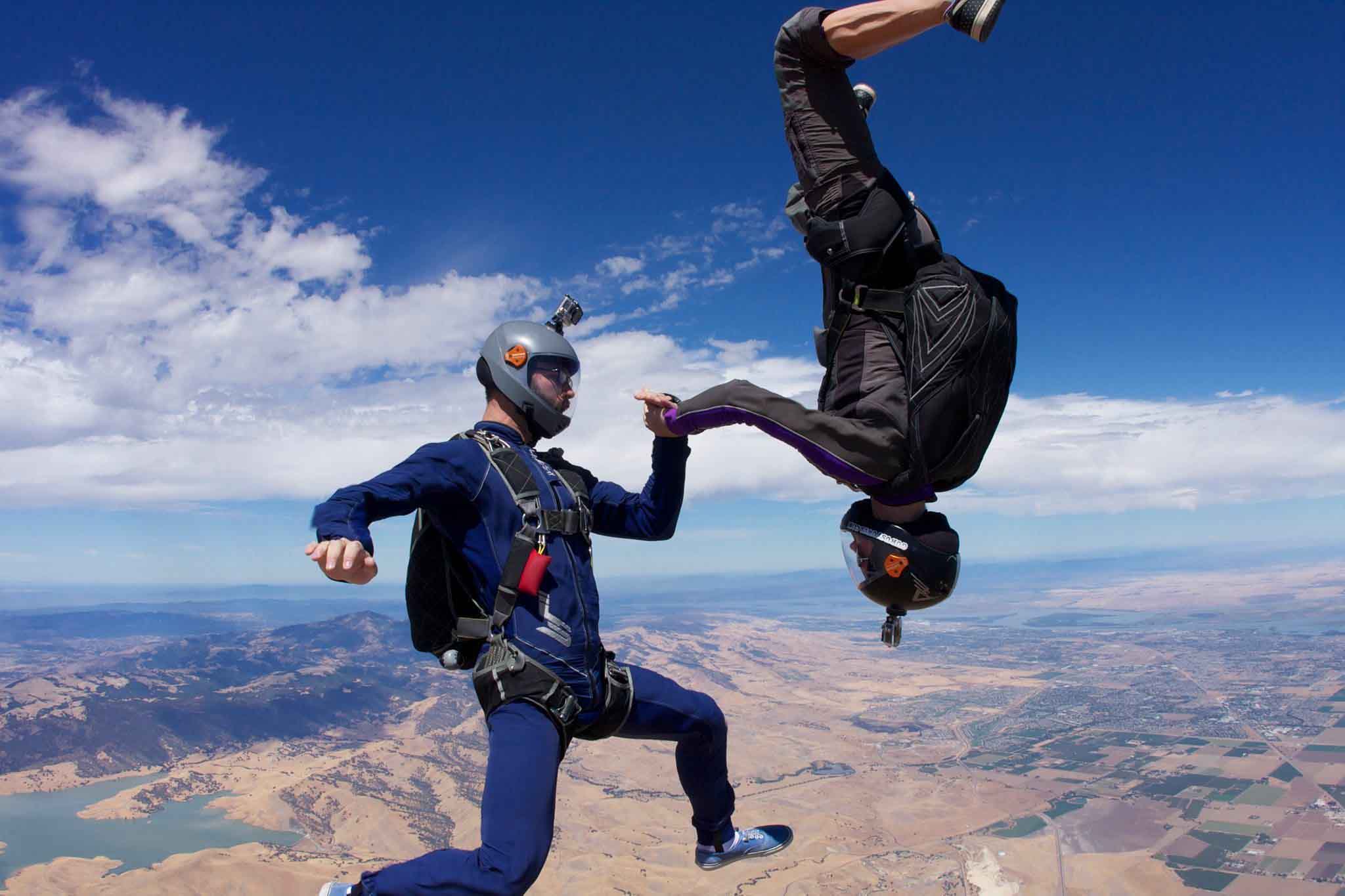
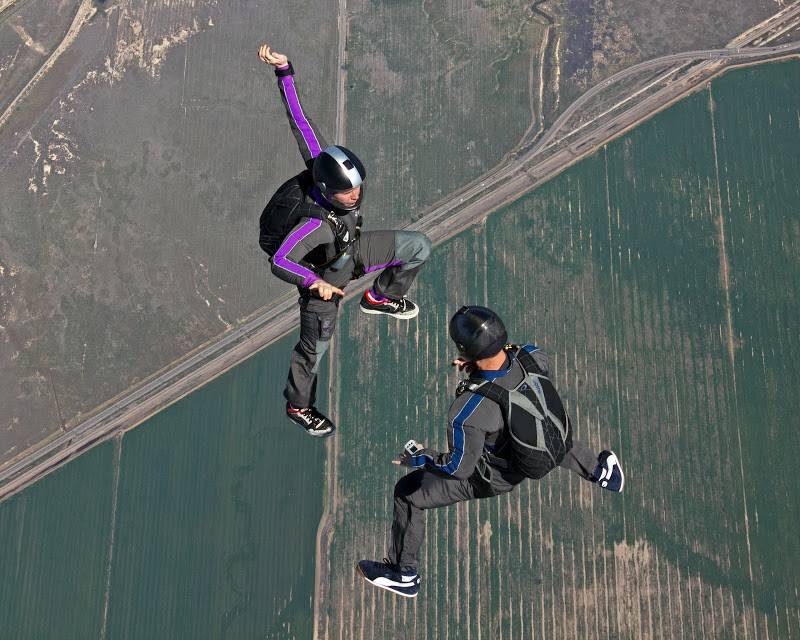
The newest discipline at the USPA Nationals is 2-way VFS, Vertical Formation Skydiving. However, that name is a bit misleading. Although predominately vertical, the dive pool currently contains 4 belly and back flying randoms. In the coming year, you can expect more flat points, including blocks, and the push will be to re-brand the discipline as 2-way mixed formation skydiving, or MFS. For the ‘open’ class, it is slated to include 15 randoms and 10 blocks. This will allow for a draw to 4 or 5 points, for a 6-round meet, and enough points left over for a tie-breaker round. For the ‘advanced’ class, the draw will be to 3 or 4 points, with the most difficult blocks and randoms being omitted.
History
2-way formation skydiving of any orientation is nothing new. It has been a part of the competitive tunnel flying circuit, collegiate competitions, scrambles events, and the former compulsory speed rounds within the artistic freefly discipline. However, this is the first time it has existed at the national level, as its own discipline, with mixed orientations.
Need for Change
At the 2010 world meet in Russia, both USA1 (SoCal Converge) and UK1 (Volare), came within 1 point of ‘breaking the formula’ for how freefly compulsory speed rounds were scored. Artistic scores must be between 1 and 10. The ‘raw score,’ in this case, 24 points, was entered into the formula to get a score between 1 and 10. In this case, it was 9.9. If it had been 25 points, it would have been 10.1.
Speed Disappears from Artistic Freeflying
As expected, the judging community knew something had to change. Less expected was the majority opinion of artistic competitors that compulsory speed should not be a part of artistic freeflying. There should be ‘artistic compulsories for an artistic discipline’ they said. Starting in 2011, the FAI changed the rules in artistic freeflying, doing away with the compulsory speed rounds. Many nations, including the United States, followed suit. This left, in my opinion, a gaping hole in competitive opportunity and logical competitive progression.
Test Events 2012-13
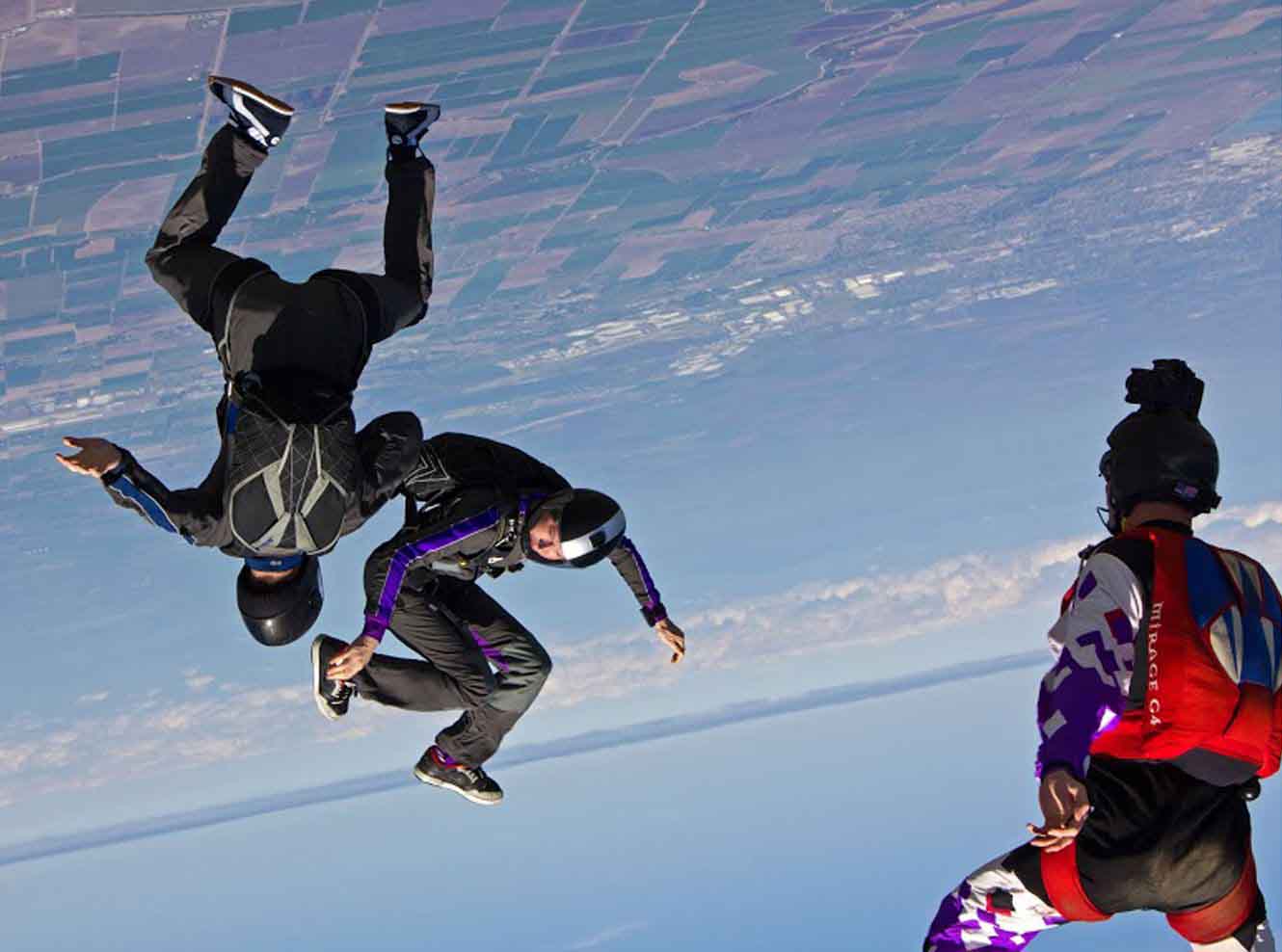
In 2012, there was an attempt to get 2-way VFS introduced at the USPA nationals, as a test event. However, the effort came a bit late, and the powers that be insisted on ‘regional competitions’ leading up to the national competition. Fair enough. With a set of rules and dive-pool in circulation, 2013 brought 3 regional competitions in Sebastian, Lake Elsinore, and Eloy, before culminating in a test event at the 2013 USPA Nationals.
Probable Go-ahead 2014
With great successes at all 4 of these competitions, the foundation has been laid for introduction as an ‘official’ event at the 2014 US Nationals. The February meeting of the USPA competition committee will be the last stop for approval, and all indications are a go! Stay tuned then for a full set of ratified rules and dive pool!
Andy Malchiodi
USA & World Champion, SoCal Converge
2013 USPA Nationals 2-way VFS Open Champions (test event): Team Ridiculous Maneuvers
“The 2-way test event was a big success at the US Nationals 2013; it fills the same need in VFS that 2-way does in CF. I’m optimistic the USPA Competition Committee will look favorably upon making it an official medal event for 2014.”
Canvassed Opinion
Objective Scoring
“It’s really exciting to see this new discipline open up. It’s a great stepping stone to 4-way Vertical Formation as well as a great discipline by itself. It allows smaller teams to train and improve together, which is easier to manage than bigger 4-way teams. Any new discipline that improves access to competition is AWESOME!! It’s a real hit for the points crowd too as it’s purely objective and comes down to a score, based only on formations completed, eliminating the issues that Artistic judging has had in the past with subjective opinion based scoring.”
Mikey Carpenter
UK & World Champion, Volare
UK Trial
“The UK plans to trial a 2-way VFS event for 2014, following USA’s lead. It will be interesting to monitor its impact, both as it grows as a standalone event and its ability to feed VFS & Artistic events”
With only 9 VFS teams from over 60 nations at the Dubai World Championships 2012, perhaps this new exciting event will help this technically challenging discipline at the grass roots
Weed Stoodley
VFS & Artistics Rep, BPA Competitions Committee
Encourage Belly Flyers
“2 way VFS, for the beginner freeflyer, is a lot less intimidating and easier to get a team started than VFS. Hopefully this discipline will encourage belly flyers to expand their repertoire, and enlighten those who ‘only’ freefly to the fact that belly flying involves more than your basic AFF position – if you wanna go fast, that is!”
Hannah Betts
World Champion 4-way FS, US Champion 2-way Freefly
What’s the Name of the Game?
“I remember when we trained 2-way vertical formation when it made up the compulsory rounds of Freefly competitions. It was a lot of fun figuring out the transitions between the points as it is the only discipline to feature both vertical and flat points in the same round – which would lead me to the conclusion that ‘Vertical Formation Skydiving’ or ‘VFS’ may not be the most fitting name as it combines multiple orientations. I’m glad the whole naming thing isn’t up to me because selecting a good name that everyone agrees on will be no easy task! Good luck with that!!!”
Mike Carpenter, Volare
“Having a 2way event is endearing to many. It is easier for a small DZ to put together a team of 2 with camera, 3 people total, than a team of 5. It’s also easier to schedule even for working skydivers at large DZs. An additional challenging and fun element has been added that is not in 4way VFS but was at some point in artistic freefly, which is belly and back points, making it not just a vertical discipline, but a multi-dimensional discipline. Being able to fly on all axes well is becoming an increasingly important and relevant skill in our sport.”
Sara Curtis, Arizona Arsenal

PROPOSED 2-WAY VFS / Mixed FS DIVE POOL
For those interested in the detail, a summary of the rules and suggested dive pool follows. If in doubt, and unless it is specifically referred to in these rules, defer to the 4-way VFS rules in chapter 9 of the Skydiver’s Competition manual, downloadable from USPA
COMPOSITION
3 member team. 2 performers (aka “fliers”) and a camera person.
RULES
The draw is to 3 or 4 moves, and this size dive pool is designed for a 6 round meet. If there are not enough moves left to draw the final round, all moves are put back into the hat, and the final round or rounds is drawn.
There are 2 divisions, advanced and open. In the Open division, all moves from the divepool may be drawn in the same round. In the Advanced division, the following randoms are omitted: D, G, I, J, K, L. This omission is the only differentiation from the open division.
Standard VFS rules apply, including, but not limited to:
- 35 second working time
- Jump altitude, 13,000 ft.
- time starts when any team member, excluding camera person, leaves the airplane
- first point can be launched, but is not required
- After first point has been completed, the proper sequence must be maintained
- complete separation required between points
- Each properly executed move is worth 1 poin
- An improperly executed random is a “bust” and no points are earned
- An improperly executed block may be worth 0 points or 1 point, depending if either half of the block is properly executed
- An omission of a point in the prescribed sequence will carry a 3 point penalty, with a minimum score of 0
- All grips can be mirrored.
BLOCKS
1. Double 69
One flier is upright and one flier is head down. The head down flier takes a two handed dock on the legs of the head up flier. Both fliers transition to the opposite orientation and the head down flier takes a 2 handed dock on the legs of the upright flier.
2. Grip 360 Spin Grip
Both fliers are head down and take a right to right hand to arm dock, spin 360 degrees, then re-dock the original grip.

3. Grip Half-Eagle Grip
One flier is upright and one is head down. They take a right hand to right arm grip, then perform a ½ eagle rotation, ending up in opposite orientations, then retake the original hand to arm dock.
4. Grip Flip Grip
One flier is upright and one is head down. They take a right hand to left foot grip and then both complete a full front or back flip, then re-take the original dock.
5. Upright Grip 360 Grip
Both fliers are upright, they take a right hand to right arm grip, do a 360 spin, and retake the original dock.
6. Upright Hand to Foot, Flip, Hand to Foot
Both fliers are upright, they take a single right hand to right foot dock, both perform full front or back flips, and retake original grip.
RANDOMS
A – Two way head down star, (head down round)
Both fliers are head down, with double hand to arm grips. Right hand to left arm and/or left hand to right arm.
B – Double Spock
One flier is head up and one is head down. The head down flier grips right handed on the head of the upright flier and the upright flier grips right handed on the head of the head down flier.
C – Vertical Compressed
One flier is head up and one is head down. The sit flier grips with his right hand on the right leg of the head down flier and the head down flier grips with his right hand on the right leg of the sit flier.
D – Sole to Sole
One flier is head up and one head down. Some part of the right sole of one flier must dock some part of the right sole of the other flier.
E – Vice Versa (mixed star)
One flier is head up and one flier is head down. The two fliers take a right hand to right arm and a left hand to left arm grip.
F – Totem
Both fliers are upright facing the same direction, and the soles of both the feet of the top flier must contact the shoulders of the bottom flier.
G – Belly/back Sidebody
The belly flier docks on the arm and leg of the back flier. The belly flier’s left hand to back flier’s right arm and belly flier’s right hand to back flier’s right leg.
H – Head up Double Hand to Feet
Both fliers are upright, one flier takes a left hand to right foot and right hand to left foot dock.
I – Belly Cat
Both fliers are on their belly and one flier docks on the legs of the other and the grips are right hand to right leg and left hand to left leg.
J – Head up Double Arm Grip (head up round)
Both fliers are head up with double hand to arm grips. Right hand to left arm and/or left hand to right arm.
K – Belly Star (belly round)
Both fliers are belly flying with double hand to arm grips. Right hand to left arm and/or left hand to right arm.
L – Belly/Back Compressed
One flier is on their back and one on their belly and the belly takes left hand to right leg and the back flier is right hand to left leg.
DEFINITIONS
- “arm”- anything below the harness
- “leg” – anything below the harness
- “hand” – includes the wrist
- “foot” – includes the ankle
- “head”- above the neck
- “sole”- the bottom of the foot
- “shoulder” – referring specifically to the top area of the shoulder, from widest point of shoulder bone to base of neck, excluding the shoulder blade.
- “head down” – orientation consists of the competitor’s head having advanced further into the relative wind
than the competitor’s feet by a significant amount, i.e., the length of the competitor’s torso; all distances and
lengths are in terms of what is shown on the judging screen. - “head up” – orientation consists of the competitor’s head trailing behind the (average) position of the competitor’s feet by more than the length of the competitor’s torso; all distances and lengths are in terms of what is shown on the judging screen.
- “belly fly” – belly and front of hips to the relative wind, with no part of the body between the shoulders and hips at more than a 30 degree angle off perpendicular to the relative wind.
- “back fly” – back to the relative wind, with no part of the body between the shoulders and hips at more than a 30 degree angle off perpendicular to the relative wind.
- “dock” and “grip” are recognized as controlled contact.
- “relative wind” – the direction from which the air appears to be coming due to the relative speed of the competitors in freefall.