




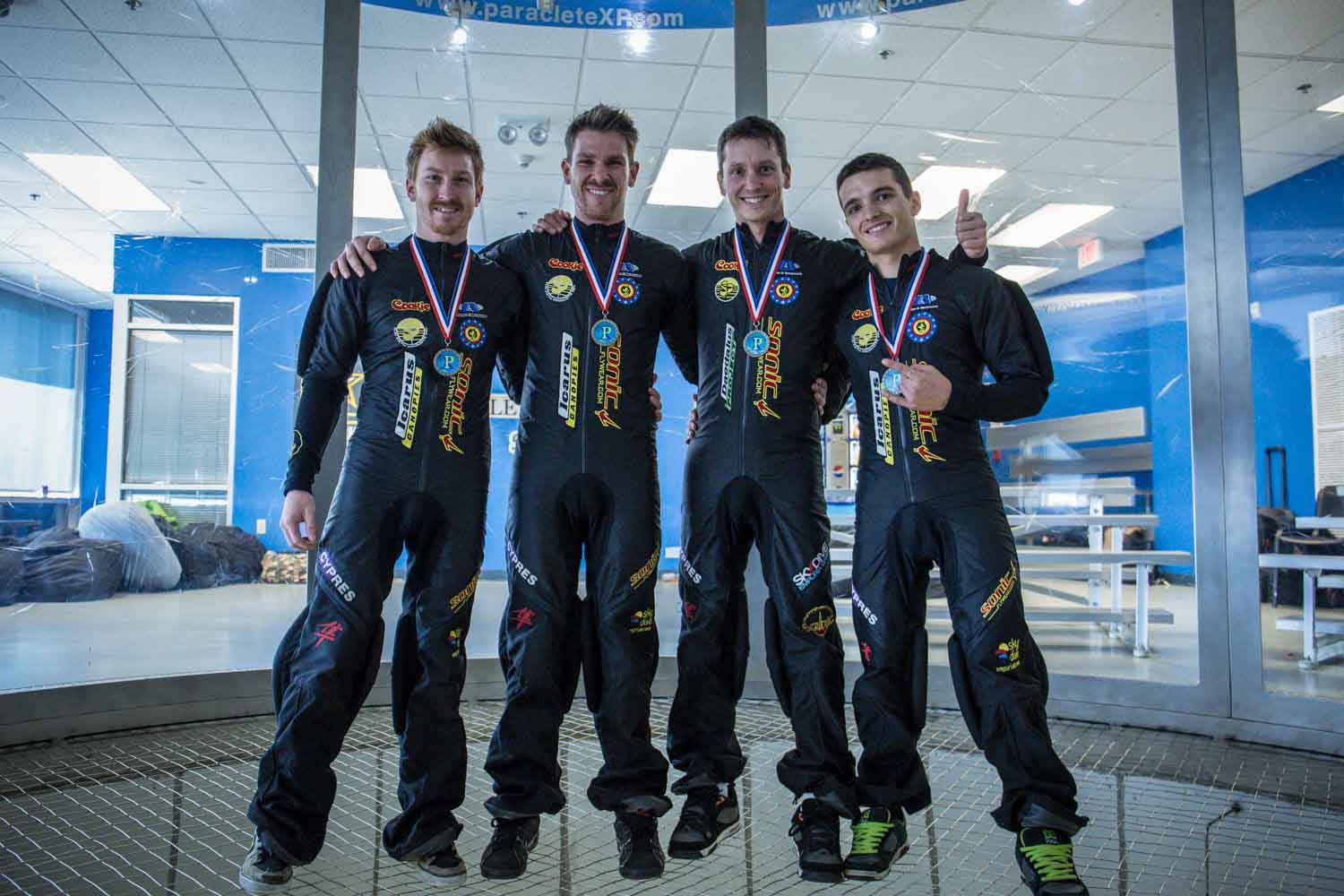
How useful are Rigs in the Tunnel?
Hi Roy
We have a nice 4-way team; we all like each other, which is a good start! It’s our third year together, we’re in AAA category and in 2013 we scored 16 average outdoors and 18 in tunnel competition.
We have made our training plan, and we have 12 hours of tunnel planned over winter. Mostly we do 2 hours every other weekend. My question is should we wear rigs in the tunnel? I see more and more teams doing this. We never have. I don’t really fancy it to be honest, I kind of like to fly free… but do you think it is advisable? We aim to put 2 points on our average this year. We have 200+ jumps planned also.
Thank you
Lucaz

Hello Lucaz,
Interesting question! Some years ago, when several top teams started to train with rigs inside the tunnel, they swore by it. They said that they would never train without them anymore! Nowadays teams are training more and more without them again, some never train with rigs at all (like Hayabusa) and other teams use them for a part of their training. The idea was great and teams over the world followed the ‘hype’. There is no doubt that training with rigs in the tunnel has advantages, but first let’s see what the biggest difference is when you fly with or without a rig…
Extra Weight
When we fly in the tunnel wearing our rigs, it is obvious that we carry extra weight (around 10kg). The more weight we are carrying, the slower we become. We can compare it with a Formula 1 racecar. If you add another 100 kilo of ‘dead weight’ to the car without making the engine stronger, the car automatically runs slower lap times. In acceleration it will be slower, but the car also needs to brake earlier. The same thing happens to our body when we fly; throw a rig on our back, and we cannot be as fast anymore as without it. It requires more energy to start a move, and longer power for braking.
Momentum
Another difference of wearing a rig is that, due to the extra weight, we carry more momentum. This is most noticeable during our turns and blocks. The timing of where to stop a move will change, compared to flying without a rig; it will always be a bit earlier.
Flexibility
Without the leg and chest straps tightened, no container on our back that restricts our freedom in arching and twisting our body in any way we want, we are simply much more flexible. Without a rig we can put ourselves in more extreme positions, which can make us fly faster. When we are limited in our movements, usually there is a (small) difference in our body position.
when you often train with rigs, it physically will make you stronger
Fatigue
Because of wearing those extra kilos (using more energy) and of having restricted freedom, flying with a rig makes you more tired compared to flying without it. If you are planning to fly 2 hours in a weekend with rigs, it can be hard work if you put the same intensity into your training as without rigs. In a way you train just like in freefall, which is good, but be careful it doesn’t make you fatigue and that you start making mistakes just because you are tired. With each team and individual, there is a thin line where you have a benefit of flying with a rig, and where you lose the advantage because you get tired. Another topic would be the team’s ‘fitness level’ of course.
What I believe is that when you often train with rigs, it physically will make you stronger. I like to see it more as a resistance / strength training. Improving in this area, should help you eventually to become a faster and stronger flyer.
Communication
Wearing rigs can make communication more difficult; the containers can block the view for the ‘key people’ on opposite sites. If you have for example the start of block 20, point and tail look at each other to give a synchronized key. If you have no container on your back it is easy to see each other, but with a rig we usually need to put ourselves slightly higher to be able to look each other in the eyes. I know these are small differences, but important ones.

If you fly so fast that mentally it becomes a real challenge to stay on top of your game, than going back into freefall will feel like slow motion
Speed
For sure an advantage of not wearing rigs is that it’s more fun! I think we all feel the same about that 😉 But an important aspect is that because we are not wearing extra weight, we physically fly faster. By doing that, we automatically train our brain to be faster too. It’s here where I see an important advantage. If you fly so fast that mentally it becomes a real challenge to stay on top of your game, than going back into freefall will feel like slow motion. When it feels that everything goes slow, it is much easier to see what is going on (communication) and you have more time to adjust to fix little mistakes.
Goals
So, what should you do? I think it is important to know what your biggest priority is, competition-wise I mean. What is the most important goal of your season? How much experience do you all have in the tunnel and with jumping?… If for example the Bedford World Challenge is your main goal, don’t wear rigs in the tunnel. If the World Meet in Czech Republic is your main goal and you don’t have much jumping experience, wear always rigs. A lot has to do with how many hours you can train in the tunnel and how many jumps you can do per season, plus the individual and team experience. With Hayabusa we don’t use rigs anymore in the tunnel. But indeed, if for example we do the Paraclete XP tunnel competition and we have prepared well for it, and two days later we have to jump out of a plane, it is a big difference to us. Experience will make the difference of how fast you will adapt to the new situation.
Summary
I see advantages and disadvantages of using rigs in the tunnel. For different teams, different recommendations apply, but for most teams making a compromise and finding a good balance is surely advisable.
Roy