




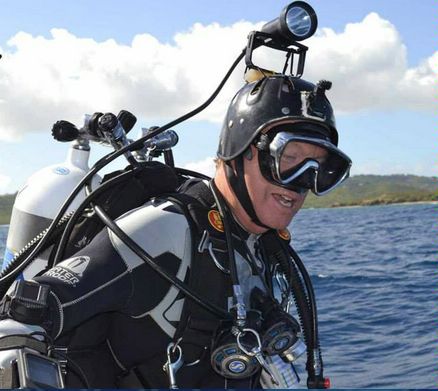
On the 15th August 2015, the world received sad news that a World Depth Record attempt ended in tragedy when diver Dr Guy Garman failed to return from depth.
Firstly, I would like to wish my sincere condolences to the friends and family of Dr Garman.
Now, I would like to consider some psychological factors pertinent to the failed and fatal attempt. I am not seeking to attribute blame, nor to define a cause. I am writing for educational purposes in the hope that the information may help prevent future accidents.
#The Issue of Experience
Dr Garman, known as ‘Doc Deep’, had been diving for 4 years and accumulated less than 600 dives. This averages out as only 3 dives per week. His progression to advanced technical diver was extremely fast, leading to a third of his dives (200) being below 200ft. A mere 35 dives were below 450ft at the time of his record attempt.
To many (most?) in the diving community this experience would be considered woefully small; his progression extremely fast and without pause for consolidation. I’ve been diving more than 25 years; 10 years in technical diving as full-time, professional instructor and diver. Yet, I wouldn’t consider myself ready to attempt breaking a world depth record. Far from it: I compare myself with peers and willingly accept that there are many whose experience, capability and knowledge far exceed my own.
Dr Garman had dived once to a depth of 800ft. It was an enormous escalation to jump down to 1200ft, that left him under-experienced in his personal tolerances of extreme deep-water hyperbaric physiological reactions, especially High Pressure Neurological Syndrome (HPNS); a known killer on previous extreme deep dives, and Compression Arthralgia. Progressively and incrementally increasing his extreme deep diving range would have better informed him of his tolerances and helped shape his descent and gas strategies. It may even have helped him set a personal depth limit above that which he attempted for the record.
Of course, that process would have taken years longer, many, many more dives, and cost much more money. But it may have provided a lesson that he was unsuited physiologically to the extreme deep or that his hypothetical planning was flawed. The attempt may never have occurred if he’d opted for prudence, patience and critical feedback at progressive, repeated steps over time.
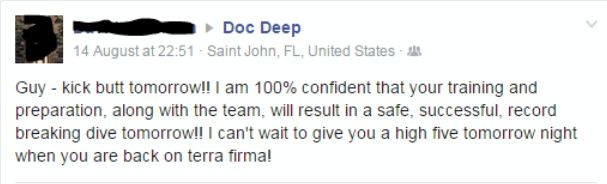
Doc Deep’s Facebook wall shows celebratory posts commemorating a rapid series of deeper and deeper dives from early 2015 until his fatal dive. Each was seen as an affirmation of complete success and led to a subsequent deeper dive. The pace of progression was astonishing. The steps between dive depths became greater and greater. Nothing went wrong so nothing was considered wrong. Each dive became a ‘green light’ to progress further. His final step, from 815ft to 1200ft represented an increase of a third; and exposed him to nearly 22 ata of additional pressure.
#The Issue of Glorifying Deep Diving
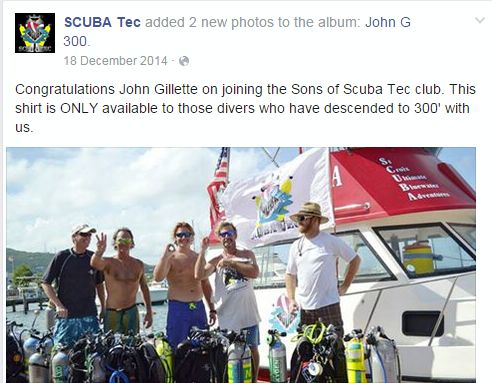
A glance down the Scuba TEC Facebook wall shows a distinct trend towards glamorizing and glorifying excessively deep dives. Virtually every wall post is boasting of a deeper, more extreme dive… an ’elite’ club that dives below 350ft… ‘limited t-shirts’ available only to those who dive below 300’. Making depth a ‘goal’ in itself, rewarding deep dives through clique and status can easily become an insidious form of gung-ho peer pressure.
St Croix is not blessed with deep-water wrecks or cave systems. Technical dives are conducted on deep ocean walls, with no specific target or goal, beyond depth itself. To ‘sell’ technical diving, they have to sell ‘depth’.
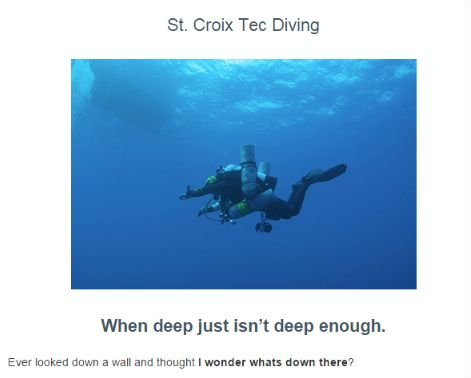
Exactly how deep just isn’t deep enough?
The most basic advice on ‘correct technical diving mindset’, as taught on diving courses seems to have been forgotten. Depth should never be glorified. Setting personal records and encouraging deep bounce dives for that purpose, is the antithesis of a proper technical diving mentality.
#The Issue of Ego and Over-Confidence
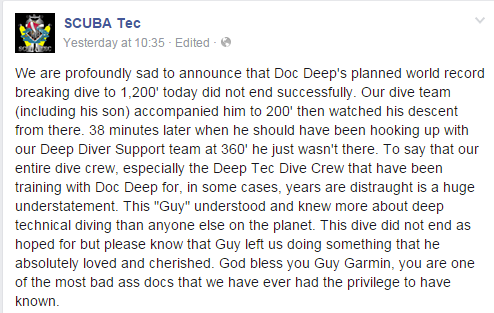
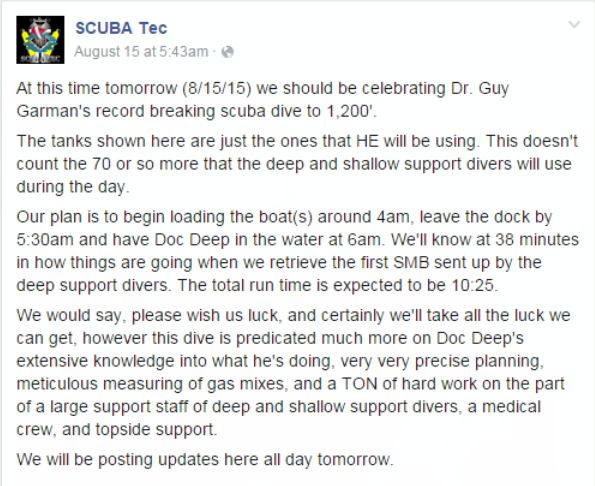
Dr Garman’s dive team, Scuba TEC, stated on their Facebook page that he “…knew more about technical diving than anyone else on the planet”. There seems some serious ego behind such a sweeping statement, especially given his relatively meager experience.
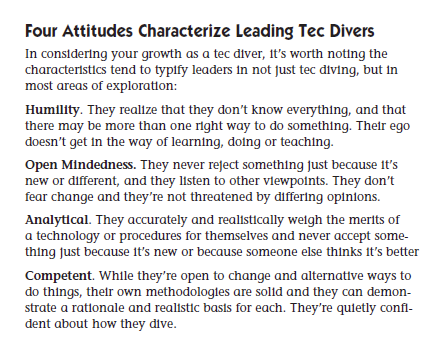
Technical diving demands significant experience. Self-discipline is needed to apply patience and humility to progressively and realistically develop one’s limits and boundaries. Competency needs to be proven at one level before progression to subsequent levels. Proving competency can only occur through accumulated experience. Technical divers must have had the chance to encounter and overcome a full breadth of real (not simulated) foreseeable and unforeseeable problems, and must prove to themselves their ability to deal with these issues. For extreme deep dives, multiple dives at progressive, staged levels of depth increment are necessary to validate an individual’s susceptibility and ability to function when exposed to hyperbaric maladies like HPNS and Compression Arthralgia. Only then should deeper, more complex (and risk-prone) depth levels be sought. When pursuing development it is imperative to remain grounded and humble. Ego kills divers. It is critical to surround yourself with peers who help you retain a grounded ego-free approach.
When pursuing development… it is imperative to remain grounded and humble. Ego kills.
Likewise, the ego must be controlled with regards to external feedback and advice. Prior to his record attempt, technical diving chat forums were filling with concerned posts over the attempt, Dr Garman’s relative inexperience and potentially flawed approaches to the dive. Some advice originated from diving medical professionals and vastly experienced technical or commercial divers. These posts were occasionally responded to by members of Dr Garman’s team, but ultimately ignored. Collective wisdom and shared community and peer experience is a great thing. Ignore it at your peril. Know the difference between genuine concern from learned peers and negative ‘nay-sayers’.
Few people desire to break world diving records. Strong ego is what drives most who aspire to achieve great things. Ego can be good and bad; it motivates us but it can also lead us into flawed decision-making that can be fatal if not balanced with prudence and wise counsel. ‘Doc Deep’ obtained the training qualifications and theoretical knowledge to tell him what he ’could’ do, but didn’t seek sufficient experience to give him the wisdom of what he ’should’ do,
#The Issue of Normalization of Deviance
The term ‘Normalization of Deviance’ arose from NASA’s inquest into the 1986 Space Shuttle Challenger disaster, first published in Diane Vaughan’s book, ’The Challenger Launch Decision’. Steve Lewis describes Normalization of Deviance thus:
“Normalization of Deviance describes a dangerous facet of human nature. It goes something like this: We do something that does not follow the accepted (and acceptable) rules or guidelines – for example, we skip certain steps in a “standard” procedure because it saves time. The trouble stems from the unfortunate fact that we get away with taking the shortcut. Then, believing it’s safe to make the same safety shortcut next time around, we do the same thing… we ignore safe practice, established safe practice. In the absence of things going totally pear-shaped, our deviation from normal practice and safe procedure becomes a new acceptable norm”.
This deviation from best practice resulted in a ”Predictable Surprise” when NASA’s luck ran out. It killed five astronauts, two payload specialists; and grounded the space shuttle program for almost three years.
Our deviation from normal practice and safe procedure becomes a new acceptable norm
What we see in Doc Deep’s progression is a rapid escalation in depth and challenge but rarely any time consolidating at a given level. The most basic guidelines are over-ruled again and again. Doc Deep conducted ever more risky dives. They were successful. He “got away with it”. They weren’t repeated, to make sure it wasn’t luck. Each single, successful deep dive established an instant, unquestioned precedence that he was ‘competent and safe’ to progress further. His ‘rise’ in skill was meteoric over 4 years; a seeming prodigy, from non-diver to world record attempt in only 48 months.
We see a distinct deviation from accepted practice. This got larger with each dive that didn’t go wrong. Ultimately it did go wrong and cost his life. Few in the technical diving community, outside of Dr Guy Garman’s support team were surprised that the fatal outcome. Many publicly predicted such a tragic failure, in advance.
As Steve Lewis notes:
“If the dive community could put greater emphasis on the pitfalls and consequences associated with the normalization of deviance, it might help to lessen the unfortunate tendency of some divers to depart from established best practices… We would in essence, be removing a link that shows itself in many chains of error. And we might see diving fatalities shrink: perhaps not to nothing, but at least shrink a little. We will never change human nature and never eliminate human error; but we can help to create a culture of responsibility based on a realistic review of what kills divers”
#The Issue of Support Team Mindset
Extreme deep divers rely upon their support teams. They provide the logistics, expertise, finance, publicity, sponsorship, in-water and psychological support that enable extreme deep diving projects to happen. Positive thinking and motivation are key aspects in that support. However, it is also the responsibility of the team to help keep the primary characters grounded and realistic. They should challenge egos and presumptions, not eagerly promote them. Support teams should not contain ‘yes men’, sycophants and cheerleaders.
Those who aspire to break world records rarely suffer from a deficit of self-belief. The last thing they need is further artificial stimulation of their ego. A support team must recognize that. It must guard against insularity. Team members should be transparent to the wider technical community and peers. They should beseech advice and seek counsel and consultation from outside. Most importantly, they should respect and consider that external advice. It is far too easy to get tunnel vision on your goals, both as an individual and as a team. Acknowledging external perspectives helps prevent that tunnel vision becoming a doomed endeavor.
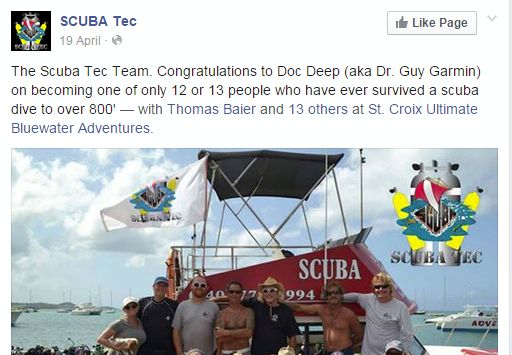
According to Scuba TEC, Dr Garman ”knew more about technical diving than anyone else on the planet”. Given his experience, that is not realistic, nor does it show an appreciation of the wealth of experience held by the wider technical diving community. It is insular and naive. It is not a boast that any person connected with an extreme deep dive project should ever make.
Seek to be a small fish in an ever-bigger pond. Reject the temptation to remain the biggest fish in a small pond.
It’s important to surround yourself with the RIGHT people to stay grounded, humble and patient. Choose those who challenge your ego, not flatter it. Dive with people who humble you with their skills, not sycophants who applaud you. Seek to be a small fish in an ever-bigger pond. Reject the temptation to remain the biggest fish in a small pond.
##The Issue of Giving Unrealistic Positive Motivation
When someone has a deep goal, it is tempting to support that dream, whatever the reality. To do less is seen as negative or impolite. The desire to “be positive” can easily become irrational. That’s okay if we’re talking about a tone-deaf wannabie surrounded by an exuberant entourage on American Idol, shot down to reality by Simon Cowell. The same baseless positivity and mindless enthusiasm is not suitable for those aspiring to extreme deep technical diving, where the consequences of failure are inevitably and unequivocally fatal.
It might be a product of the modern culture of ’instant-gratification’. We are told so often we can achieve whatever we want. We can throw money at our goals; there will always be someone around to collect that money and tell us how great we are. Technical diving, in particular, is becoming a more mainstream diving pursuit. Access to training, qualifications and equipment is ever more easy. Dive centers are under pressure to sell more courses, equipment and gain publicity. Some instructors are more than happy to pander towards that culture of instant-gratification, regardless of the consequences.
What we rarely see is the old advice to ”go out and pay your dues the hard way”. Hard work, patience, perseverance, learning your limitations, humility, investing time and effort, rather than money, to accomplish your dreams. What happened to telling someone “No”, or “Not Yet”?
What happened to telling someone "No"…. or "Not Yet"?
Four years and 595 dives from first dunking his head in the swimming pool on his Open Water course, ‘Doc Deep’ had received sufficient positive affirmations to seriously believe he ”knew more about technical diving than anyone else on the planet”; and was ready to go deeper on open-circuit scuba than any man in history. In hindsight, it seems ludicrous. That it wasn’t readily apparent to Dr Garman and his team should cause us all to robustly and honestly re-assess our own capabilities, strengths and weaknesses.
Technical diving training should be a psychological ‘nut-cruncher’. A good instructor will leave students in no uncertain terms of their capabilities. The ‘high-fives’ and “you’re a superstar” must end when you leave the safe surrounds of recreational, shallow, low-risk diving. If you didn’t feel humbled on your technical training, then you got ripped off. If you don’t feel humble as a technical diver, then you’re insulating yourself from the big pond and the big fish within.
#The Issue of Groupthink
‘Groupthink’, (first used by Irving Janis in “Victims of Groupthink”), occurs when the team makes faulty decisions and ignores alternatives, due to pressures that lead to a deterioration of “mental efficiency, reality testing, and moral judgment”. A team is especially susceptible to groupthink when its members are similar in background, insulated from outside opinions, when there are no clear rules for decision-making and when the team is highly cohesive and under significant pressure to achieve a result.
Janis described 8 symptoms of groupthink:
1. Illusion of invulnerability – Creates excessive optimism that encourages taking extreme risks
2. Collective rationalization – Members discount warnings and do not reconsider their assumptions
3. Belief in inherent morality – Members believe in the rightness of their cause and therefore ignore the ethical or moral consequences of their decisions
4. Stereotyped views of out-groups – Negative views of “enemy” make effective responses to conflict seem unnecessary
5. Direct pressure on dissenters – Members are under pressure not to express arguments against any of the group’s views
6. Self-censorship – Doubts and deviations from the perceived group consensus are not expressed
7. Illusion of unanimity – The majority view and judgments are assumed to be unanimous
8. Self-appointed ‘mindguards’ – Members protect the group and the leader from information that is problematic or contradictory to the group’s cohesiveness, view, and/or decisions
Collective wisdom and shared community and peer experience is a great thing. Ignore it at your peril.
When there is pressure for team unanimity, individual team members become less motivated to realistically assess the alternatives, especially those potentially negative to achieving the team goal. The result is increased carelessness and irrational thinking, in an effort to preserve cohesion. Ultimately, the probability of achieving a successful, or safe, outcome deteriorates.
Teams can install safeguard processes to protect against groupthink, such as:
a. Empowering team members to speak out critically within the team
b. Inviting external experts to observe the project and challenge team view
c. Encouraging team members to discuss the project with external experts
d. Nominating a ‘Devil’s Advocate’ in the team (aka the 1oth Man Rule)
e. Taking time to observe and consider external (peers/rivals/community) reactions to the project variables.

#The Issue of Destructive Goal Pursuit
‘Destructive Goal Pursuit‘ is the inability to stop an activity because the goal is so important (especially in the eyes of the leader) that it takes precedence over everything. In diving we normally operate as buddy pairs or teams and there is always the maxim that anyone can thumb the dive at any time for any reason. However, when you are task focused, sometimes you lose track of what is going on around you and, even when you do realize that things are past the ‘last safe point’, you still carry on.
It takes a good level of mutual trust and respect to be able to end the dive when there is considerable pressure to complete the task. Unfortunately a number of fatalities have occurred because their pursuit of the goal took primacy over their own (or other’s) safety.
When a strong-willed, highly-driven person sets to accomplish a difficult goal; and is surrounded by a motivating team, it can create a situation that makes it very difficult for anyone to ‘apply the brakes’ if necessary. The task focus and team-brain are devoted entirely to achieving the goal and a form of tunnel vision arises. There are psychological pressures not to detract from the team effort by raising concerns or appearing to act negatively.
The team must always remember that a project can snowball in speed and intensity. It can be difficult for anyone, especially the leader, to halt such a project once momentum increases. Nobody wants to let anyone down. It is important that all team members feel empowered and supported to voice concerns. There must be group protocols to routinely re-assess progress and enable the project to be aborted or amended as a formal consideration. No pressure must be applied during this process; personnel must be encouraged to think independently and voice thoughts truthfully.
There are old divers and there are bold divers but there are no old, bold divers
#Questions That Arise
At this time, shortly after the fatal incident, more information is needed for a full accident analysis. Many factors could have contributed directly to the fatality. Upon recovery of Dr Garman’s remains, we may find catastrophic equipment issues, or medical evidence of debilitating physiological events under extreme depth pressure.
My writing on psychological factors looks into less direct causes: factors that may have otherwise led to the project being carried out differently, for a positive result, or not even carried out at all.
The question that must be asked was whether Doc Deep’s support group became so focused on their goal that they lost track of the ‘last safe point’ and nobody suggested stopping, or slowing, the endeavor.
- Did anyone try to ‘thumb the dive’ in the weeks, months or years leading up to the fatality?
- Did anyone counsel caution or raise doubts?
- Did anyone seek outside advice or consultation to provide a ‘second opinion’ on the groupthink and goals of the team?
Some very important lessons arise, especially the need for team checks and balances to prevent groupthink leading to a destructive goal pursuit situation. The role of a support team isn’t to be cheerleaders or provide unquestioning positive motivation. The team needs to keep individuals ‘grounded’ and cognizant of the big picture. Don’t be insular as a team. Reach out to the community, to other experts, for a second opinion. Heed that opinion.
Article kindly reprinted by permission of Scuba Tech Philippines. Original article