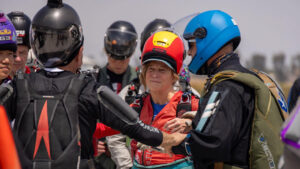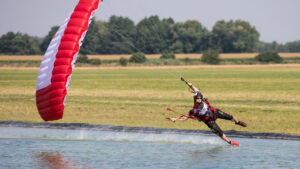




With nearly 7,000 jumps and years behind the camera, Elliot has built a career filming and photographing skydiving from the inside. In this interview, he shares how Byrd’s Eye Studio started, how his gear has evolved, and and how he’s built a career filming in the sport.
Years and jumps in the sport, home DZ?
I completed my AFF in 2009 at Mile High in Longmont, Colorado, shortly after graduating college. In 2011, I moved to North Carolina for work and became a weekend warrior at Triangle Skydiving Center. Then, in 2017, I took the leap to pursue skydiving full-time, quitting my job and relocating to Raeford, NC, to work at Paraclete XP. In 2021 I moved to Wisconsin to take a full time marketing position for Skydive Midwest. I have 6,872 skydives.

Photo by Brian Festi
How did Byrd’s Eye Studio come to life? What inspired you both to combine your talents into one brand?
My wife and I both worked for CROs (Clinical Research Organizations) during the week and spent every weekend at the drop zone, jumping from sunup to sundown. Lauren’s passion in skydiving is 4-way formation skydiving (FS), and my passion was jumping with her. We quickly realized that being in the formation together wasn’t going to work long-term, so I transitioned to flying camera for her teams, an experience that grew my passion for camera flying.
Our move to full-time skydiving was sparked by news that the Golden Knights’ 4-way women’s team might be retiring, which would open the door for another all-women’s team to represent the U.S. Phoenix XP was born out of that opportunity and ultimately became the U.S. Women’s Team for the 2018 World Meet.
The big question for both of us was: how can we skydive full-time and make a living doing it? We earned our instructor ratings to work at the Paraclete XP School and launched Byrd’s Eye Studio to focus on event coverage, marketing, and organizing at drop zones across the country.

Photo by Norman Kent
What’s your current go-to camera setup for freefall footage, and how has that evolved through the years?
I got into camera flying just before the launch of the GoPro Hero. My first camera helmet featured a side-mounted Sony handcam, but I quickly transitioned to using action cameras once GoPro hit the market. Today, I have three different camera helmet setups that I use depending on the type of jumps I’m filming. Since weight is a major factor, I always try to minimize what I carry on my head unless absolutely necessary.
My go-to helmet is a Cookie Fuel with a center-mounted still camera and a front-mounted action camera, which I use for most of my day-to-day jumping. When filming teams, I switch to a Cookie G35 equipped with a Skydiving Parts dual GoPro mount integrated into the cutaway system.
The latest evolution in my setup is a custom 3D-printed mount by Trunk at Hypoxic, designed for a Cookie Fuel, which I reserve for big-way events. For these jumps, I always run a still camera and two action cameras—one as a backup in case of failure. The 3D mount allows me to add a third action camera dedicated to capturing vertical video for social media reels and stories.

How do you balance quality with safety in terms of camera setups? Any gear tips for new camera flyers?
Over the years, I’ve experimented with a wide range of camera configurations. In the beginning, my setups prioritized ease of use, camera protection, and convenience—often at the expense of safety and long-term wear on my body. It didn’t take long to realize two important lessons: proper weight distribution is crucial for saving your neck, and my life is worth far more than any camera.
My first setup featured a side-by-side configuration, with a still camera on the right and an action camera on the left. Placing the still camera on the right gave me easy access to the battery and SD card while shielding the multiport connection for my tongue switch. However, the weight distribution was poor, and the setup created a significant snag hazard due to the still camera’s hand grip.

After a few hard openings and some strained neck muscles, I decided to switch the setup—mounting the still camera on the left and the action camera on the right. This new configuration offered significantly better weight distribution, which helped relieve the strain on my neck. However, it came with its own trade-offs. The still camera’s multiport was now exposed to potential riser strikes, and I had to remove the camera entirely to swap out batteries. Unfortunately, the risk caught up with me—a riser strike during opening damaged the multiport. While I was able to get it repaired, the fix didn’t come cheap.

After the costly repair to my still camera, I decided to add a SmallRig camera cage to maintain the same setup while offering better protection. While the cage did its job, it also added considerable weight and imbalance, which led to noticeable neck strain after a full day of jumping.
That experience led me to the configuration I’ve relied on for years. I removed the SmallRig cage, center-mounted the still camera, and front-mounted the action camera. Although I still need to remove the still camera to change batteries, the multiport is now better protected, and the weight distribution is the most balanced I’ve found significantly reducing neck injuries.

One thing most people don’t realize about working as a videographer?
On the surface, it might look like all fun and games, but there’s a lot most people never see. When the beer light comes on and everyone else is done for the day, my work is just beginning. Like any job, there’s a significant amount of behind-the-scenes effort—sorting, cataloging, and editing media can take hours after a long day of jumping. Large events like boogies can easily turn into marathons, with 12-hour workdays stretching on for an entire week.
What’s been your favorite kind of project to take on, and what’s on the dream list?
I would have to say filming records is my favorite. It’s an incredible thrill to have a front-row seat to the hard work and dedication of a group of skydivers coming together to achieve a goal. I’ve been filming big ways for years, and watching people put in the time to hone their skills—and then earn an invitation to the big events—is incredibly rewarding. Stepping out of a trail plane and seeing divers pouring out of multiple aircraft is also an unforgettable visual experience. On my dream list, filming a new big-way world record, something over 400 jumpers, would be incredible, though I’m not sure it will ever happen.

Photo by Norman Kent
What are you most proud of, not in terms of output, but impact?
I recently began teaching camera courses to help skydivers interested in stepping into the media side of the sport. When I first started flying cameras, the only way to learn was from local jumpers who were already doing it—paired with a lot of trial and error. I’ve since developed a course that covers all the essentials of camera flying, from choosing the right equipment and setting up your helmet to handling emergencies, as well as techniques for filming tandems, teams, and big-way formations.
Do you have any physical / mental training you do for flying?
Over the years, I’ve found that staying physically fit makes a huge difference during long, hot days at the drop zone. When filming teams, I’ve done 16 or more jumps in a single day, often with back-to-back loads. To keep up with that pace, I train at the gym five days a week, focusing on full-body strength training and plenty of cardio.

Photo by David Wybenga
Do you still train and fly for yourself? If so, what does that look like?
When I made the leap to full-time skydiving at Paraclete XP, I grabbed a tunnel membership and flew about an hour a week for two years. My goal was to get proficient in every discipline so I could film it all—belly, freefly, you name it. Unfortunately, since moving to Wisconsin, I haven’t been able to keep up with tunnel flying. The tunnels out here just aren’t as accommodating for repeat flyers, which makes consistent training a real challenge.
Who are your sponsors?
Sun Path, Performance Designs, Cookie, CYPRES, SSK, LB, Liquidsky