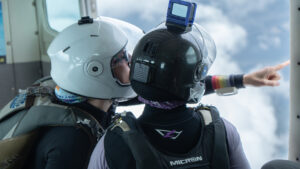




Luis Adolfo Lopez-Mendez shares how small gear culture is putting people at risk…

I always wanted to have the most fabric over my head possible when I had a cutaway. For me there is absolutely no reason to have a small reserve.
Luis Adolfo Lopez-Mendez
How many jumps do you have Luis?
I have over 22,000 jumps and 26 years of skydiving experience.
How many cutaways have you had?
Fourteen.
Is there a reserve ride you were on that particularly felt good having a lot of fabric over your head?
I was filming a tandem jump in Empuriabrava. This is a very unique DZ, as we run short over the city with tandems, and there are no outs in the city. The only option is the water canals of the marina (biggest marina in EU). I was first out and had a spinning malfunction that put me low under my reserve. I had no outs except a little park, surrounded by construction cranes. I managed to swoop in between them and safely land in the middle of the park. If I would have had a small reserve (heavily loaded) that same scenario could have been a horror story.
What size reserve do you fly?
I now fly a 143 Optimum Reserve from Performance Designs.
How did you decide which reserve to fly?
I have always tried to have the biggest reserve that I could fit in my container. I had a 113 PD reserve but when Performance Designs came out with the Optimum reserves that have a lower packing volume, I immediately switched to the biggest I could fit in my Vector 306 rig, a 126 OP. I jumped that for a long time and when I heard that the UPT V316 reserve chart could fit a 143 OP, I changed both of my rigs immediately. I always wanted to have the most fabric over my head possible when I had a cutaway. For me there is absolutely no reason to have a small reserve.
I have pondered a lot about this matter and came to the conclusion that when you are under your reserve, you have already been under a stressful situation, you are at a lower altitude, and now you will need all the time possible to make a safe decision on where to land in case you can’t make it to the DZ landing area. Also, if you are unconscious, a big reserve, lightly loaded, could be the difference between life, death or getting seriously injured- if you are going to hit something unconscious, it might as well be as slowly as possible.
Another consideration for having a bigger reserve is the Skyhook or RSL. I hear a lot of discussions that these systems could cause line twists on your reserve, making it spin fast and lose altitude, and that’s why some jumpers choose not to use them. For me this makes no sense – if you have a big reserve, lightly loaded, it would not spin at all or would spin very slowly if you have a line twist, that’s why having a bigger reserve and jumping with a Skyhook will always be the better option.
It’s good to add that you should always make your decision to cut away at a safe altitude – being low on your reserve means that your decision-making was not fast enough or that you fought your malfunction for too long. If your reserve is deployed by the Skyhook at a safe altitude, even if you get a line twist, under a big reserve that is not a problem, you will have time to clear it. Again, line twists become a problem when your reserve is small and heavily loaded – it will spin fast and lose altitude, making this situation a nightmare and really dangerous. Unfortunately I know a lot of jumpers who have died or have been seriously injured under this scenario.
Being low on your reserve means that your decision-making was not fast enough or that you fought your malfunction for too long
Luis Adolfo Lopez-Mendez

Have you seen a trend towards smaller containers and smaller reserves?
I see the growing trend toward small containers and small reserves these days – it seems everyone wants a small rig, thinking that this will make them fly better, faster and smoother. I don’t agree with this – the difference in size and weight between a small or big reserve is inconsequential to your flying performance. What is important is that your harness is made custom to fit your body. I see this a lot with experienced jumpers who want small canopies and small rigs and because of that are stuck with a small reserve, most of the time with a high reserve wing loading or sometimes smaller-framed flyers wanting a small rig so they can fly better or look cool. I also see a lot of women choosing small main canopies and small reserves to have small containers even if they don’t do high performance landings, without thinking about the wing loading on each canopy. If you land on the DZ everything might be ok, but what if now you need to land off and there are not too many options? That’s when it becomes a problem. Also they don’t take into consideration that a small reserve will spin with a line twist. Each rig manufacturer has a table of canopy sizes for main and reserve and should be followed as a guideline. I would encourage beginners, intermediate and advanced jumpers to think: one, what’s the worst case scenario you can find yourself under your reserve? And two, be honest with yourself if you could land that reserve size safely in that scenario.
Ego is not your amigo.
It’s ok to have a bigger container so you can fit a main and reserve canopy that you are comfortable flying under any circumstance. Remember that an incident is a combination of factors, some that we can control and some that we cannot. The ones we can control are what canopy and size we choose so it can get us safely to the ground, so think smart.

What are your thoughts on flying a bigger reserve and what’s a wing loading you believe is right for a reserve?
I would always choose to fly the biggest reserve I can fit safely in my container. If tomorrow, technology would allow me to put a 170 reserve in my rig I would change immediately.
I don’t like to give numbers about what wing loading to use for the reserve as there are too many variables to consider, but to have some sort of a guideline novice would be under 1, intermediate under 1.3, advanced/ expert would be under 1.7. Having said that, there are a lot of factors to consider – experience, weight, currency, where you jump most of the time, type of jumps you do, etc.The wing loading of my reserve is 1.53. What I would recommend is the lowest wing load possible and the biggest reserve you can fit safely in your container for beginners and experts alike. Always go bigger if you can, big is cool, small is 90s style.
Luis is proudly sponsored by PD, UPT, Cypres, LB, Tonfly and is a part of FlyWarriors
Follow Luis on his Instagram