



Sebastian Alvarez, a Chilean Red Bull athlete, broke three wingsuit world records, in one single jump. We caught up with this former Air Force pilot to hear more about what was involved in the making of this groundbreaking performance…

Photo by Joerg Mitter/Red Bull Content Pool
Here’s the scoop on the three world records Sebastian broke in this monumental flight:
Time: Alvarez’s flight ( 11m 1s), was exactly 1.30s longer than the previous official FAI record of 9m 31s. Maintaining that body position took hardcore physical training.
Speed: Alvarez reached 550kph (342mph) – faster than a Formula 1 car! He was able to harness the Earth’s jet streams to optimize his speed. The previous Guinness world record stood at 397kph (247mph).
Distance: He travelled over 53.45km (33.22 miles) – almost double the distance of the previous official FAI record of 29.06km.

Photo by Joerg Mitter/Red Bull Content Pool
Where did the idea for this project come from?
The idea for this project came to me a long time ago — probably about six years back. I knew it would be something incredibly challenging and amazing. But it wasn’t until almost two years ago, after my “Skydive into a Wave” project, that we really started working full-on to develop the Starman mission.
From the beginning, the goal was clear: break as many records as possible in a single jump.

Photo by Joerg Mitter/Red Bull Content Pool
What kind of planning and preparation went into pulling this off?
We’ve spent years planning every detail and preparing thoroughly. One of the most critical aspects was always the oxygen system — making sure it would work perfectly at extreme altitudes. That also meant putting together the right oxygen team and securing an aircraft that could handle a high-altitude O₂ system.
Once that was locked in, we focused on finding the ideal wingsuit for the mission — we went with the Squirrel C-Race Worlds for this jump. Thermal protection was key too: I wore electric heated layers to keep my body and hands warm. At altitude, temperatures dropped to -70°C.
The helmet was customized as well — we covered the mask to protect the exhale valve from freezing due to condensation and the extreme cold.
And of course, there was the training. Last year was entirely dedicated to building the right muscles and flight performance to maintain the most efficient body position, which would help me stay in the air longer and faster. The final month before the jump, I focused on cutting weight to increase my flight time.

Photo by Joerg Mitter/Red Bull Content Pool
How did you choose your exit point and landing area? What factors were most critical in making those decisions?
The exit point was actually an easy choice — about 7 to 10 miles west of the drop zone, since I was flying east with the jet stream that was active that day.
The landing area, on the other hand, was more unpredictable. We had a solid idea of where I might land based on calculations, but with a flight this long, there are always variables, I could never be 100% certain of the exact spot. The helicopter and ground crew were staged near the expected area, but I ended up flying a bit further than planned.
Fortunately, the region was filled with open fields. Around 10,000 feet, I began scanning the ground, adjusting based on my glide performance, and picking the safest place to land.

Photo by Joerg Mitter/Red Bull Content Pool
What kind of equipment did you use to stay in flight so long?
We used the best all-around wingsuits from Squirrel, customized with boot fairings to reduce drag and extended wings to increase glide performance. These modifications helped maximize flight time and distance — but they also made the suit significantly harder to fly.
The added surface area and aerodynamic features made it much more physically demanding, requiring serious strength, endurance, and control throughout the entire flight.
What was it like flying in the jet stream? Did you experience turbulence, burbles, or unique wind at that altitude?
It was absolutely incredible. You feel the extra push almost instantly. My FlySight was giving me speed numbers I had never seen before.
Yes, I definitely experienced turbulence — you can feel the shifts in wind layers as you pass through them. It’s intense and surreal at the same time.

Photo by Joerg Mitter/Red Bull Content Pool
Were there any moments where the mission almost didn’t happen?
Not really, but of course, there were moments full of doubt. Every part of the project had questions we needed to solve but we tackled each one slowly, steadily, and with purpose. Through training and multiple test jumps, we answered those questions one by one.
The most critical moment was probably two weeks before the jump when we had to choose the exact day. With a big team flying in from all over the world, it was a stressful decision and it had to be perfect.
Can you share a behind-the-scenes moment that no one saw, but was meaningful to you?
The real story is in everything that happens before the jump: the ground training, the countless skydives, the strict diet, the early mornings, the late nights, the travel, the time away from family and home… and the frustration when things don’t go as planned.
People see the final moment and might think it all happened overnight. But the truth is, a mission like this demands an insane amount of effort and sacrifice from every member of the team.

Photo by Scott Plamer/Red Bull Content Pool
What was going through your mind in the moments right before exit — and during the flight itself?
During the pre-breathing, about 45 minutes before takeoff, I was calm and focused, mentally walking through the entire jump and visualizing everything, especially what could go wrong and how to react immediately if it did.
On the way up, I stayed extremely focused, especially on the oxygen system and my blood oxygen levels, making sure I wasn’t experiencing hypoxia.
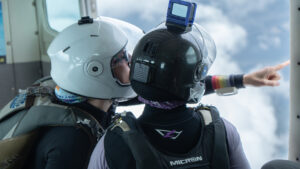
Right before exit, I switched fully into mission mode. I took a moment at the door to enjoy the view, look back at the wake turbulence and condensation trailing the plane, and glance up to see how deep and dark the sky looked.
Then I took a deep breath… and jumped. 100% focused on getting the job done.

Photo by Joerg Mitter/Red Bull Content Pool
Now that you’ve achieved this world record, what’s next for you?
First, a bit of rest to surf with friends, enjoy the records with my family, and just take it all in. Then, I’ll be diving into a super exciting new project I’m developing… this time, not related to wingsuiting.
Thanks, Sebastian!
Relive Sebastian’s epic flight with this video
- Follow Sebastian on his Instagram or Facebook pages.
- Sebastian’s sponsors include Red Bull, Squirrel, Spy Optic, LB Altimeters, UPT, Cypres, Icarus World