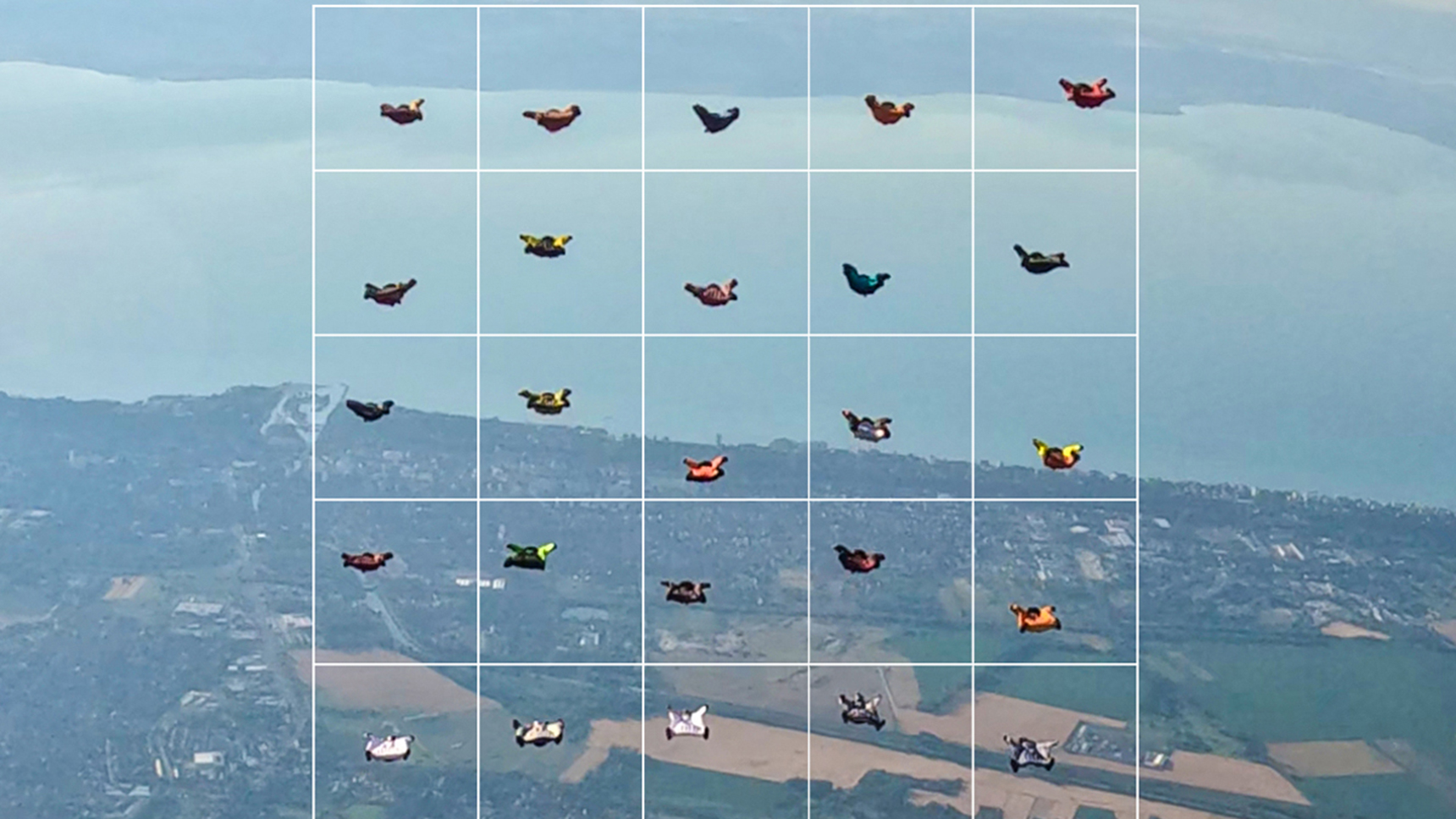





An experiment in a new FAI wingsuit discipline evolved into five official formation records. Michał Brosig takes us behind the planning, teamwork and technical challenges that made it possible.
Some records begin with a clear plan and a goal that everyone knows from the start. This one began much more simply, with an idea during a few fun jumps.
A year before the record event, during a boogie at Skydive Balaton in Hungary, I suggested that we try the newly introduced FAI Vertical Wingsuit Formation format. The concept sounded simple: every flyer would have an assigned slot in a three-dimensional formation and would need to hold that position with precision, without drifting or uncontrolled movement.
At first, I was not sure if people would find it interesting. Wingsuit pilots usually enjoy movement: carving, diving, flocking and flying dynamic lines together. Asking experienced flyers to stay in a fixed position could have seemed too static. But after the first attempt, the reaction was completely different. Holding a precise slot turned out to be technically demanding, mentally engaging and surprisingly fun.
After a few jumps, it was obvious that this was more than just an experiment. It was something worth developing into an official record project.
From June 21 to 25, 2026, twenty-six of us gathered again at Skydive Balaton in Siófok, near Lake Balaton, to attempt official FAI wingsuit formation records. The team consisted of 25 wingsuit flyers and one camera flyer, whose video would later be used by the judges. Participants came from nine European countries, including 10 Polish flyers. The project was organized by Poles: I was the main organizer, and Michał Migała was both co-organizer and camera flyer.
By the end of the event, we had completed 13 jumps: four training jumps, three Vertical record jumps and six Sequential record attempts. The result was five official records: 23-way, 24-way and 25-way Vertical Wingsuit Formation European Records, plus a 25-way Sequential Wingsuit Formation European Record and World Record.
But the biggest goal of the week was one most of the team did not know about when they arrived.

Photo by Michał Migała
A New Type of Record
Vertical and Sequential Wingsuit Formation records are still very young categories. They were added to the FAI rules in 2024. Similar formations had been flown before at drop zones and boogies, but flying them as official records is a very different challenge.
In a casual wingsuit flock, a formation can be good enough if people are close, stable and flying together. For a record, “good enough” is not enough. The formation must be clearly defined, each slot must be occupied correctly and the overall shape must be clean enough for the judges to approve.
The Sequential category adds another level of complexity. The team must build one formation, then transition in flight and build a second one during the same skydive. That means every flyer needs to know not only where they start, but also where they are going and how their movement affects the people around them.
This made the project much more than simply gathering a group of strong wingsuit pilots. We had to understand the FAI rules, prepare the formations correctly, document the attempts properly and make sure the judges had everything they needed to evaluate the jumps. For most fun jumpers, the FAI General Section and Section 5 are not regular reading. For me, they became some of the most important documents of the project.

Photo by Michał Migała
Building the Team and the Plan
The team came together naturally. The core group was made up of flyers who had tested the vertical format with us the year before. They already understood the idea and the style of flying we needed. From there, we added a few more experienced pilots to reach the 25-way formation I had been imagining.
The challenge was not only to find skilled flyers. We needed people who were willing to adapt to a precise and relatively new format. This was not a standard wingsuit bigway camp. Everyone had to accept that the goal was not just to get close to the group, but to fly an exact slot with discipline.
Planning the formations became a project on its own. Existing tools were not really designed for what we wanted to do, especially for Sequential Vertical Wingsuit Formations. I needed a way to design the formations, assign slots, plan transitions and help every participant visualize their role.
So I wrote a dedicated application for the project. It allowed me to prepare the formations and the movements between them, then share screenshots and short videos with the team. On the ground, we also used a simple mock-up to walk through the formations and transitions before taking them into the sky.
For a formation of this size, that preparation was essential. Once you exit the aircraft, there is very little time to think through a problem. The real work has to happen before the jump.

Photo by Anna Strożek
Why Balaton Worked
Skydive Balaton was the natural location for the project. The drop zone had already hosted our first tests the year before, so it felt right to return to the same place where the idea began.
It also had the infrastructure we needed: hangars, space, helpful staff and, most importantly, a Mi-8 helicopter. The Mi-8 was a game-changer because it allowed all 26 people, 25 formation flyers plus the camera flyer, to go up together in one lift.
The reserved airspace was just as important. For a wingsuit formation of this size, especially one flying long straight lines toward Lake Balaton, clean airspace and predictable jump runs made the whole project much easier and safer to manage.

Photo by Anna Strożek
Three Jumps, Three European Records
We began with four training jumps in smaller formations while waiting for everyone to arrive and settle in. These jumps gave us time to adjust speeds, tune the base and let the group get used to flying together.
Then came the first official record attempt: a 23-way Vertical Wingsuit Formation. It worked and became a European Record. On the next jump, we increased the formation to 24 flyers. That also worked.

Photo by Michał Migała
On the third record jump, we attempted the main goal of the event: the 25-way Vertical Wingsuit Formation European Record. It was accepted as well. Three official attempts. Three successful jumps. Three European Records in a row.
By the end of the first day, we had already achieved the main objective of the event. There had been some normal logistical problems: delayed flights, lost luggage and the usual complications that come with bringing people from several countries together. But in the sky, everything had gone almost perfectly.
For most of the team, that could have been the end of the story. But I had another plan ready.

Photo by Michał Migała
The Hidden Goal
For more than six months, I had been quietly preparing a Sequential World Record attempt. I did not want to announce it too early because the 25-way Vertical European Record was already a serious goal. I wanted everyone to focus on that first.
The Sequential plan was to build two formations in one skydive. First, the team would create a square. Then, more than 20 flyers would move to new positions and rebuild the group into a diamond.
Every slot had been planned. Every transition had been designed. The visual materials were ready. The concept was ready. I was just waiting for the right moment.
After the successful 25-way Vertical record, I told the team. The funny part was that not everyone was fully sure what the Sequential category actually required. In a way, that showed exactly why the attempt mattered. We were working in a new area of the sport, and the rules were still unfamiliar even to experienced flyers.
The Hard Part
The Sequential attempts quickly proved to be much more difficult than the Vertical records. Building the first formation, the square, was not the main issue. The real challenge was the transition. More than 20 people had to leave their original slots, move through the sky, avoid creating chaos and then arrive in a new formation.
For a moment during each transition, the clean geometry disappeared. References changed, distances shifted and every flyer had to make quick decisions while still flying safely and precisely. The second formation, the diamond, required a fresh level of control because people were arriving there after movement, not from a clean approach.
The first attempts were far from perfect. But each jump taught us something. We changed details, improved the briefing and clarified individual roles. Slowly, the diamond started to look more like the formation we had planned.
At one point, we finally built the diamond and thought we might have the record. Then the judges rejected the jump. The problem was not the second formation. It was the first one, which was not accepted as symmetrical enough. That was a difficult moment. We knew we were close, but the day ended without the Sequential record.

Photo by Anna Strożek
The Decision
The next morning, we started with a longer and more detailed briefing. This time, the goal was not more motivation. Everyone was already motivated. What we needed was clarity.
We went through the formations again, discussed the transition, reviewed weak points and made sure everyone understood not only where to fly, but why their role mattered. After two more jumps, the video looked promising and was sent to the judges. Then came the hardest part: waiting.
As the organizer, I did not really allow myself to celebrate early. Even when a formation looks beautiful on video, it is not a record until the judges confirm it. During the event, my mind was always on the next correction, the next briefing, the next attempt. A record only exists when the judges say it does.
When the confirmation finally came, the pressure turned into joy. The Sequential jump had been accepted as both a European Record and a World Record. From that moment on, we could call ourselves World Record Holders.

Photo by Michał Migała
What It Meant
Looking back, flying was not the only challenge. The harder part was building a project from scratch: learning the rules, creating planning tools, organizing the team, choosing the right location, managing uncertainty and keeping everyone focused.
The records will be written down as numbers: 23-way, 24-way, 25-way, Sequential 25-way. But for me, the most important part is what happened behind those numbers.
An idea tested during fun jumps became an official FAI record project. A new wingsuit category became something we could fly with precision. And a team of 26 people from nine countries came together over Lake Balaton to prove that this format has a future.
Some records are organized and chased from the beginning. This one started differently. This one started with a question. Then it became a secret plan. And finally, over Lake Balaton, it became a World Record.
Record holders:
Michał Brosig (Organizer), Michał Migała (Co-organizer, Videographer), Julija Veigure (Base),
Alexandra Kraft, Andre Kühne, Cristina Nuñez Pabon, Dawid Winczewski, Edgars Veigurs,
Florian Kaschuba, Jakub Juszczak, Jakub Mijakowski, Massimo Lavarian, Oleksandr Nemish,
Pauline Ravaudet , Piergiorgio Tomasello, Piotr Walasek, Reto Nyffenegger, Ritvars Berzkalns,
Sebastian Senft, Serhii Serdiuk, Stefan Gilbert, Stefan Kauer, Tobias Uhlig, Tomasz Nowicki,
Wiktor Ulman, Zbigniew Izbicki
At the time of publication, all records mentioned in this article are pending official ratification.