



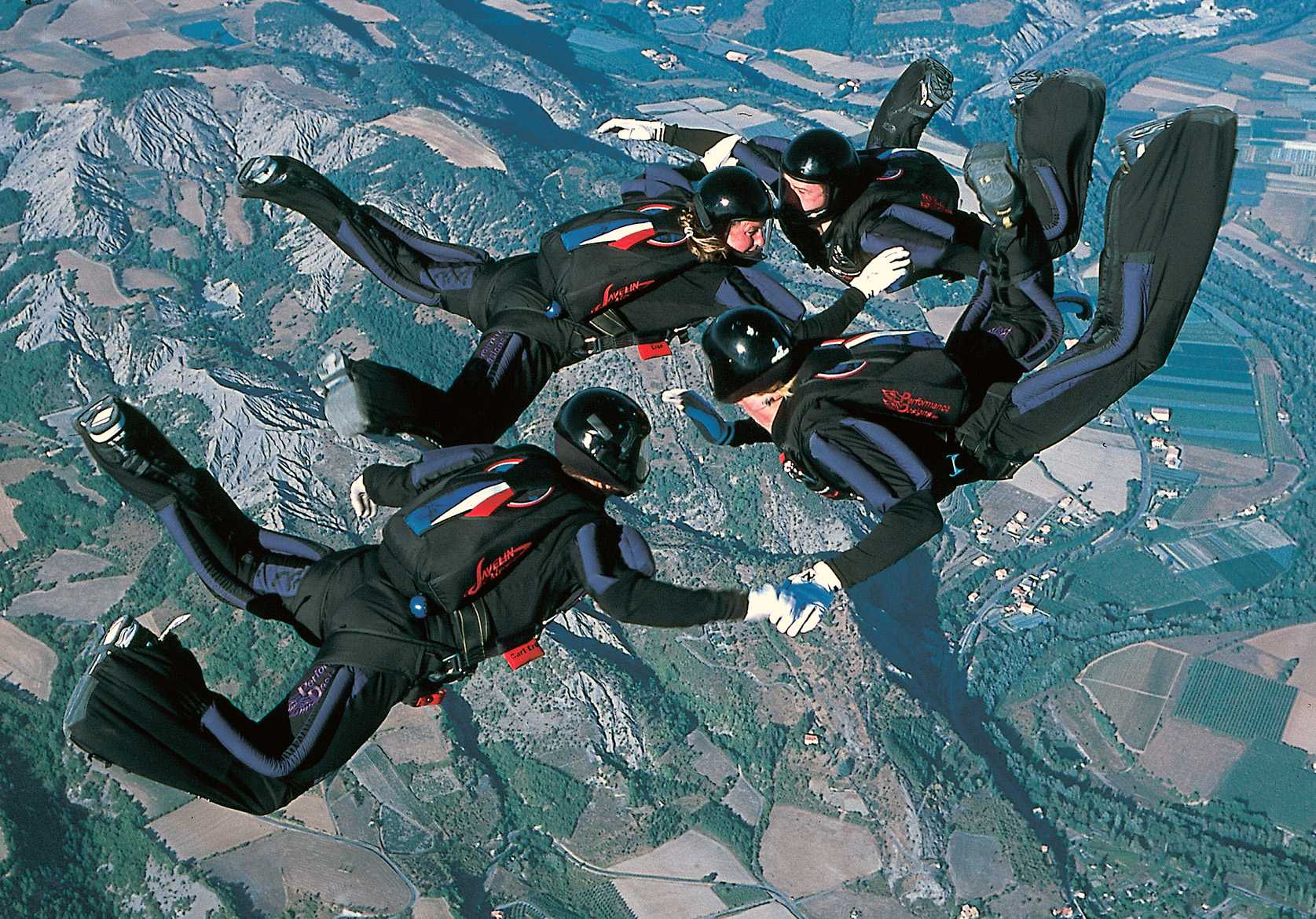
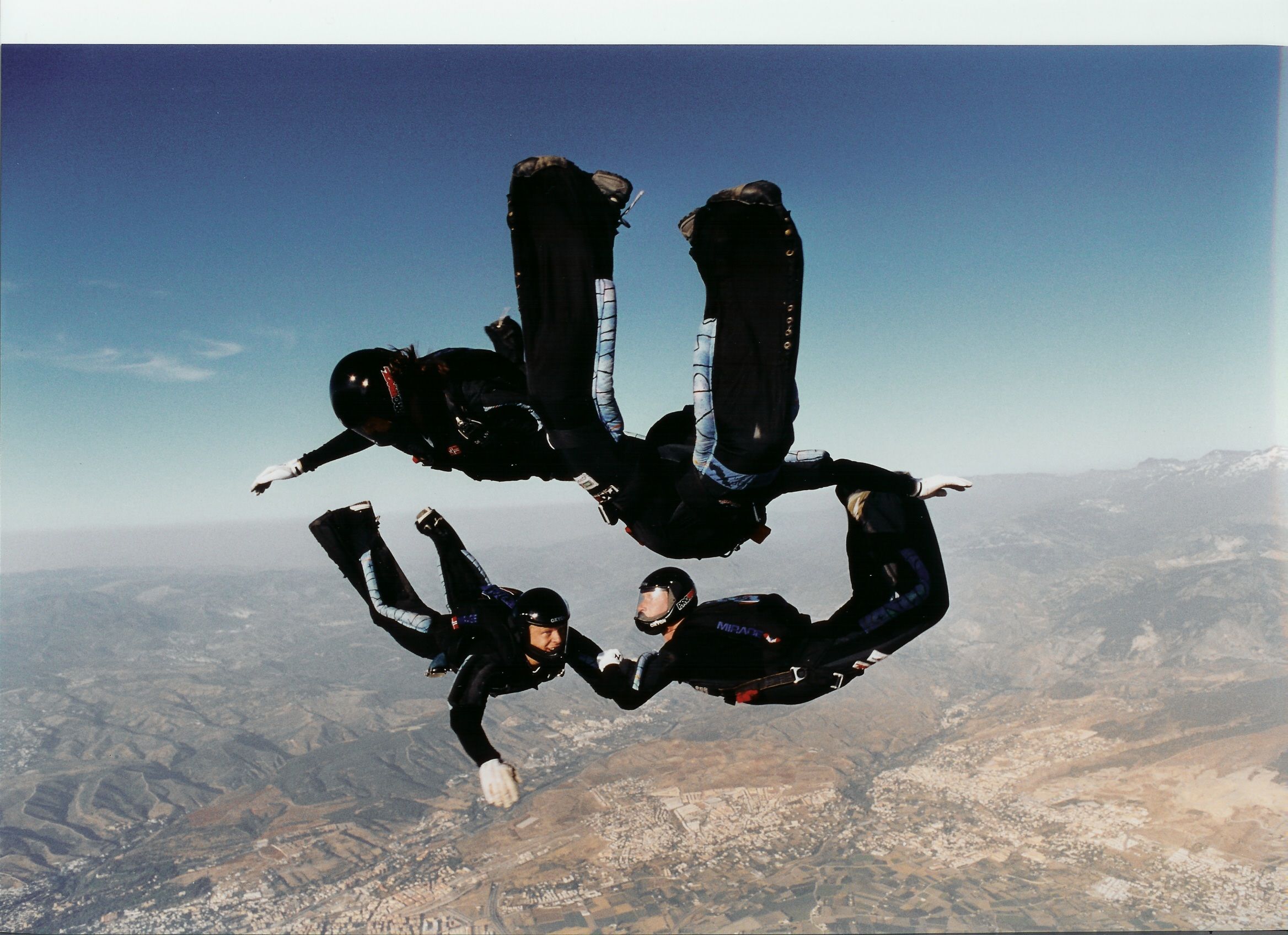
I have often been asked what it was about our team, the Deland Norgies, that made us succeed the way we did. Rightfully so, we never became world champions. We did, however, win three consecutive bronze medals in the 4-way open event at the World Championships in 1999, 2001 and 2003. In those days we were competing against the top FS nations in the world; USA and France and not to forget UK and Italy.
DeLand Norgies background
Country: Norway
Team members
Pål Kobenstvedt (point)
Carl-Erik Tuv (tail)
Torstein Valen (inside centre)
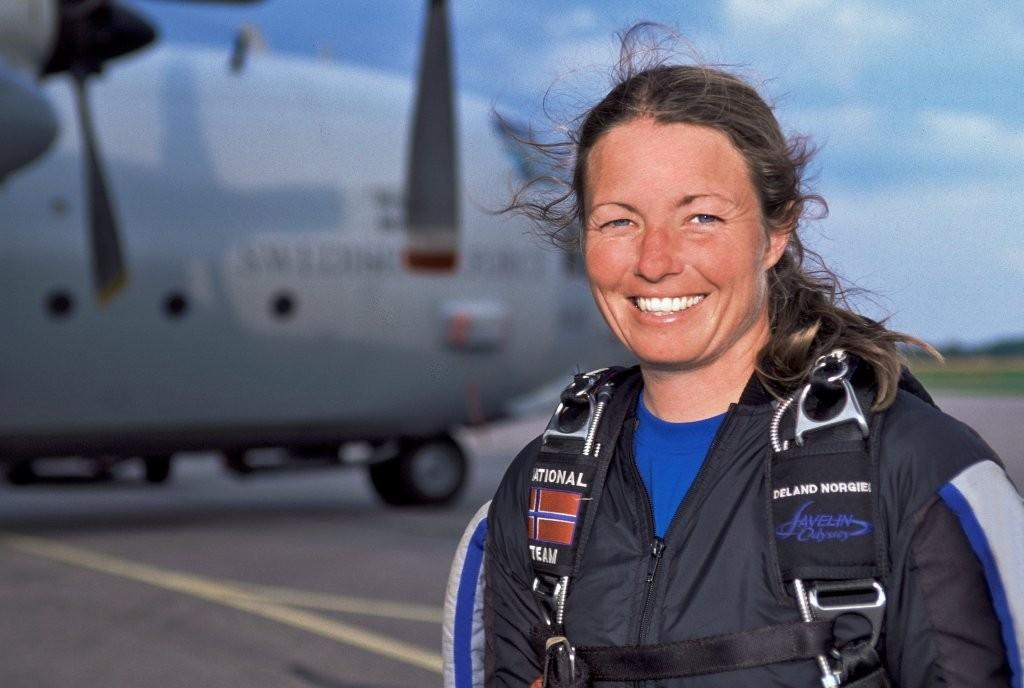
Lise Nansen (outside centre)
Eyvind Norbye (videographer 1996-1997)
Alexander Johnsen (videograpger 1998-2001)
Dag Einar Hernes (2001-2003)
- 1996/1997 – Start of the 4-way open team
- 1997 – 6th place World Championships (Turkey) 16.1 average (winning score 21.0)
- 1998 – 3rd place World Cup, 2nd place European Championships (Evora, Portugal) 18.0 average (winning score 22.0)
- 1999 – 3rd place World Championships (Corowa, Australia) 19.1 average (winning score 20.8)
- 2000 – 4th place World Cup, 2nd place European Championships (Eloy, Arizona) 20.5 average (winning score 21.2)
- 2001 – 3rd place World Championships (Granada, Spain) 20.6 average (winning score 21.4), 2nd place World Games (Akita, Japan)
- 2002 – 4th place World Cup,
2nd place European Chanpionships (Empuriabrava, Spain).
21.6 averge (winning score 22.4) - 2003 – 3rd place World Championships (Gap, France). 20.6 average (winning score 22.9)
- 1996 -2013 Multiple Norwegian and Nordic champions, still competing together as a 4-way team
Since we could not match our competitors on funding, we would be absolutely best on anything that only cost effort
Funding
We didn’t have the equivalent financing and sponsorship of USA and France. Our national airsports federation funded us partly, but this funding was not enough to finance a “wishlist budget” with unlimited jump numbers etc. We therefore decided that since we could not match our competitors on funding, we would be absolutely best on anything that only cost effort.
Having been on teams before, we knew that the corporate sponsorship that would “save us all” was less than likely to happen. Neither of us had wealthy families, friends or acquaintances or were remotely connected to companies likely to sponsor us. We therefore focused on being attractive to skydiving manufacturers, reckoning that free gear would really help us spend more of our money on jumps. So we systematically approached the skydiving industry and secured sponsor contracts which gave us free gear or gear at reduced prices. This really helped and we thank all of our sponsors immensely for their trust in our team.
Be in shape
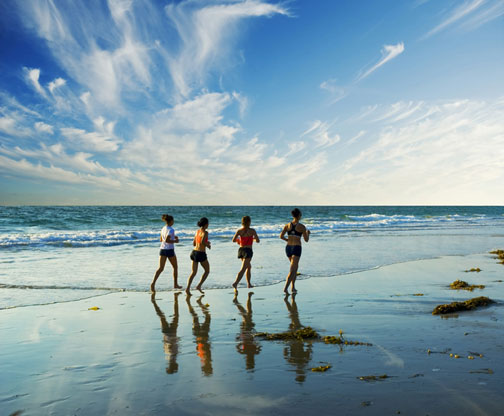
We quickly realized that we would have to train smart and make sure we did everything in our power to enhance our skydiving performance. We focused on being “ 24-hour”-athletes. Any training that didn’t cost money would be maximized and fully utilized. This included physical training 6 days a week, hereunder endurance, strength and flexibility training. Our team manager (from the airsports federation) and trainers from Olympiatoppen (Norway’s top athletic centre) helped us set up an efficient and specialised training program for each team member. We were regularly tested and logged every single training day (yes, skydives also of course). We logged hours of sleep each day as well as our individual general form to maximize training and rest time.
Being in great physical shape also helped us sustain long training days, prevent brain locks (yes – you brainlock more when you are tired) and made us more solid and better in the air.
To get more exit practise, we would spend afternoons in the pool with our jumpsuits on, exiting from the edge of the pool
Creeping
Before we even started skydiving together as a team, we spent an entire winter on the creepers, creeping every single block and random and all possible transitions. We do live in the cold north of the world and skydiving is possible during winter time, but not recommended if your goal is to train efficiently. We crept blocks and randoms, slow, medium and fast paced. We crept with and without a creeper camera. We practised the moves and keys. We practised A-slots and B-slots. We crept flat and also set up a slight downhill (to simulate the relative wind after exit). This was a big part of our success and one of the main reasons why we rarely had any brainlock issues on the team.
For the 2001 season we were jumping out of a tailgate (as opposed to Twin Otters the prebious years). To get more exit practise, we would spend afternoons in the pool with our jumpsuits on, exiting from the edge of the pool.

Nutrition
Nutrition was an important part of the program. On training camps we would typically start the day with porridge or equivalent “carb bombs” to enable us to sustain as much energy as possible. We would bring our own homemade pastas and light meals (fruit and vegetables etc.) and make sure we ate small portions in between each jump break to maintain our energy level. Our training day during camps would a lot of the days look like this:
07:00 Meet for a light run, stretch and mental preparations
07:30 Walk-through and creep the days’ jumps
08:00 Take-off first jump
16:00 End of jump day, 12-16 jumps incl. debrief
17:00 Off to the gym or wind tunnel
22:00 Good night

An important part of our nutrition program was the total exclusion of alcohol and nicotine (I can assure you that all other substances were excluded as well). Our philosophy was that all such substances would decrease our physical shape and thus reduce our overall performance. Besides, alcohol and nicotine cost money – money we would much rather spend on jumps. We would, however, look away from the “ban” once a year after the year’s main competition had concluded (World Cup or World Championships). We were known to catch up on the intake of alcohol and nicotine on those occasions.
Mental Upper
You should also not underestimate the mental upper this gave us before every competition. We knew we had done absolutely everything we could to be the best we could be.
Mental focus
Our team mantra was “every point on every jump”. To make mistakes was fine, to not give 100% in effort was not! We all committed to doing our very best on every single jump. This is easily said but trust me – not so easily done some days or that part of the day when the energy level is low and you’ve had it with your team mates (oh yeah, we had a few of those too). We had a golden rule on the team that I felt really helped us focus on the important stuff. Whenever we ended up in discussions or disagreements, we would all stop and pause and ask ourselves “if we continue this discussion – will it make us turn block 21 any faster?” You would be amazed how often our discussions would just die then and there.
An important focus area was mental training. This would include a mental walkthrough each morning of a given day at the upcoming World Championships. We would create different scenarios each day (in the lead/tied/behind by so and so many points). Whoever led the walkthrough would include detailed descriptions of competitors, spectators, the premises and so on to maximize the training and help us visualize and prepare. This short, but important exercise would have us “be at the World Championships” a hundred times before we even got there. When the day finally came, we felt very familiar with the situation.
Keeping track of were we were
One of the things we kept track of was our jump statistics. We kept track of all of our best block times, goal times for each block, okay times for each block, the same for exit times, scoring point goals for 3-block jumps, 2-block jumps, 1-block jumps, randoms etc. This careful registering of all of our times and scores made us totally aware of our strong sides as a team and – more importantly – our weaker sides. We had a huge poster in our team room which showed all our competition results graphically and with average points as well as exit times and block times.
We attended all competitions we could to get competition experience (thanks, Kurt Gaebel for starting the National Skydiving League!). Sometimes we would walk home from a competition with results that we were embarrassed to post there. We all agreed that the only way to fix that was to just do better.
There is no easy way to become best. No shortcuts. Just dedication and hard work – like in any other sport.
It’s all in the details
We would watch videos of all the top teams and compare our scores with theirs, study their technique and style, talk with them and get as much information as we could. We would know all the videos by heart and could tell anyone who was interested (not so many) which song played when Airspeed did their 9th round in Turkey.
All of the small things we did and measured were followed by us saying “that could be half a point in average”. Things like talking to the judges after each competition and getting their opinion on where we needed to clean up or if we could do anything to make their job easier (wear solid dark jumpsuits and white gloves); taping the door on the Casa in Spain in 2001 after one of our team members´ booties hung up on a nail that was sticking out of the ramp during our official practise jump (truly that would have been more than half a point had it been round 1!). Like taping our visors during competition; like making sure we knew every single competition rule – I had a bootie grip catching Carl-Erik in a block at round 10 in Australia – thank goodness I knew that was a legal grip and keyed it and continued! Like making sure our Dytters were set for the correct altitude on every single round (unlike a very good friend of ours who later became a World Champion – he learned it the hard way after tracking off before the 35 seconds was up at the World Championships in 1997). Like always packing our last two parachutes ourselves (money saved and more money for jumps) to mention a few.
One single point
Two of our World Championship medals were won by just one point. One single point. If you consider 1 point over 10 rounds on a 19-21 average pace, we are talking half a second better over 10 rounds! That’s how small those margins were and I believe it was a summary of everything that we worked on and put into our training that contributed to our success.
I believe that today’s top teams have more or less the same philosophy that we had. There is no easy way to become best. No shortcuts. Just dedication and hard work – like in any other sport. If you don’t have all the money, make sure you train smart and give it your very best.
If you come back with a 4th place and money in your pockets, you do not deserve any better
# Solly Wisdom
Our coach Solly Williams said to us before the World Championships in Australia in 1999 that if we came back with a 4th place and money in our pockets, we did not deserve any better. Two of my team mates took that literally. They left Australia with a bronze medal around their necks and less than an Aussie dollar in their pockets. They didn’t even have money to call home to get picked up from the airport in Oslo when they arrived (pre-cellphone days, folks!).
Would I go for the same plan if I was to start a team again?
If my goal was to become a World Champion – for sure. If my goal was to take part in the nationals, do a few fun competitions or be an above-average recreational jumper I might just make some changes and slack on some of the things we did. However, being as good as you can be and making out your full potential truly is a lot of fun. You might find it’s worth giving up a few luxuries for a while to achieve that.
Best of luck with your training. Have fun and train hard!