



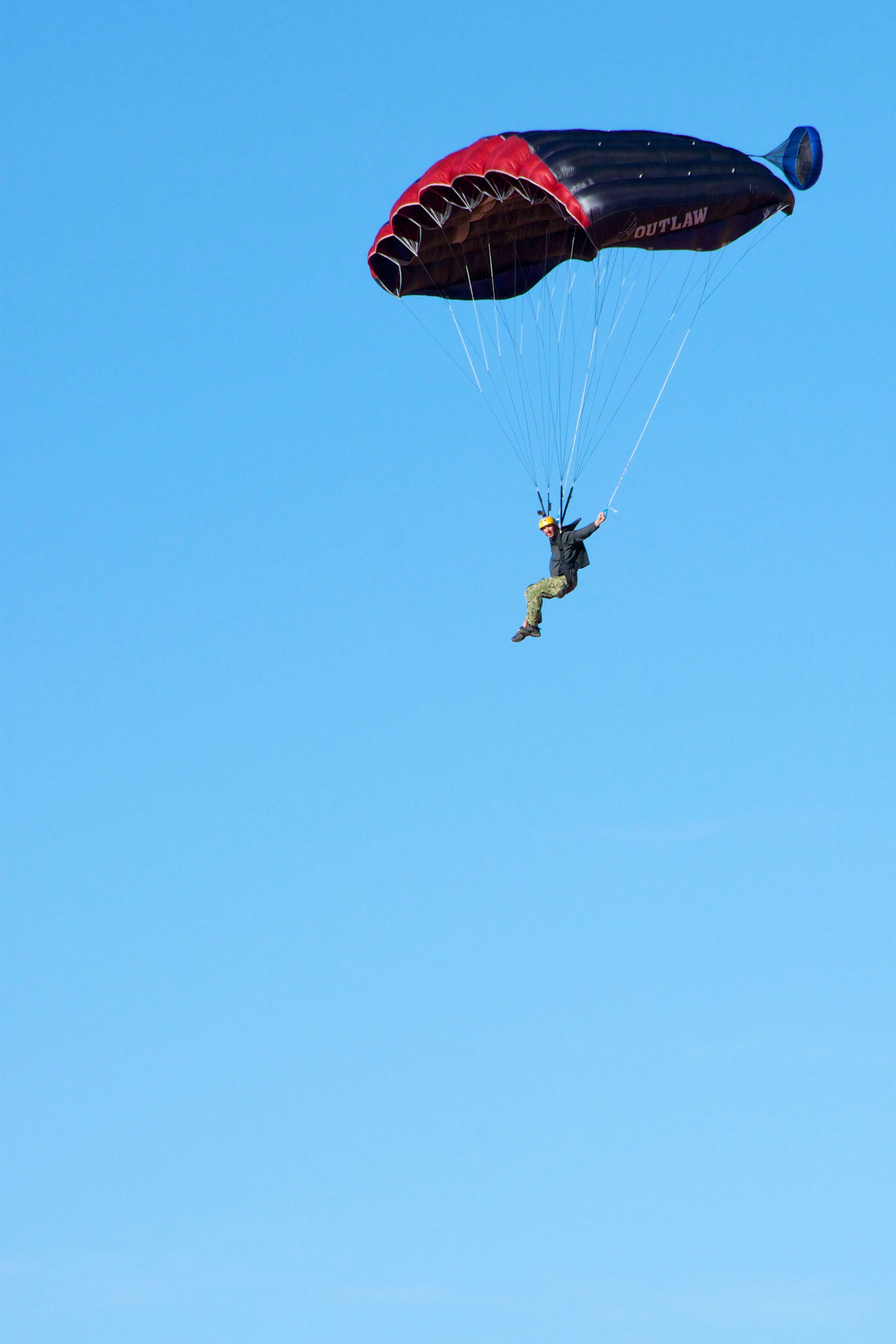
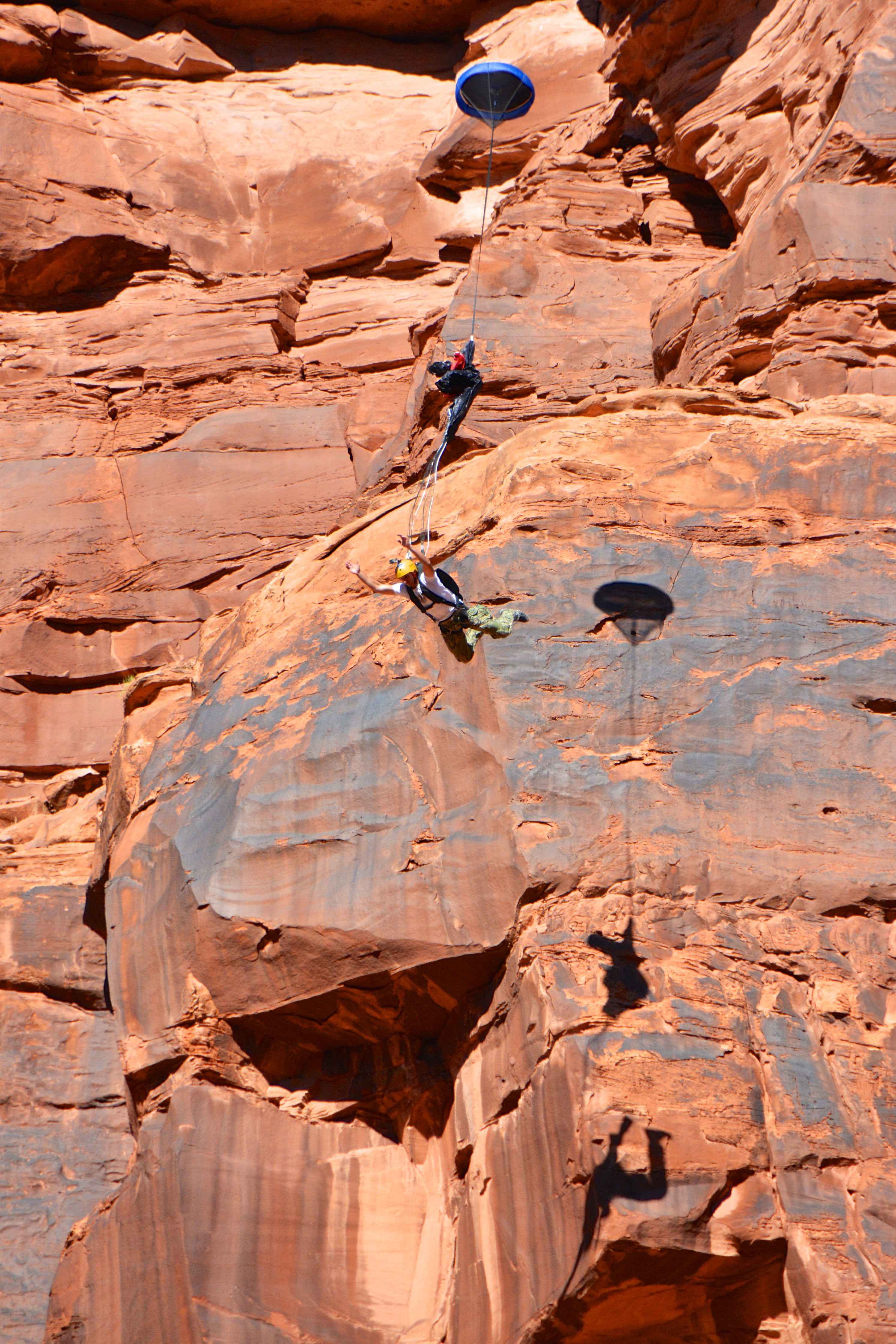
The Outlaw is a versatile Base canopy that, Squirrel say, excels in technical landing areas and has more science per square foot than any other Base canopy. The focus on the Outlaw was on making an incredibly versatile canopy, for all base environments. This has been made possible by low-freefall-specific features and reefing devices for terminal openings.
Some of the new science:
- 5 mini-vents at A-chord line
- Rear-chord Float-Flaps
- Center-cell slat system
- ZP Ellipse at leading edge
- Staggered upper brake cascade
- Advanced profile and leading edge
##Mini-vents
Extending the top surface more into the leading edge increases the OUTLAW’s efficiency and performance at trim speed and deep brakes. Extending the bottom surface into the leading edge places the A-line attachment points as far forward as possible, to increase pitch stability. This would otherwise reduce nose opening size, so to maintain nose-inflation during opening, five mini-vents have been added.
##Float-flaps
Inspired by a paraglider design, this innovation allows low stall speeds and forgiving slow-speed characteristics. The Outlaw excels in steep approaches using deep brakes. Spanwise tension in the canopy and a 3D-shaped differential cut between top and bottom surfaces keep the Float-Flaps closed while the canopy is in trim flight, meaning that the Outlaw’s glide performance is not compromised. Applying brakes progressively opens the Float-Flaps, adding laminar airflow to the top surface of the canopy. This stabilizes turbulence and provides a smooth transition to deep-brakes for a steep approach with a low sink rate.
Staggered upper brake cascade
The Outlaw’s upper brake cascade is finger trapped, with no loop to loop junctions, to allow a more consistent flex and help prevent kinks that can lead to tension knots.
There are many more features you can read about here
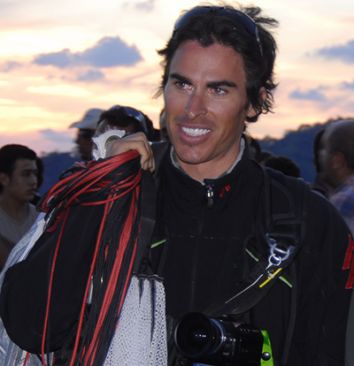
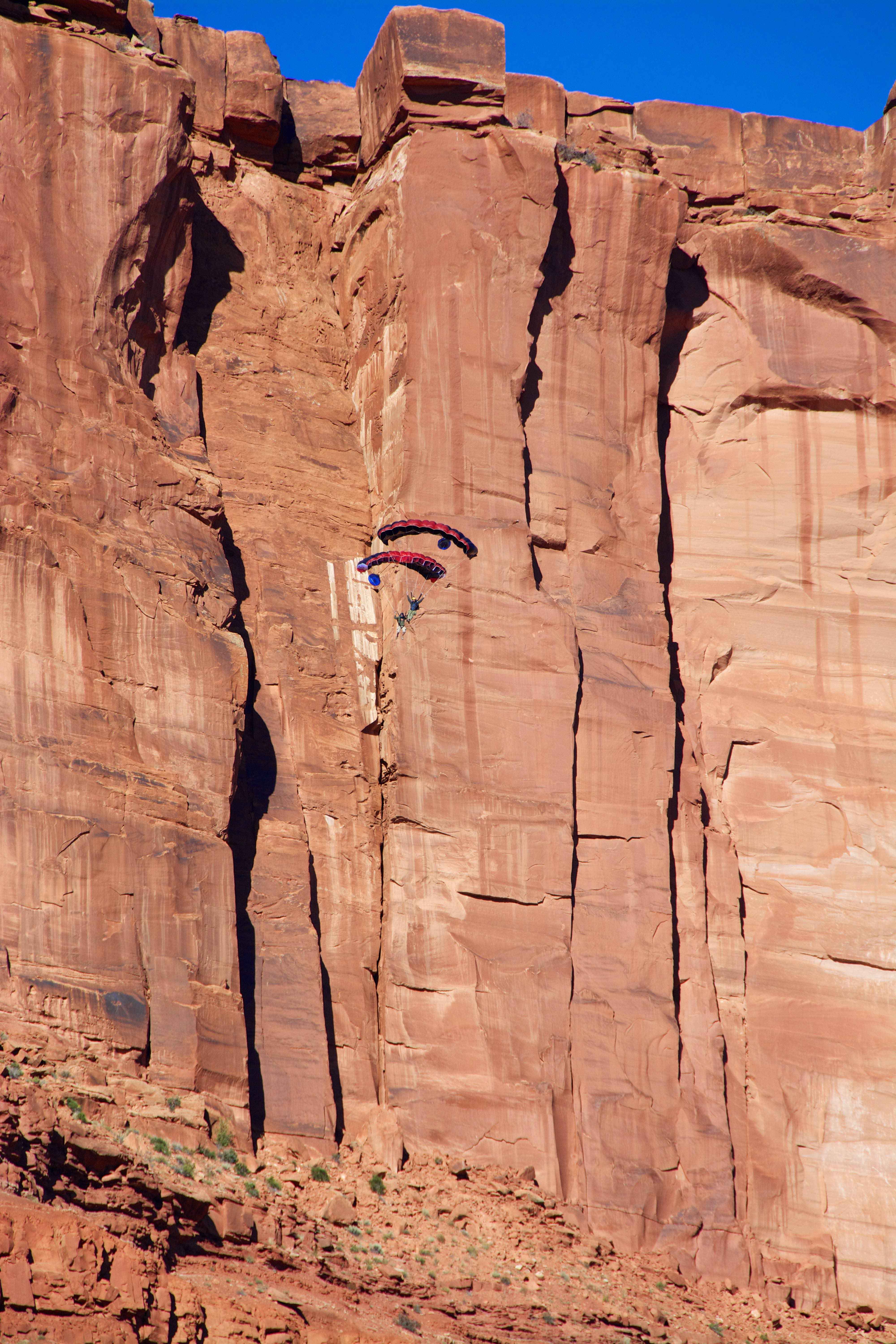
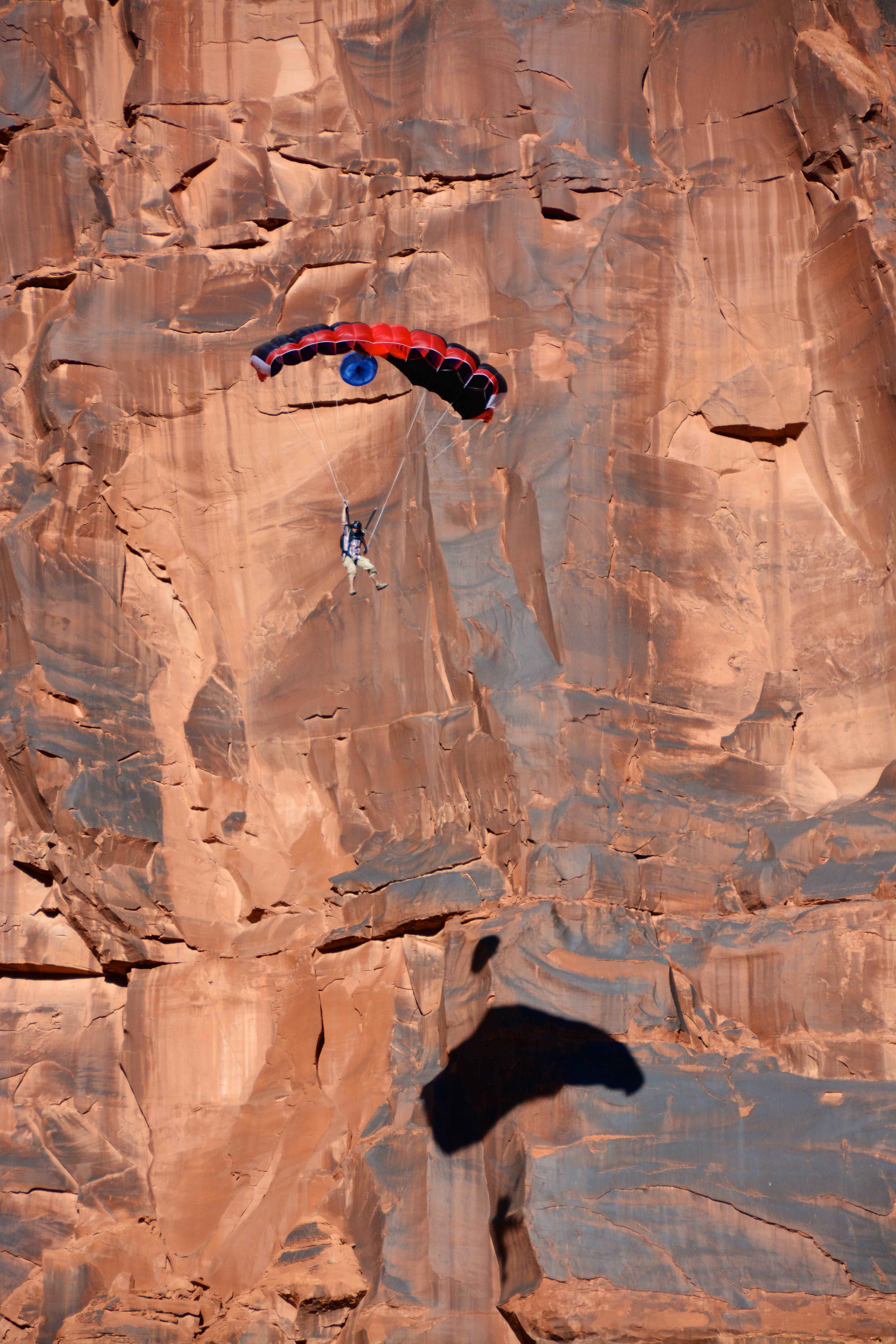

We asked Matt Gerdes, Squirrel CEO, about the Outlaw…
##Another new Squirrel product Matt, you guys are cranking them out!
It seems like we’re cranking them out, maybe, from an outside perspective, but the reality is that products like the Outlaw really take a long time and a lot of work. One of the cool things about our company is that it’s not just a couple of guys sitting here making stuff. We are a large and diverse team with more designers than any other BASE company. Right now we have three designers and two aerodynamics consultants on staff. We also have a large stable of test jumpers who are getting after it full time. This allows us to be a bit more prolific than the other companies which are smaller in size.
##How did the concept for the Outlaw parachute begin?
The Outlaw is the brain child of Simon Perriard, a young genius; rigger, paraglider designer, climber & BASE jumper from Switzerland. He is a brilliant guy with a very open mind, especially when it comes to designing canopies. Like our engineers from Ozone Paragliders, he has a vast amount of aerodynamic experience in paragliders, which is very useful when applied to parachutes. He has had the Outlaw design concept working for several years now, and has been working on it since before Squirrel existed. He watched us grow and, after talking to other manufacturers, decided to collaborate with Squirrel to get his baby into production. We were stoked on the idea, and although the parachute was ‘nearly finished’ in 2012, it has taken us that long to get it to market.
##Why did it take 2 years to get from ‘nearly finished’ to the market?
Those two years were spent getting the pattern to the point that our production facility liked it, getting the design polished to the point that our team pilots liked it, and putting in the test jumps needed to ensure that the concept was sound and solid and did what we wanted it to do. The testing process was interesting – this canopy is more complicated than the Ibex or any other parachute we have jumped. We wanted something that worked well for a wide range of people at a wide range of objects.
##So is the Outlaw’s main strength its versatility?
Absolutely. Base jumping now includes a very wide range of situations – the sport has really changed in the past 10 years – it’s not just ‘slider-up or slider-down’ any more. Jumpers these days, especially in the US, are going for low freefall objects and technical LZs (just like we always have) but then putting on a wide range of tracking and wingsuits and heading to the Alps (kind of like we always have, but with a wider variation in gear nowadays). There is no one magic parachute, but if you configure the slider brake (see the manual) correctly and use the right PC and deploy it responsibly, then we think it performs very well overall.
##Is the Outlaw safer than other base canopies?
Simon is super keen on safety, he is very cautious and Swiss – in a good way! – and a lot of the new features on this canopy are the result of that mentality. We would not say that the Outlaw is safer than other canopies, that would not be true at all, but we do think that it has increased pitch stability and better handling and deep brake behavior, as well as improved slow speed handling (rapid heading changes in deep brakes) than other canopies we have flown. That is just our opinion though. We’re excited to hear what everyone thinks this year.
##What are the differences between the Outlaw and your other 2 canopies?
The principal difference between the Ibex and the Outlaw is that the Ibex is designed specifically for wingsuit and tracking use. It is the lightest and lowest-bulk parachute we make, so if those are your priorities, then take an Ibex. If you want something more versatile, then choose the Outlaw. The Epicene remains the only skydiving main parachute in the Squirrel range, and is not to be compared to the Ibex or Outlaw.
Read more about the Outlaw here
#Warning!
Full warnings against liability for the product are included, ‘for the thickheaded’, and with the common sense statement: Being a BASE jumper means taking responsibility for your own life, death, and wellbeing.
Amongst other disclaimers the manufacturer points out that the Outlaw system demands extensive training and good judgment to use properly. It is critical that owners fully understand each aspect of the parachute system, and configure the system correctly for each scenario. The slider, slider brake, packing method, pilot chute selection, and jumper freefall technique MUST be adjusted for every scenario in every jump.