



With the 200-way Vertical World Record and 250-way State Record attempts fast approaching, bigway organizer and leader Andy Malchiodi shares key safety tips to help you fly your best and stay safe during next week’s bigways at Skydive Chicago.
Bigways Are a Team Sport, Not a Solo Mission
Bigways are a team sport, but as individuals, we can lose sight of that. It’s easy to understand why. There is no ‘other team.’ There is no physical, tangible adversary we need to physically best. There is our minds, our plan of action, and our physical execution. And sometimes our own mind is the most difficult adversary to overcome. As such, we can easily compromise safety when we’re so exclusively concerned with ‘I’ and ‘my’ performance. Fortunately, incentives are nicely aligned when we consider the jobs of our teammates, particularly those in our immediate proximity. When we do that, coupled with a thorough understanding of the plan of action, we can slow down mentally, open our apertures, and take in a much bigger picture. This benefits our individual performance, sets our teammates up for success, and enhances safety.

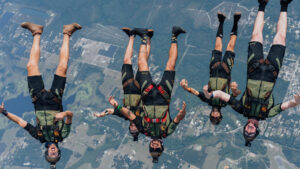
Photo by Felix Wetterberg
Understand the Organizer’s Plan and Your Role in It
The organizers of any bigway event expend a lot of energy to create what they believe to be the safest, most successful plan of attack. In the same breath, you can rightly say, organizers make mistakes, and the best plan of attack is only as good as its execution. As a participant, it is your responsibility to thoroughly understand your individual task, and the broader plan of action. In doing so, you can thoroughly, and accurately, visualize every step of the way to success.
Visualization is a Safety Tool
When we land from each attempt, organizers and participants compare notes, adjustments are made, wash, rinse, repeat. This engagement enhances safety many fold. If one person is out there ‘winging it,’ without a thorough understanding of the finer details, then their visualization will be non-existent. They cannot plan. And we’ve all heard the expression, ‘if you fail to plan, you plan to fail.’ In a best case scenario, this may manifest in someone getting lost, or another benign outcome. But at worst, it contributes to collisions, breakoff issues, etc. So know and understand your job thoroughly, and have a good sense of the people’s jobs around you. Know who you are meant to arrive ahead of, and who you are not. Know who is likely to be on your right, left, front, and back. The more engaged everyone is, the more thorough the visualization, not only will the jumps be more successful, they will be safer.

Expect the Unexpected
Further, although impractical to plan for every conceivable situation under the sun, assume the worst when it comes to the big things. If you do, you put yourself in the best position to manage the situation appropriately. You KNOW you’re gonna be on a collision course with someone on approach. You KNOW someone will be in your way on breakoff. You KNOW upon deployment, you’re going to need to take evasive action to avoid collision and/or have a canopy malfunction. You KNOW someone is going to try to kill you under canopy on your base to final. Fortunately, these things rarely happen in practice, but that makes them no less likely to happen on any given jump. It makes for a pleasant surprise when you’re ready for it, but it doesn’t actually happen. The person who isn’t surprised by the situation is the one most likely to handle the situation appropriately.