





Head up angle breakoffs may feel fast, but the numbers tell a different story. Jake Carlton breaks down years of data from head up and headfirst angles.
Ok, so you’ve participated in a couple of angle camps and shred every weekend with the boys. You’re feeling super confident despite not being able to fly on level on the belly. Now what’s the next step? Head up angles, for sure!
All jokes aside, if any of you have spent any time flying with me recently, you have probably heard my current disdain for flying head up angles. I want to make it clear: I don’t actually dislike head up angles. What I dislike is the exact scenario above, where adequate progression steps aren’t met prior to diving into the progression of flying angles feet first.
Now, if you’re reading this and asking, “What is head up angle flying?” this is definitely not the article for you. I would recommend scrolling down a couple of articles and reading Pete Lubrano’s article about what to do on a long spot. That may be a better educational source for you at this point in your progression.
However, if you are reading this already thinking of sacrificing your first born to the head up gods just so you can finally fly head up on the belly without corking out of the jump, then this is the article for you. Hopefully it can help you choose better practices moving forward.

Photo by Chris Bess
Why Fly Head Up?
So, to clear the air, I will put it in print by saying there is value to flying head up as a team in an angle jump. There, I said it. Skydive Mag published it, now it cannot be taken back.
Head up allows us to fly through vertical orbits (or eagles) as a team of three or more. In groups smaller than three, you can do 180s (flares and classics) on the top and bottom of the vertical orbit, which allows you to stay head down. The timing of these rotations becomes incredibly challenging when applied to a team setting of three or more.
Enter the head up angle, which allows us to fly through these moves without rotation, creating a much safer approach and a higher success rate in the dynamic environment created by skydives with vertical orbits added to them.
Now that we have established the value, it’s also important to establish the drawbacks.

Photo by Chris Bess
The Movement Problem
The largest issue that becomes immediately evident is how little ability we have to move across the sky in this orientation, especially in a team setting.
Is that fact in and of itself a problem? Not necessarily. We can plan transitions to head up that allow us to harness the skydives inertia and continue moving across the sky fairly well. Not quite as well as traditional head down (or headfirst) angle flying, but the speeds are still respectable.
Conversely, we can fly certain transitions that do not even affect the direction of flight despite the feeling that we have stopped and gone the other direction.
“How is that even possible?” you ask. That question is for a different article. In this article, I want to focus specifically on the practices of a head up jump moving into breakoff. So, it is time to get nerdy.

Photo by Chris Bess
The Data
I have spent the past couple of years collecting data on the horizontal and vertical speeds of angle flying in all orientations. This information is a necessity in the flocking world.
As I spent more time coaching flocking, I started to realize how woefully ignorant we are in the angle world about how we actually move through the sky. Serendipitously, as I made this realization, a new altimeter brand by the name of Deep and Steep rolled out a GPS altimeter that allowed jumpers to go back and analyze vertical, horizontal, and total speeds. With this new tool, the data aggregation began.
Without turning this article into an embarrassing display of spreadsheets and graphs, I’ll boil the findings down into something more digestible. All the data I am about to present is averaged from teams flying in organic angle environments. Meaning, the jumps were not designed to maximize speed, but rather to maximize a group’s ability to fly together.
We also collected data from jumps specifically designed to maximize performance. In the head up orientation, there was not much fluctuation. Head down, on the other hand, showed much larger swings in horizontal speed depending on setup and conditions.
Head Down
Average Speeds Mid-Skydive
- Vertical: 145–175 MPH
- Horizontal: 65–95 MPH
Standard “Cruiser” Head Down Angle
- Vertical: 165 MPH
- Horizontal: 80 MPH
Average Breakoff Speeds
- Vertical: 110–130 MPH
- Horizontal: 100–130 MPH
Head Up
Average Speeds Mid-Skydive
- Vertical: 135–155 MPH
- Horizontal: 35–55 MPH
Standard “Cruiser” Head Up Angle
- Vertical: 140 MPH
- Horizontal: 40 MPH
Average Breakoff Speeds
- Vertical: 135–155 MPH
- Horizontal: 35–55 MPH
There is another style of leading head up angles where the orientation is flown much more vertically. What we noticed was that the vertical speeds became so high, and the horizontal speeds so low, that most of the horizontal movement in the data was actually wind drift. For that reason, we did not include it.
Now, there are a lot of numbers in there, but there are some very important takeaways.

Photo by Tex
Takeaway #1
We are approximately 50 percent more effective horizontally while head down than head up on a cruiser-style jump.
More importantly, we are roughly 70 percent more effective head down during breakoff in terms of glide ratio.
Takeaway #2
We did not find a statistically significant change in glide ratio moving into breakoff while head up.
We noticed a direct relationship:
- As horizontal speeds increased, vertical speeds also increased.
Head down displayed the opposite relationship:
- As horizontal speeds increased, vertical speeds decreased.
These observations raised immediate concerns about breaking off from each other while still head up.
So naturally… we started doing math.
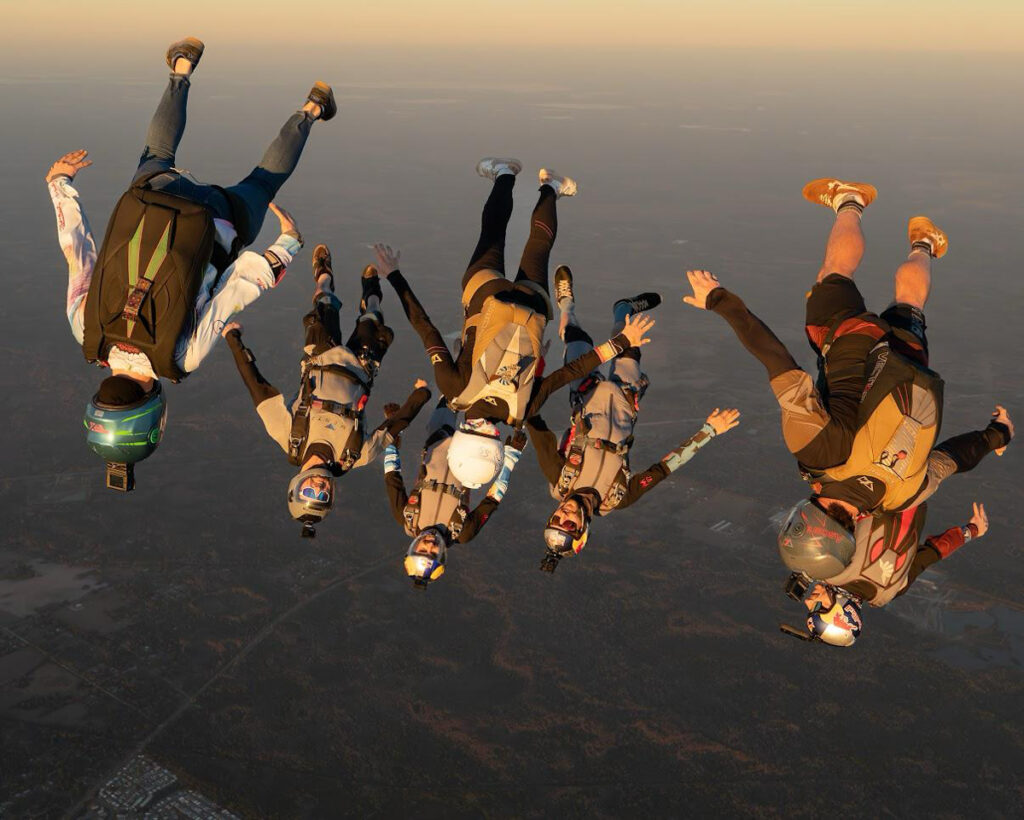
Photo by Tex
WARNING… MATH!
Pull out that old TI-83 you had in college because we are about to dive in.
If you look at this section and all you see is The Matrix, all good, you can skip ahead to the conclusions. But for the mathematically inclined individuals out there, here are the conditions we used.
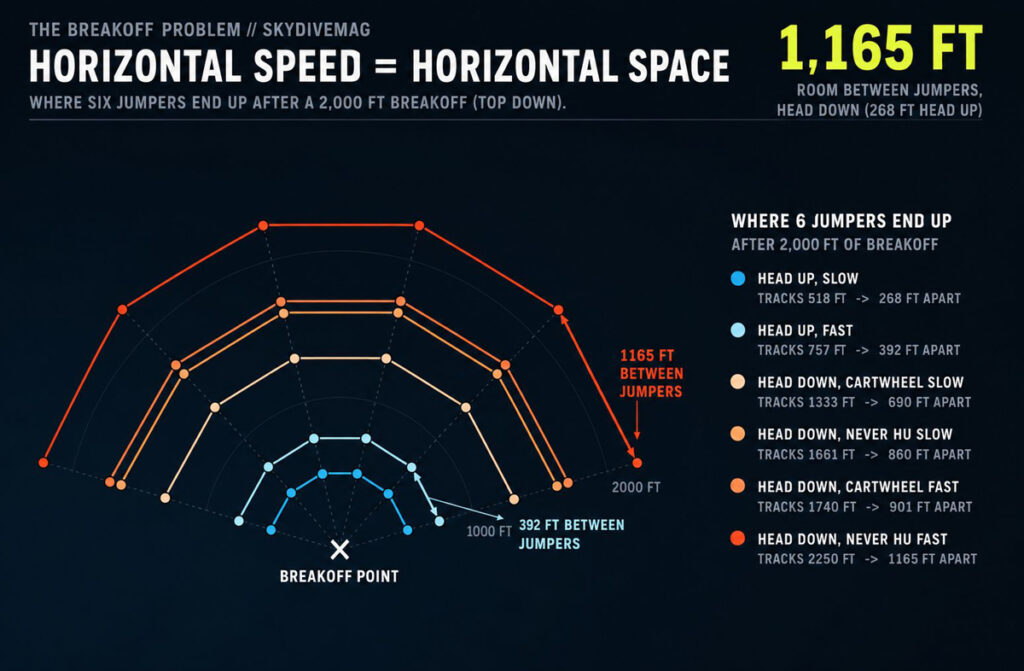
The first condition we set was 2,000 feet of breakoff altitude loss.
Meaning:
- If we break at 5,000 feet
- We continue tracking away until 3,000 feet
This number was chosen to provide the maximum horizontal separation possible. Most breakoffs realistically only carry for around 1,500 feet of altitude loss.

Photo by Chris Bess
The Separation Model
The second condition was a 30-degree angle change between jumpers, assuming a group of six:
- One leader
- Five followers
This is a fairly standard group size at most events around the world, give or take one jumper.
We then used the Law of Cosines to find the horizontal distance between two jumpers who originated from the same point and moved away from each other at a 30-degree angle.
Formula
D = 2L sin(θ / 2)
I’ll work through the first example and let you do your own math from there.
Example 1: Head Up Breakoff (Slow)
- Horizontal Speed: 35 MPH (50.33 fps)
- Vertical Speed: 135 MPH (198 fps)
- Altitude Loss: 2,000 feet
- Horizontal Distance Covered: 518 feet
- Heading Change: 30°
- Total Separation Between Jumpers: 268 feet
Step-by-Step
- L = 518 ft
- θ = 30°
- θ / 2 = 15°
- sin(15°) ≈ 0.258819
- d = 2(518) × sin(15°)
- d ≈ 268 feet

Photo by Chris Bess
Cheater Method
When we use the 30 degree heading change variable, we can estimate the total separation between the two jumpers by taking the total distance traveled and dividing it by 2.
Example From above:
- Total distance covered: 518 ft
- D ≈ 518 / 2
- D ≈ 259
It’s not full proof but it quickly gets you close enough to get an idea of the distance between the two jumpers without doing all the trig.
Photo by Fish
Real World Consequences
Once we calculated the separation distance, we applied it to a real-world situation involving two high-performance canopies having off-heading openings and flying toward each other.
These were the outcomes.
Head Up Breakoff (Slow)
- 35 mph horizontal (50.33 fps)
- 135 mph vertical (198 fps)
- 2000 feet of break off time (5500 to 3500)
- 518 total feet covered of horizontal distance
- 30° angle heading change
- Total separation between jumpers: 268 feet
- Estimated Reaction Time: 1.4 seconds
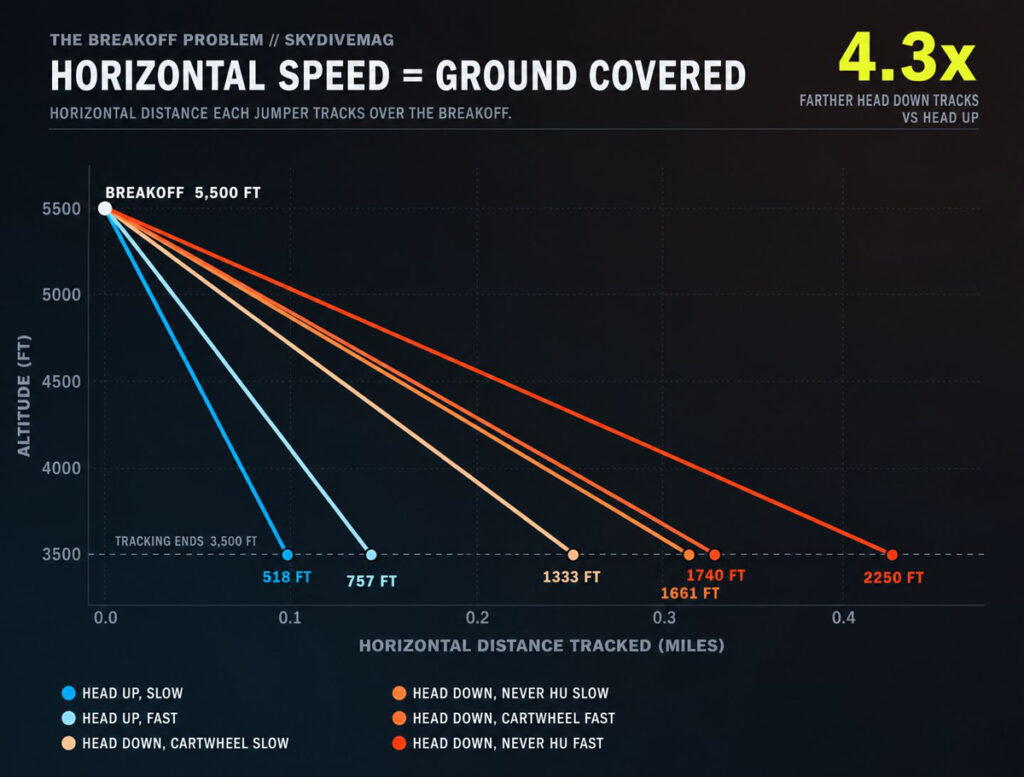
Head Up Breakoff (Fast)
- 55 mph horizontal (80.66 fps)
- 145 mph vertical (213 fps)
- 2000 feet of break off time (5500 to 3500)
- 757 total feet covered of horizontal distance
- 30° angle heading change
- Total separation between jumpers: 392 feet
- Estimated Reaction Time: 2.7 seconds
Head Down Breakoff from Cartwheel (Slow Horizontal)
- 90 mph horizontal (132 fps)
- 135 mph vertical (198 fps)
- 2000 feet of break off time (5500 to 3500)
- 1333 total feet covered of horizontal distance
- 30° angle heading change
- Total separation between jumpers: 690 feet
- Estimated Reaction Time: 4.7 seconds
Head Down Breakoff from Cartwheel or Team Layout (Fast Horizontal)
- 105 mph horizontal (154 fps)
- 120 mph vertical (176 fps)
- 2000 feet of break off time (5500 to 3500)
- 1740 total feet covered of horizontal distance
- 30° angle heading change
- Total separation between jumpers: 901 feet
- Estimated Reaction Time: 6.1 seconds
Head Down Breakoff from Jumps That Were Never Head Up (Slow Horizontal)
- 100 mph horizontal (147 fps)
- 120 mph vertical (176 fps)
- 2000 feet of break off time (5500 to 3500)
- 1661 total feet covered of horizontal distance
- 30° angle heading change
- Total separation between jumpers: 860 feet
- Estimated Reaction Time: 5.9 seconds
Head Down Breakoff from Jumps That Were Never Head Up (Fast Horizontal)
- 135 mph horizontal (198 fps)
- 120 mph vertical (176 fps)
- 2000 feet of break off time (5500 to 3500)
- 2250 total feet covered of horizontal distance
- 30° angle heading change
- Total separation between jumpers: 1165 feet
- Estimated Reaction Time: 8 seconds

Photo by Chris Bess
The Transition Delay
Now, I know all the naysayers have entered the chat.
“But Jake, we never break off on our feet. Once we hit breakoff altitude, we transition to our head and continue breaking off from there!”
The next crucial observation we noticed was that transitioning to a headfirst angle does not mean immediate acceleration. On average, we observed a 1,500–2,000 foot delay before horizontal speeds began increasing again.
So, the team layouts and cartwheels referenced above were initiated:
- No lower than 6,500 feet AGL if breakoff was planned at 5,000 feet AGL
- No lower than 7,000 feet AGL if breakoff was planned at 5,500 feet AGL
Team layouts as referenced above is a move where the team flies around each other performing a front or back layouts around a center point of a formation while a teammate in the opposite orientation performs the opposite layout maneuverer to transition back into head down. (i.e. head up belly flyers perform a front layout over the head up back flyers ending head down on the back continuing on the original line of flight, while the head up back flyers perform a front layout under the head up belly flyers, ending head down on the belly still traveling on the original line of flight.) It is not an in-place lay out. The in-place layout is the worst transitional option to headfirst angles.
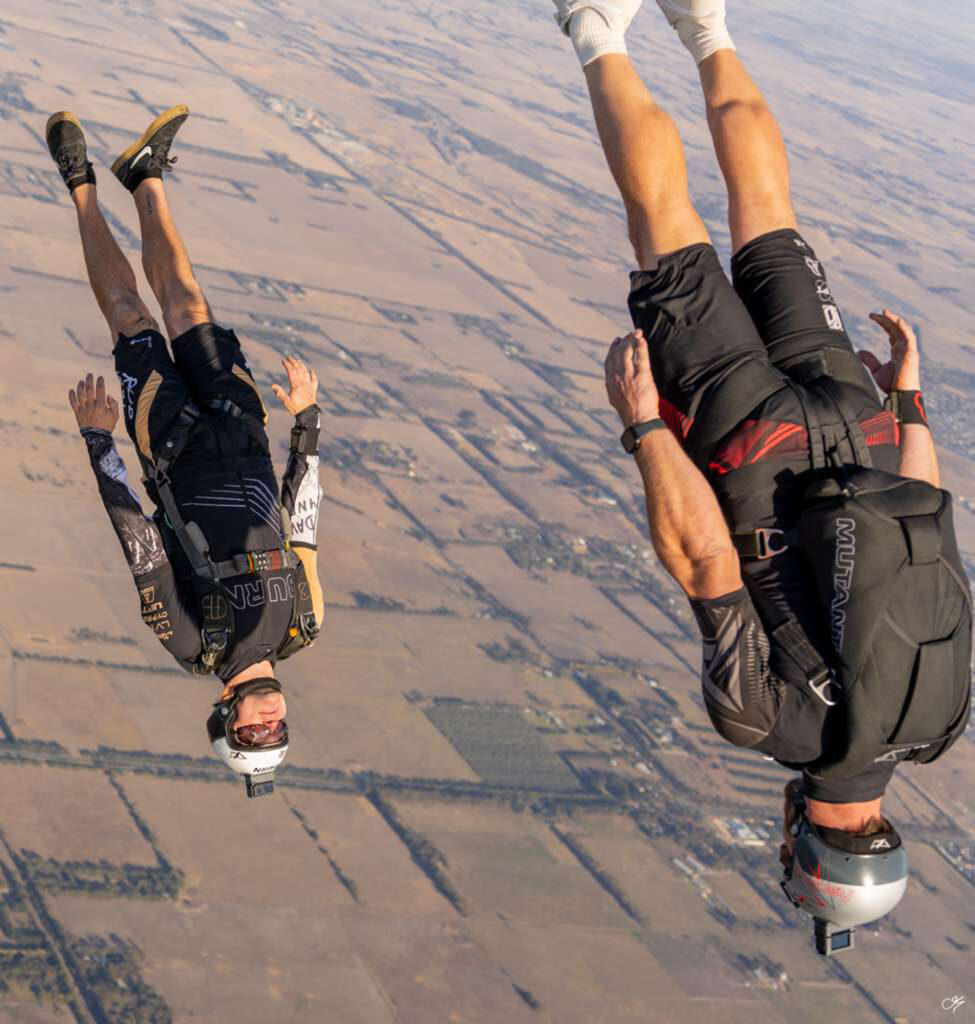
Photo by Chris Bess
Major Takeaways
We have been very lucky up to this point that we have avoided several canopy collisions caused by insufficient spacing during head up breakoffs.
That is a testament to:
- Modern canopy opening performance
- The fact that most teams still struggle to fly close together while head up
But moving forward, as teams become more proficient at flying head up together, we cannot continue planning around the best-case scenario:
- Perfect openings
- Ideal vertical spacing
- And just hoping “it’ll buff”
So, I’ll say it here first:
It is unacceptable to breakoff head up in groups of six or more jumpers
(which is most angle camp environments)
Personally, I would argue that even five is pushing it and does not seem worth the risk of a life risking collision with your buddy when you could have very easily transitioned back to your head 1,500 feet earlier.
However, if you are feeling lucky and want to tempt fate, that is a personal decision you must make. You just won’t be jumping with me when you do.
Obviously, as groups shrink, you can get away with more. So, take this information, apply it to the skydive you are part of, and make decisions accordingly.