




Article by Kate Cooper-Jensen, with contributions from discipline experts
When I made my first jump in November of 1978, my jumpmaster told me that, whether I chose to make one jump or many hundreds, I had to be ready to accept that:
- I’d have a malfunction
- I’d be injured.
What he didn’t mention is that I would without doubt land out.

Image by Roy Wimmer-Jaglom
What does “landing out” mean?
Landing out is the unintentional landing of a parachute, main or reserve, in an area other than what was intended.
At many dropzones it is easy to determine the best place to land out but with the soaring popularity of “exotic” boogies, coupled with varied movement disciplines and multiple passes out of larger aircraft, out landings are more common than ever.
Let’s examine the best ways to stay safe while landing in an unfamiliar area. Whatever discipline you are partaking in there are some basic steps you can take to ensure the safest possible landings.
- Identify where the Landing Zone (LZ) is, if possible. Head towards it but remember that the safer and more accessible landing areas might easily be FARTHER from the LZ rather than closer.
- Make your out landing area decision early – don’t fall into the trap of trying to find a better or closer place and then finding out you have exhausted your options for safe landings.
- DO NOT MAKE A LOW TURN. Make sure wherever you land you have decided on a landing direction and follow it.
- Identify wind direction if possible. Tips such as wind lines on water, smoke stacks, flags, and even the first people down can help you to identify the optimal landing direction.
- Once you’ve decided on a landing area and direction then start to identify potential hazards in the chosen landing area. These can include power lines, trees, shrubbery, fences, livestock, termites’ nests (yup – seen them and they are HARD) and logs/rocks etc.
- Be aware that if you’ve chosen a landing area others could easily use it as well so be aware of possible converging landing patterns – keep your head on a swivel!
- If wearing a full-face helmet, it’s advisable to put your visor down to land in any unknown vegetation or sand.
- Know the emergency number for the country you are jumping in and know the phone number to manifest, or if there is a language gap, to a person at the DZ who can translate. Jumping with a phone can make pick-ups much easier. WhatsApp or similar type services can also work well if you have coverage. If the DZ you were supposed to be landing at uses Burble you can send messages through the system to let manifest know your whereabouts.
- Look for others under canopy – locals might know the best places to land and it’s easier to find a group than solos scattered in different fields. If you are landing off to land by a reserve canopy, cutaway main, or free bag, be aware others might be chasing it as well.
Wherever you land, make your decision at a high enough altitude to be able to assess hazards and land using a predictable canopy pattern.

Complications
But wait, there’s more. Sometimes, making safe off-dropzone landings can be very tricky. Different disciplines can add to the difficulty. The following are probably the most vulnerable to landing out:
- Wingsuiting
- Movement jumps
- Flocking
- Canopy formation
- Balloon jumps
- Very large formations, records
- Destination boogies
Think about it, high performance canopies, FS jumpsuit booties, wingsuits, canopy formation jumpers trailing freebags and/or canopies and weight belts can all add significant challenges to safely landing out.

Hazardous landing areas
Some examples of potentially dangerous off dz landings are:
- Water landings
- Tree landings
- Downwind and/or crosswind landings
- Uphill, downhill or cross hill landings
- High brush/cornfield landings
- Urban (buildings, roads) landings
Prevention is better than cure. We’ve contacted some of the best of the best in different disciplines to discuss the safest ways to handle some of the disciplines and landing options above…
Wingsuit Off Landings
by Matt Gerdes

Landing off happens – we accept that. What we don’t accept is the attitude that wingsuits should land off more, or that flying a wingsuit is an excuse to land off or increases your chances of landing off. Wingsuits give us the ability to open our parachutes in precise locations almost regardless of the jump run and spot. The focus here should be on prevention.
Wind is a big factor, so check it before boarding the plane. Plan your opening location with wind at depolyment altitude in mind. If it’s blowing 20 knots at 3,000′ out of 270, plan your flight path so that you can open your parachutes west of the LZ. Wind above opening altitude can also play an important role, so factor that into your flight plan as well.
When you are leading groups, you take responsibility for the group’s opening location. No coach or organizer is perfect, but we should all consciously strive for perfection when leading. We should all make great efforts to not just land on the DZ, but to land in a specific part of the landing area on each and every jump. Even if the spot is bad, and the wind is strong, we can always make it back if you know where you are when you get out of the plane – all we have to do is plan it, and pay attention.
Know the winds aloft, know the winds at opening altitude. Know where you need to fly in order to avoid other groups, and be upwind of your pre-planned opening area. If the visibility conditions are not conducive to navigating back to the DZ easily, ride the plane down.

Wingsuit water landings
If you are going to land in the water, unzip your wingsuit from the neck down, not the ankles up. Unzipping from the neck down to ankles will allow you to kick out of the suit entirely, with only your arms left inside. Follow USPA guidelines for your water landing and when escaping from the shoulder straps of your rig, extract your arms from the wingsuit simultaneously. Note, this technique only works with wingsuits that have continuous zips from neck to ankles (all Squirrel brand wingsuits).
[For more information on wingsuit water landings read this article: Water WS Landings]
Angle Off Landings
by Alethia Austin

To some people and to some DZs landing off might just be a common situation. To others and me, it’s pretty high up the list of things we should work hard to avoid – and that can easily be avoided, no matter the conditions. From an angle flying perspective, after the pilot has dropped us in a suitable spot based on the weather conditions, there are two people who are responsible for someone having a landing on or off a DZ; the leader of the movement jump and the canopy pilot.
The leader of the movement jump has the responsibility for making it back to the dropzone in the weather conditions, to open their group in a spot that will give the jumpers the ability to make it back in said weather conditions, under any canopy. This is something that anyone leading an angle group should be absolutely certain they can do, no matter the weather, exit order or experience level of the jumpers.
The second person responsible for getting back to the dropzone is the pilot of every canopy in that group. If the leader opened you in a good place, it’s now up to you to understand your holding area in regards to other groups on the jumps. As angle groups we don’t fly immediately back towards DZ/jump run until we’ve seen the other groups open. It is also your responsibility to understand and plan a flight path that will get you back to the dropzone without causing unnecessary traffic and hazards.
If landing out ius inevitable, once you have your spot chosen, treat it like a normal landing: focus. Don’t panic! Simply fly your canopy predictably, calmly and land as you would any other landing, with a full flare and a strong body position (unless needing a PLF).
In conclusion:
- Always spot before exiting
- Only follow good leaders – or always lead to a safe opening spot
- Make a decision early on where you’ll land
- Fly your canopy calmly and predictably
- Land with a full flare
Flocking Off Landings
by Pete Allum

Flocking can be done on any type of canopy, from large docile student canopies to the tiny pocket rockets that whistle by you on the landing area. The discipline does require you to have an intimate knowledge of the surrounding area and the current weather conditions. With the above in mind I would strongly recommend that you have a canopy coach or very experienced local pilot lead the flocking jump. The leader will keep their main focus on the safety of the group as well as leading the dive flow.
When I’m planning a flock, I want to know the wind strength and direction at every altitude so that we can stay in a navigation box that will eventually lead us to a safe landing back on the DZ. However, like wingsuiting, flying a canopy from high altitude can give us a lot of range. If used wisely that range can get us back to the PLA but with a lack of attention it can also send you off target.
Study all of the possible out-landing options and have a clear idea of the hazards. If you are jumping a heavily loaded high-performance wing, you want to identify areas that give you enough run out. High pulls also give us the potential of a high cutaway and subsequent reserve ride and as we occasionally exit some miles prior to the usual exit point we are almost guaranteed an out landing
On every flocking jump I take a phone and the local DZ number.
Urban Landings
by Gary Cunningham

Look out for power lines, or other wires that can be hard to see until the last second. Also watch out for lamp posts, which many BASE jumpers have gotten hung up in the past. The winds can channel between buildings, and be turbulent behind any object. If you are landing in a small clearing that is surrounded by buildings, trees, or a solid fence then the wind can swirl around inside.
If you have to land on a road, cars can suddenly appear from around a corner. If there is no clear landing area then sometimes a tree may be the softest option if there are any.
Balloon Landings
By Dan BC

Predicting where you’re going to land after a balloon jump is far from an exact science. Speak to the balloon pilot about the winds, launch location and anticipated landing area. Take a good look at google maps’ aerial view of the area, and identify other possible landing areas, and potential hazards. Then be sure you have the proper equipment to land safely in the range of landing areas you may be faced with.
Usually balloons take off in early morning in virtually nil winds, so be aware to allow plenty of possible overshoot, and to agree a landing direction with the other jumpers if it is not obvious. Before exiting be sure you know the wind direction and a ground/sun reference to determine your preferred landing direction. Pick your landing area before you exit.
Separation from the other skydivers is hard to come by. Balloon jumps are generally between 4,000 and 6,000 AGL, at very low airspeed. There isn’t much time to track away and establish ideal separation. You’ll be lucky to have adequate separation. Your priority is making sure you are clear of other canopies. Do that first before looking down to plan your pattern and landing. I realize you’ll want to look down since you’ll be over an unfamiliar landing area. But you’ll need to be sure you guarantee good separation first.
Remember the balloon is not moving much. If you are exiting after another group wait until you see all the canopies open and cleared from underneath or near the balloon before exiting.
Canopy Formation Off Landings
by Chris Gay
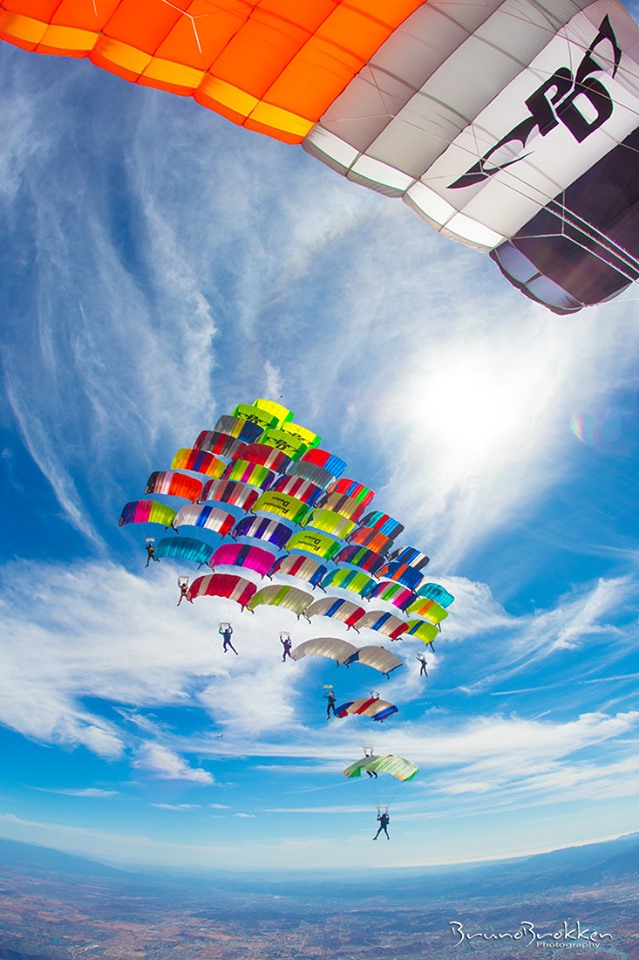
With Canopy Formation (CF) there are these reasons a person or persons will land out:-
- Bad piloting and not watching where the formation is going
- Bad spot due to inaccurate forecast or miscalculation of winds at all levels of flight
- Following a person who had a malfunction or a wrap/cutaway
- Following equipment that was cut away after a wrap
At the start of any CF camp there should be a discussion of what to do when any of the above scenarios happen. When the entire group is landing out due to bad piloting or inaccurate wind forecast or calculations the whole group should try and stay together. The most experienced and knowledgeable of the area should lead the group to a large enough landing area for all experience levels on that particular jump.
We always recommend that at least one jumper follows someone landing out due to a malfunction, wrap or reserve ride. However only follow that jumper to an area that you can also safely land in. Having someone close enough to the jumper with the issue can assist communication with the DZ in getting help there quickly especially if the jumper is injured.
We also recommend that at least one jumper follows someone who is chasing equipment after a cutaway. Again it is very important to only follow that jumper to an area that you can also safely land in. If you follow equipment it is very important not to get so concerned about the equipment that you find yourself with no good landing options at too low an altitude to make any changes.
We recommend that all CF jumpers carry their phones with them on every jump. In the near future this will become a requirement especially once we have a soon-to-be-coming CF tracking App that the ground crew can monitor in the event of an out landing.
Big-way/Records Off Landings
by Lesley Gale
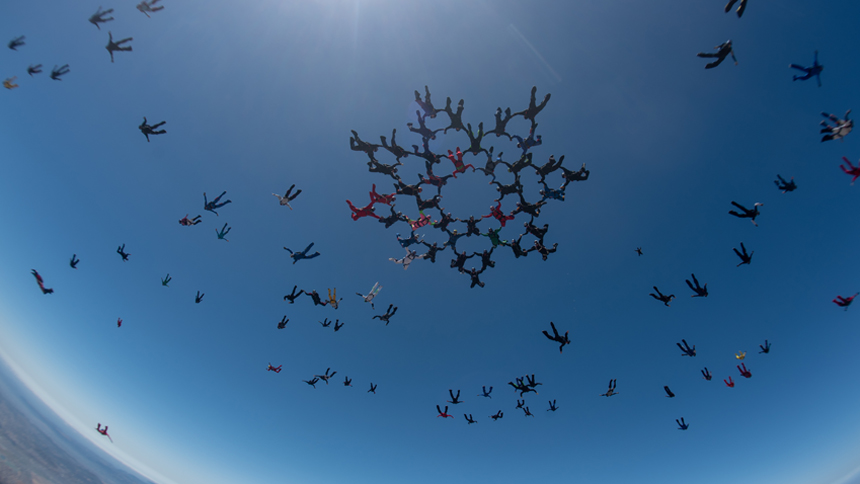
Big-ways have more potential to land off due to the number and spread of jumpers, tracking off higher (sometimes 7,500 feet), dispersing the individuals across a large expanse of sky. It’s important therefore for record and big-way organizers to only jump in appropriate conditions, in suitable locations, with very experienced pilots and spotters. It is also wise not to take off for a big-way within 60-90 minutes of sunset, due to the safety aspect of trying to locate missing jumpers in the dark.
It makes sense to for participants to check out Google Earth of the whole area and look for potentially good off landing areas (eg golf courses, beach, parade grounds), Also, check out undesirable landing areas, and look for power lines as they can be hard to see under canopy until too late. Vines, cornfields, rape may look attractive but carry their own hazards. Avoid vine fields, they are potentially lethal, as full of wires.
Once you start record jumps it is likely you will be breaking off in a consistent direction (in similar weather conditions). So, you can start to get a feel for what the terrain looks like, where you will open, what canopies will be around you and your usual landing area. If you don’t recognize the terrain when tracking off, or you realise you’re much further out, that’s a clue you may be heading for an out landing. Do NOT slow down your track to ‘help’ the situation; the priority at this point is clean separation for everyone on the load to deploy safely. After opening, keep flying away from the center. Do not turn quickly to try and ‘get back’ to the DZ as the inner waves will be tracking towards you and they don’t want to see your open canopy any more than you want to see them opening around you! Check for other canopies and only then look down to identify suitable landing areas.
Safety in numbers – there will be others around you, work together to establish some sort of pattern to the best landing area(s). Ideally you should land in the same direction as everyone on the record load. Sometimes this is pre-determined, so stick to it if feasible and safe, especially if you’re only just off the drop zone. But if the best landing area is long and thin then take the long most-into-wind direction, aiming to land at the downwind end to give the most run-off. If your canopy is one of the fastest descending, be bold and brave and set the landing direction – considerately!
Be aware of possible turbulence or wind shadows if landing in or around trees or buildings. In urban areas this will be extreme – the wind strength will drop off below the building line and the turbulence will go crazy. Therefore, choose parks, hotel grounds, etc. If you’re going to land in vegetation higher than your head (eg corn, rape), get a feel for the nearest field edge or road before landing. Flare gently for just under the top of the crop and be prepared to PLF. With corn the lines will go over multiple plants. Be kind to the farmer when extracting yourself.
Remember if you’re landing off and have found a lovely alternative, others will probably want to land there as well. Turn around after landing and prepare to clear the area. Gather the troops and make your way back to the DZ as a pack.
Destination Boogie Off Landings
by Rich Grimm

Photo shows Bird Island, Seychelles, by Bruno Brokken
Before you sign up to participate in an event, know your abilities. If you’re not sure it’s for you, speak with the organizer or with your local experienced jumpers and instructors about it. The landing areas at exotic boogies vary from beach to open field in the mountains to pyramids in the middle of Cairo. All of them have one thing in common; they are exactly like doing a demo jump. There are usually few outs, spectators and different wind conditions and LZ (Landing Zone) sizes. You can prepare yourself for this by being current and practicing your canopy flying and landing skills at your home DZ. Often at beach boogies we land parallel to the water line which leads to crosswind landings. Learn how to navigate these situations before attending.
Be well prepared once you arrive at the boogie. Pay close attention to the safety briefing and watch the first few loads land. Watch the winds. Stay within your skill set. Don’t try to “out cool” anyone. Especially on landing.

Image shows Skyfari safety briefing, in front of Table Mountain, Cape Town, by Bruno Brokken
Being in the saddle at 3,000 feet is a great idea. You’ll have more time to think your way through an off site landing or a water landing. Pick a spot to land soon after opening. If you’re going to land in trees, on a road etc, don’t do low turns on final. Just flare or PLF! Remember your best LZ might be behind you downwind or actually the water if necessary. Washing your rig and a repack takes far less time and money than a broken femur to heal. Wear a flotation device if you’re at a beach boogie. Don’t panic if you are going into the water. Your reserve will float, and you have a flotation device. Use it. Don’t cut away over the water. Fly your canopy right to the surface and flare. Don’t land in the surf line. Getting tangled in your lines isn’t a good scenario.
Only angle fly or do movement jumps with a boogie organizer. Have a minimum of 100-200 wingsuit jumps before jumping a wingsuit at an exotic boogie. Get a briefing from the wingsuit load organizer. Fly conservatively. I always recommend a jump first at a destination boogie without the wingsuit, to sort out the surroundings and LZ. Plan the openings and canopy flights before boarding the plane. Sort out the slower and faster canopies so everyone has an idea of what to expect. Never spiral down into the LZ.
PLF, PLF, and did I mention PLF on landings gone bad. Account for your fellow skydivers on the load. This is a big one: raise your decision altitude and hard deck for cutaways. Look down in free fall to get your bearings and anticipate a bad spot more quickly.
Go slow the day after you go BIG. “On” nights” should lead to a day by the pool. It’s easy to forget that gravity and skydiving rules still apply in beautiful destinations. Don’t let spectators make you forget to watch for other canopies. If you get to a boogie and it feels like the LZ or winds or canopy traffic situation is above your abilities and you’re uncomfortable – don’t jump. Don’t succumb to any peer pressure. Good, safe skydivers and boogie organizers will applaud your decision.
If you find yourself in a predicament under canopy, don’t panic. Think your way to a safe, canopy level landing. The best safety device you have on a bad spot is your brain. Use all of the skills you have been taught. And please, have travel, medical and evacuation insurance because, yes, it can happen to you.
Summary

The bottom line is, you WILL land off the dropzone sometime in your skydiving career. Knowledge is power and the better prepared you are, the better you will handle the experience. Enjoy!
Article by Kate Cooper-Jensen, with contributions from experts in various disciplines