



Last week we looked at critical factors with simple solutions to get your training day off to the best start. Quick recap of the key points:
- Plan to be on the first load almost invariably
- Get your gear ready first before meeting
- Discussing your daily goal and plan is essential
- Create a clear meet ‘with your gear ready to go’ time
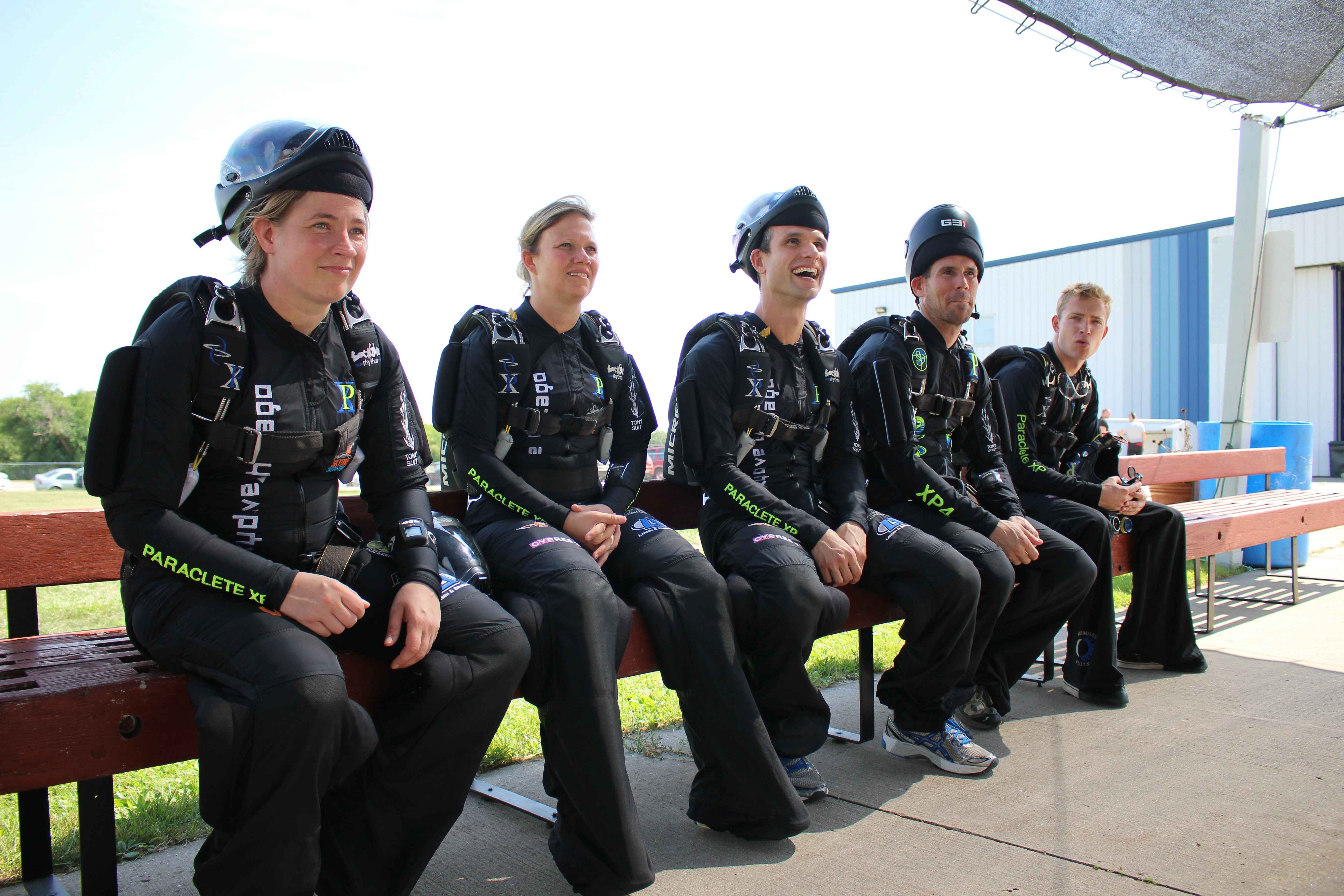
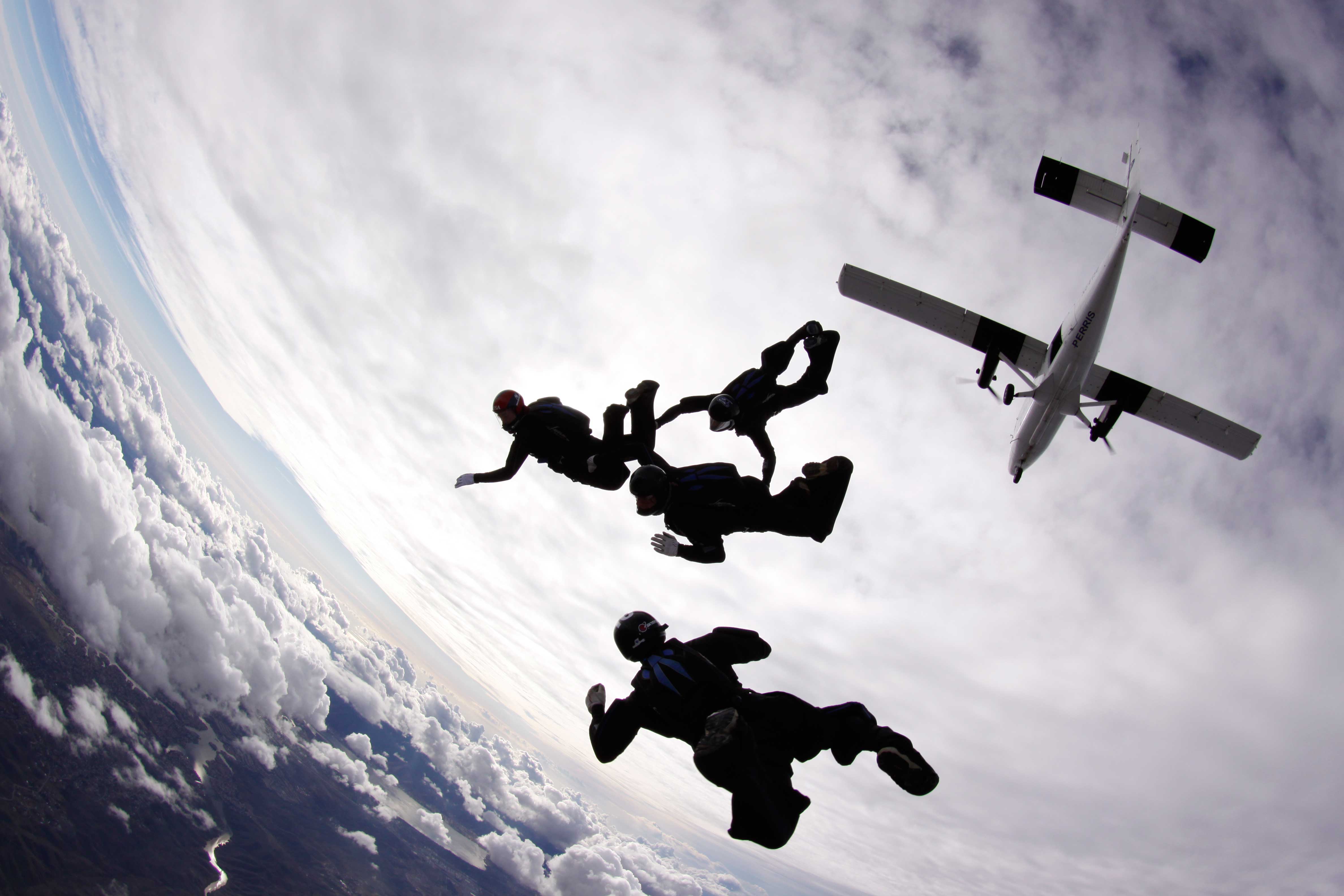
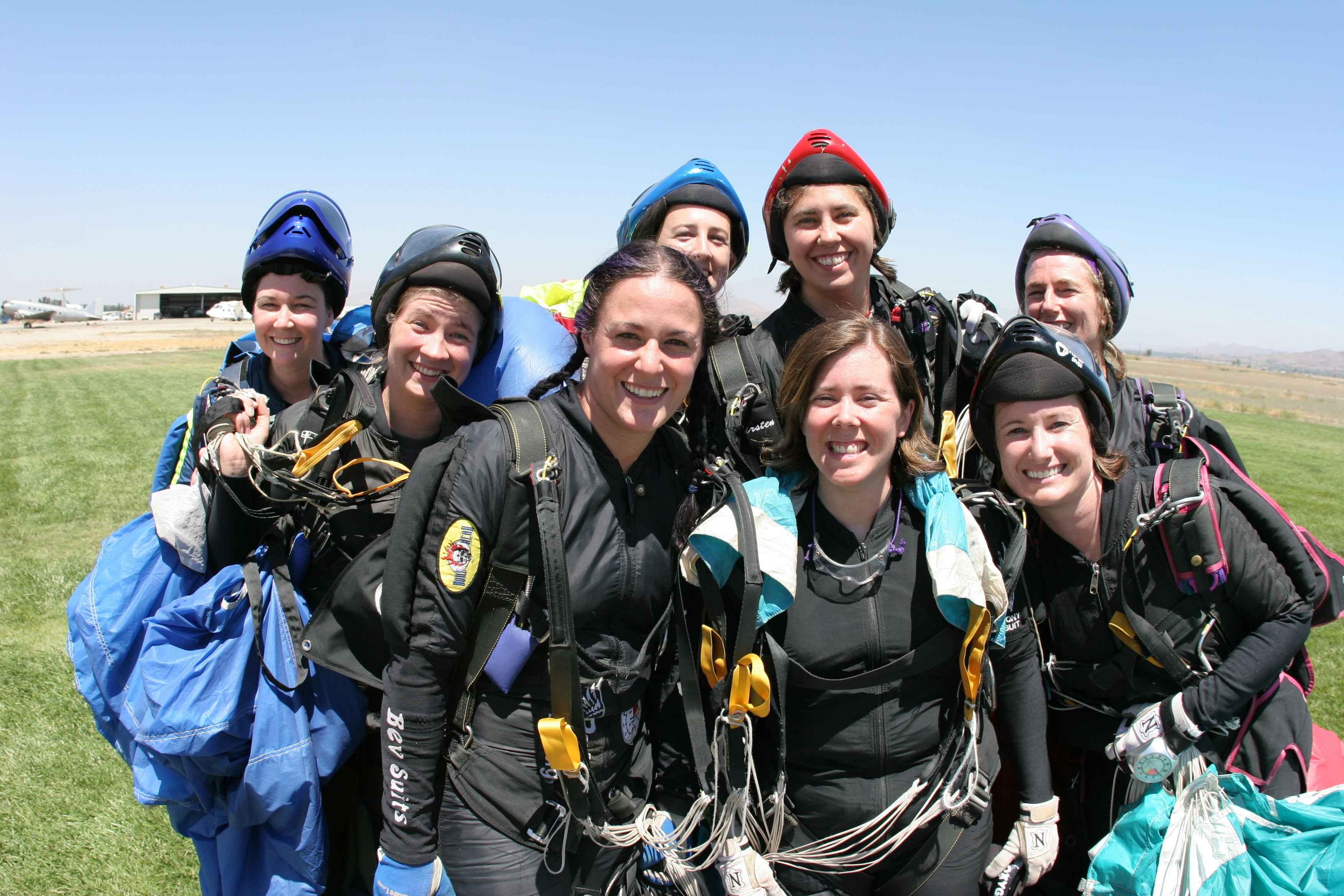
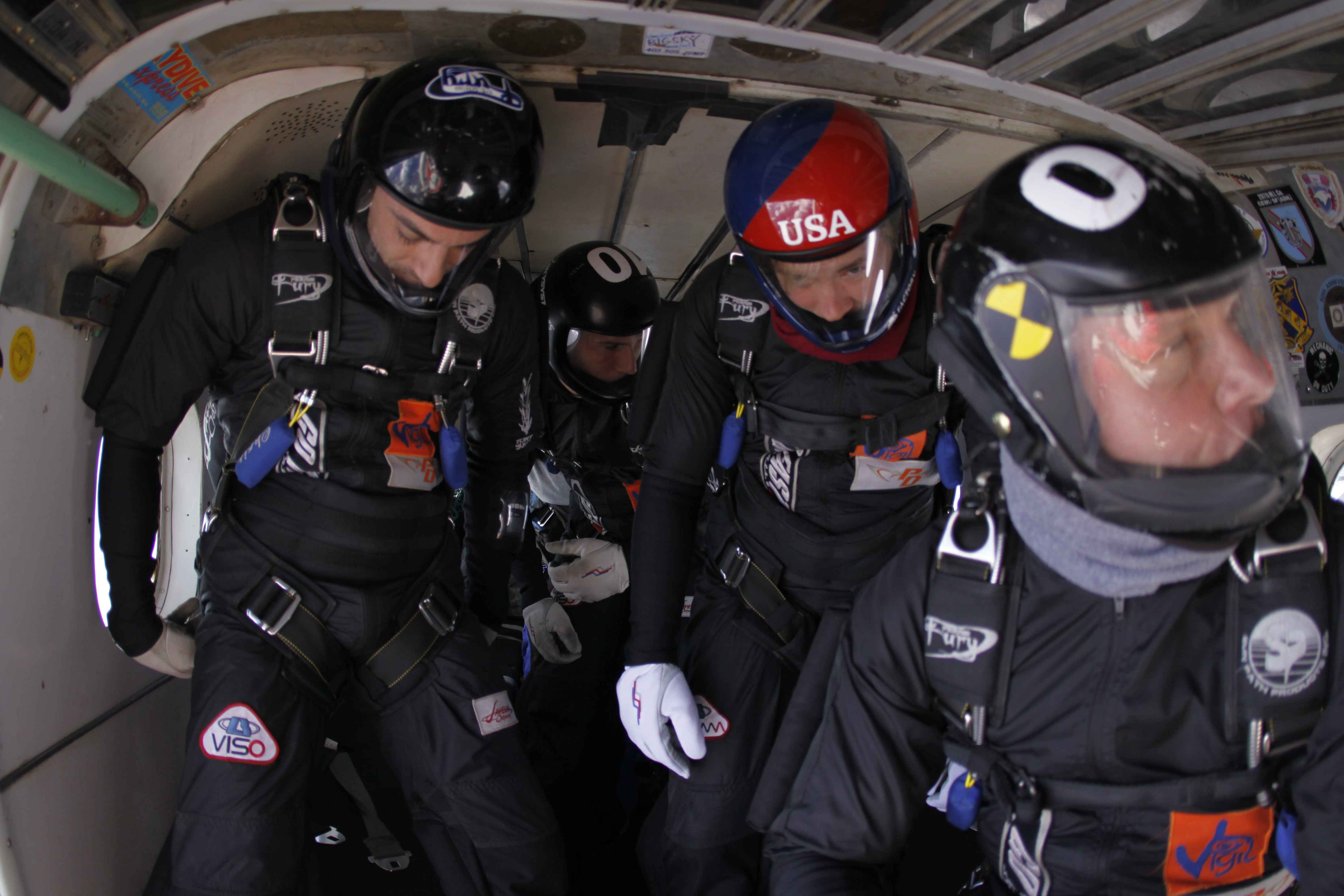
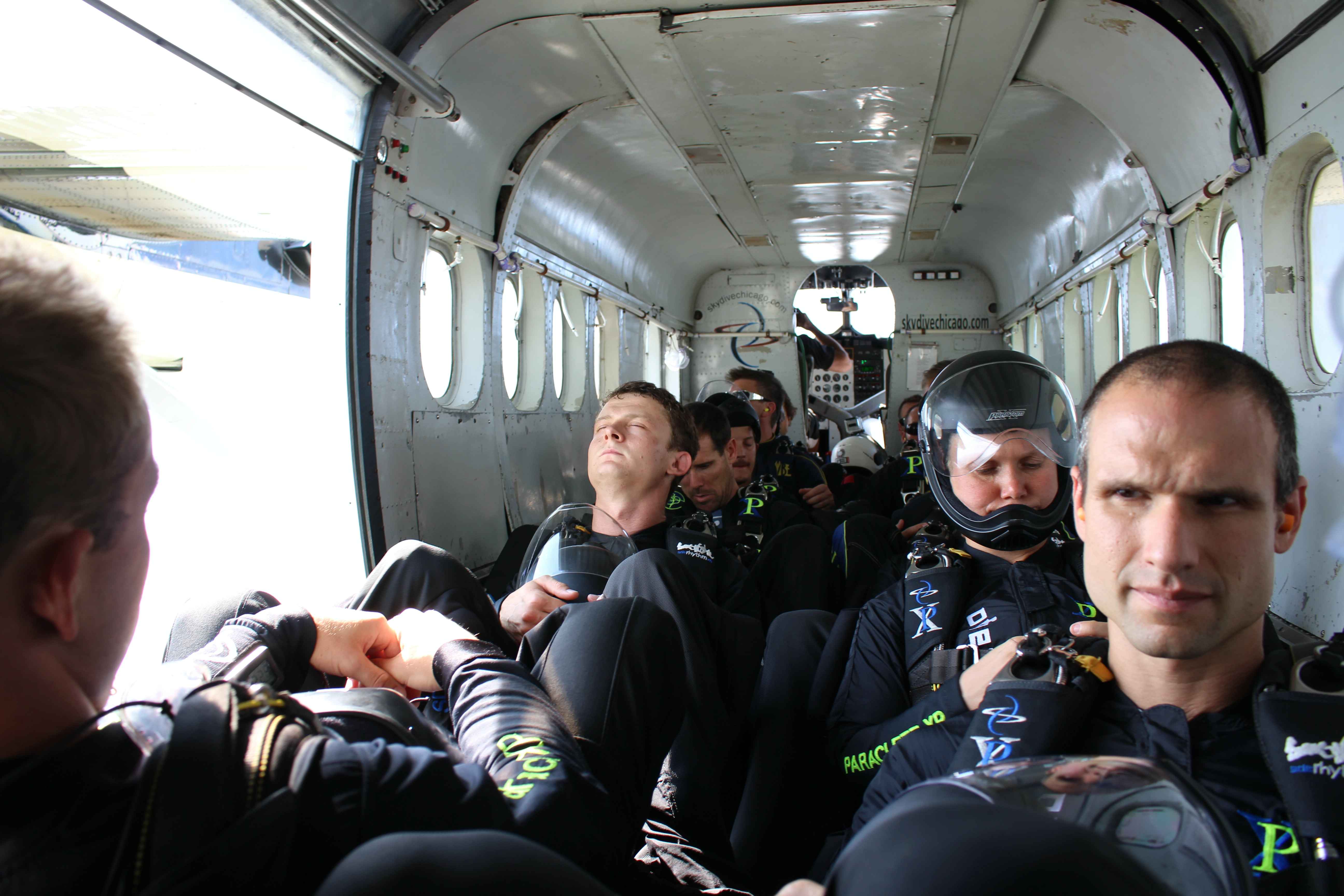
skydivemag.com had lots of amused comments on Facebook regarding the variations in team discussions (ants, trash or chocolate), so this episode we’re including photos of the three teams to see if you can match them up with their drivel. If you don’t know what we’re talking about you need to read Part 1, The Start, before we go on to…
#PLANNING THE DAY
When your team formed you might probably talked about the number of jumps you want to do each day. This is a crucial step in planning and budgeting, but sometimes less experienced teams do not do the math to see if their plan is realistic or desirable. Above all, you want a plan that balances the highest quality jumps with the most effective quantity for the group.
##Fatigue
Fatigue is a bad thing. This point seems obvious when expressed simply, but sometimes teams disregard it when planning. Other teams choose to ignore it under the pretense that it is simply a weakness to be powered through at all times. There is merit to pushing when tired; learning to deal with being worn-out is a phase of a complete training plan. Despite your best efforts you might find yourself a little weary near the end of your day, and this is an excellent chance to practice mental toughness.
However a smart team should use every strategy available to increase their energy and use that energy on their jumps. They choose the right amount of training to make best use of their time and money. This bright group does whatever they can to feel fresh and focused on each skydive and because of it they improve more.
The quality vs quantity scale is a continuum; perhaps a team would be freshest doing 3 jumps a day but this team would still improve a lot more by doing 12 jumps. If that team did 16 jumps that day they would learn some more than if they did 12, but it would taper off sharply. The ideal depends on skydiving experience, team training experience, and physical fitness.
##Length of Day
One of the biggest contributors to fatigue is somewhat counterintuitive. Generally speaking the length of your day has a bigger effect on tiredness than the number of skydives. Experienced competitors will absolutely tell you that 12 jumps in 8 hours is far less exhausting than 8 jumps in 12 hours. When I coach, I advise teams to shoot for about 9 hours on the dropzone and avoid days over 10 hours. This rule is breakable; my team (SDC Rhythm XP) will push longer in weather situations or during certain training phases. However be aware of what you are doing and how you are feeling. You might be wasting your training dollars and torturing yourself for no benefit.
##Momentum
Another concept to consider is momentum. Breaks are bad for energy levels, long breaks are often worse. When you are always busy prepping, debriefing, and jumping it is easy to continue jumping with good energy. However as soon as a break is introduced either from bad weather, a longer call, or an too long lunch break attention levels plummet and it becomes difficult to get the ball rolling again. There is an important art to learning how to enter and exit “stand-by mode” with minimal energy loss. But unless you are trying to specifically train this skill don’t plan for much extra break time on the ground. You will absolutely feel worse than if you maintain a steady pace.
##Ground Time
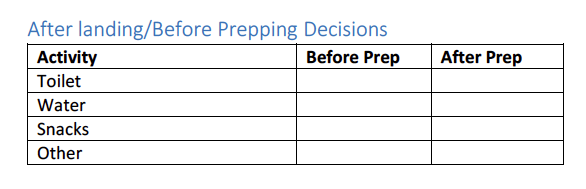
With the length of day and momentum in mind, a team will need to decide how much time to spend on the ground. The right amount of time between loads depends on experience levels of the jumpers as well as the team. Newer jumpers need more time to gear up, land safely, walk in to the packing area, etc. Newer teams need more time to prepare skydives. Make an effort to choose the minimal amount of break that allows the team to land, creep, quickly take care of needs (toilet, snacks, water), and get back on the plane. Aim to motivate efficiency between skydives (or sets) without instilling panic.
##Packing
An early decision to make is whether the team is packing for themselves or hiring packers. Packing for yourself is clearly easier on the budget which could mean more jumps, but has some downsides to weigh. Packing adds to fatigue and reduces the number of jumps that can be made in a day. Even those who can pack in under five minutes will need to consider how it will slow the pace of the day and reduce the jump per day average. In particular if you are hiring a coach consider hiring packers. No sense in having your coach wait around while you pack when they could be telling you cool stuff like “look more, stop sooner, and headswitch later.”
For those of you definitely hiring packers, make sure they know the start time, how many jumps you will be doing, and what your schedule will be. Your training day could come to a screeching halt if the packing team can’t keep up.
Aim to motivate efficiency between skydives without instilling panic
##Efficiency
Between each skydive or set of skydives, strive for exemplary efficiency. Even if you are not turning, hustle back to the packing area as quickly as possible. Drop your gear as quickly as possible. Your team should decide to get snacks and take toilet breaks before or after prep. Once the group decides, stick to the plan. Meet up on the creeper pad or debrief room as quickly as possible.
Make your team’s mission to save these few minutes on the ground before they prep and your day will be easier and more relaxed. More commonly teams are lazy about the time between landing and meeting up. This strategy means someone is always waiting for someone doing something. The problem escalates quickly and instead of having a solid 7 minutes of free time after creeping, the disorganized team ends up cutting prep short and rushing panicked to the plane.
##Eating and drinking
Earlier we discussed the evils of long breaks, and this especially includes long lunch breaks. A better strategy is to think ahead and bring food to be eaten during the day. Easy to eat and drink items placed within easy reach of where you will be running around all day will keep your energy steady. Become a power snacker: there is usually opportunity for eating during debriefs and in short breaks here and there. If you want something more substantial at lunch focus on little or no prep, portability, and food that won’t lead to impromptu plane siestas.
##PACE
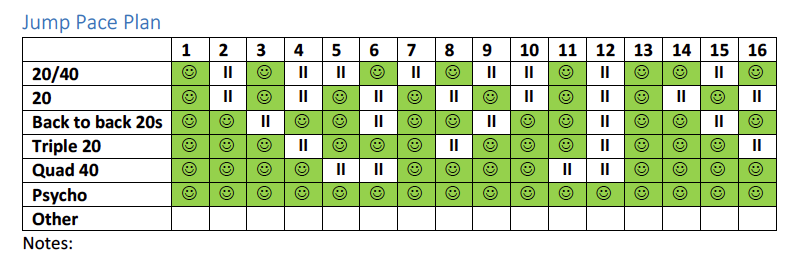
Time to decide what your pace will be. You can of course play it by ear and just manifest when everyone is done packing and ready to go. Doing this loses some of the attractive “well oiled machine” feeling team training provides and runs the risk of unintentional long calls. If you can work with your manifest to choose a pattern ahead of time, the day will feel more methodical and predictable. Fewer breaks, more momentum and a shorter day result in better team skydives.
#Back to backs
Back to backs (also called turns, doubles, triples, quads) allow jumpers to make loads continuously. They allow jumpers to make more skydives in less amount of time, keep momentum up, be more flexible in making different kinds of calls, and are generally very fun. However, they are not the right choice for every team in every training phase.
Before choosing to do back to backs consider the extra gear required, the ability of the team to land confidently, return to the landing area at a jog, and gear up quickly. The team should be experienced enough with FS that they can remember the details from creeping several skydives across each set. Finally back to backs sacrifice some preparation details for quantity, so your current training phase should match this style.
#Sample Pacing
Below are a few common patterns I use with teams. This list is very far from exhaustive and I have lots of tricks up my sleeve for dealing with getting out of sync, coping with unexpected challenges, and seizing opportunities. Looking these over is a great starting point and hopefully provides some inspiration on what your training could look like.
Note that I am using the “20 minute” call as the time between loads below. Some dropzones consider a turn to be 15 minutes instead. The principles are the same, just substitute your own dz’s number to make the pattern work.
##20/40 minute alternating
Ideal for starting teams doing repeated skydives (with packers). The team makes a jump, watches the video during the 20 minutes on the ground, repeats the same jump, watches the repeated video and then prepares a new skydive. This pattern is perfect for teams still learning big picture items like fall rate, looking, stopping, and clean random work since the group gets non-specific learning from the second video viewing (even though they are going to do a different skydive)
##20 minutes repeats (singles)
This pace keeps things moving and is the most common option as team get the hang of their preparation process. The team makes a jump, debriefs the video, repeats it, and then moves on. At the end of the day all of the repeated jumps are debriefed at once. If teams are very efficient, they may be able to keep up with the debriefs even on the short call, but the priority is the preparation.
##Back to back -20s (Up 2, down 1); unique jumps in a set
Team prepares two skydives and does each of them once on a turn. The jumps are debriefed in the 20 minute break before being repeated. Two new ones are then prepped on the next turn. The timing on this allows for good prep (if your team is efficient) and good debriefs. As a bonus the video watching section allows the team to hydrate, nibble, and catch their breath.
##Triples-20s (Up 3, down 1); jump, jump, drill
It is a stretch to creep three jumps in 20 minutes, so a nice option is to prep two real skydives and allow the third jump of the set to be a simple block drill that doesn’t require creeping.
##Quads-40 (Up 4, down 2); unique jumps in a set
As your team gets more psycho (I mean psycho in the best possible way), you might dabble with 4 in a row. The longer call in between allows you prep or debrief 4 in time. Day goes fast and you get lots of jumps!
Please put us on all of the airplanes until we say stop or our packers burn down the hangar
##Please put us on all of the airplanes until we say stop or our packers burn down the hangar
Not a typical plan, this can be done. If you know it is going to be 120 degrees out by 10:30, a thunderstorm is rolling in, or you just want a ton of jumps you can just keep turning and turning and turning. Show up very early and do a mega-creep in the morning. You will absolutely lose a lot of detail from the prep throughout the day, but you will crank out some skydives. You might even get a full day in before those clouds shut things down!
#PERFECT TIMING
Once the team has selected a pace for a training day, you might want to know what to expect for jump numbers. Below is a table that shows my timing estimates for a dropzone running on a 20 minute calls. If you have no prior experience with how training works on your DZ, this table is a great place to start.
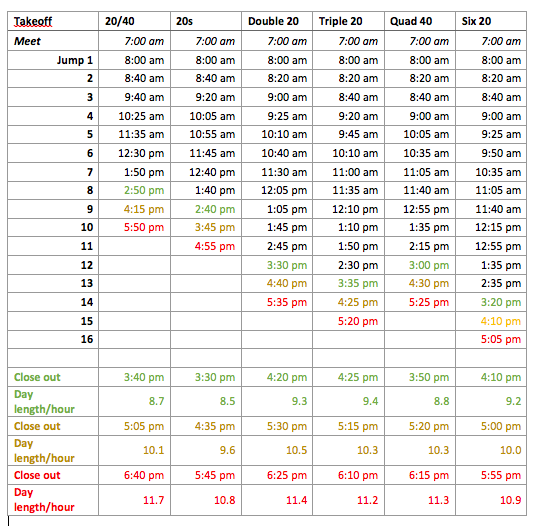
The green times demonstrate a nice full day without having to worry much about fatigue. The yellow zone is a doable but long day. Jumping into the red zone carries a high risk of being unproductive.
The table assumes a five minute fuel load or delay about every seventy five minutes. It shows a meeting time of 7:00am and assumes closeout takes about 30 minutes. It is probably a little on the optimistic side as far as realistic dropzone operation. If you are on a dropzone that runs on 15 minute calls, you can probably add one jump to the estimates over the course of a day.
##TRAINING DAY KEY POINTS
- Fatigue is the enemy; spend your best energy on each skydive
- Tiredness is caused by length of day and momentum as well as jump numbers
- Eficiency in eating, drinking & prepping reduces fatigue & allows more jumps
- Choose a pace appropriate to your experience level and training goals
Next week the final, Part 3, of this article discusses closing out the day and the camp, jobs to assign before the next meeting and those all-important checklists.
Designing your training day, Part 1
Download checklists here, from SDC Rhythm XP’s website, which has a superb section on Resources)