



6 questions people often wonder about skydiving
For people who don’t skydive, the mystique around it can be dizzying. There can be so many assumptions made about the sport, and for good reason – jumping out of an airplane is a pretty weird thing to do.
For most people, their understanding of skydiving comes from movies, things they’ve seen on social media, or myths they’ve had passed down as a fact.
We’d love to clear a few questions up for anyone looking to skydive.
“What if the parachute doesn’t open?”
Let’s just go straight for the big one. The question almost everyone asks first.
Here’s the reality: modern skydiving systems have come so far and there’s a certain amount of confidence in the sport because of this.
Every skydiver jumps with two parachutes: a main parachute and a reserve parachute. The reserve parachute, the backup parachute, is packed from a master rigger who is heavily qualified for that pack job and maintained on strict schedules. Most rigs and most tandem rigs include an Automatic Activation Device (AAD), which will deploy the reserve parachute automatically if the skydiver is still in freefall below a certain altitude.This means: if you somehow don’t deploy your parachute, it will open for you. And if that first one doesn’t open or has a complication, you can get rid of that one and open your reserve parachute.
Parachute malfunctions do happen. That’s not a secret. But they’re anticipated, trained for, and managed. Skydivers practice emergency procedures repeatedly, and instructors train students from day one on how to handle them.
The idea that skydiving relies on “one parachute and fingers crossed” hasn’t been true for decades.

“Can you breathe in freefall?”
You can definitely breathe in freefall. The air is moving past you, and sometimes into your mouth if you have your mouth wide open, but it’s not being sucked out of your lungs. What people often feel is a sort of sensory overload, forgetting to breathe, not suffocation.
The adrenaline and excitement can feel really exhilarating and activating for our senses. Some people hold their breath without realizing it, assuming they couldn’t breathe.
Once you relax, breathing feels normal. A good tip – give a good shout or laugh when you exit, it’ll help you remember to breathe.
“Does it feel like falling?”
Skydiving doesn’t actually feel like falling, not in the way people often think it does.
That stomach-dropping feeling you get on a roller coaster comes from a quick downward acceleration. In skydiving, the plane is moving at a fast speed and as you exit the airplane, you reach terminal velocity pretty quickly and then remain at a relatively constant speed.
Instead of “falling,” skydiving feels more like flying. The sensation is more like moving through space than dropping out of it.
People are often shocked by how calm freefall feels compared to what they imagined. It’s a nice surprise.
“Is skydiving dangerous?”
Skydiving is not without its own risks, and no experienced jumper will tell you it is. But, it’s also much more regulated and structured than most people realize.
Modern skydiving includes:
- Standardized training programs for instructors, coaches, parachute riggers and fun jumpers (casual skydivers)
- Instructor rating systems
- Equipment advancements and standards
- Rigorous maintenance requirements
- Ongoing safety education
Organizations like the USPA (and equivalents worldwide) track incidents and spread awareness to educate how to avoid them, update training standards, and continuously refine the industry’s best practices.
It’s a very regulated and high tech sport, with several bodies ensuring we’re not haphazardly jumping out of airplanes. This is a good thing, and the sport welcomes the furthering of safety culture.

“Can I pass out during a skydive?”
Passing out during a skydive is extremely rare. It’s not a normal or expected experience.
Most people are fully alert from exit to landing. Skydiving is sometimes the most alert people have felt in a long time. It tends to sharpen your focus in the moment, which makes for a fully present jump, but also which is why people can always recall their first skydive in great detail.
It’s not impossible, but for most people it’s very unlikely.
“Do you have to be young or super fit?”
There are some physical requirements for skydiving, such as weight, but the sport is far more accessible than people assume. You don’t need to be an elite athlete.
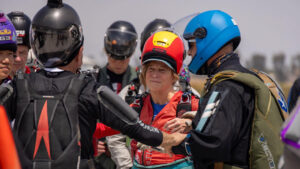
People skydive in their 50s, 60s and beyond. Some first-time tandem jumpers are celebrating milestone birthdays well into their 70s or 80s.
In some cases, people with physical disabilities are also able to skydive. With experienced instructors, additional planning, and modified procedures or equipment, individuals with limited mobility, including some who use wheelchairs, have successfully completed tandem skydives. Each situation is evaluated individually, with safety as the priority.
Most fears around skydiving come from either a lack of information or misinformation. The sport is built on a culture that takes safety seriously, even when it looks wild from the outside.