


Gary’s Skydiving Accident and the Road Back to Life After Paralysis
What would you do if you only had five minutes left to live?
I ask only because I’ve been there. A mile high, neck broken, body paralyzed, dangling helplessly under a canopy at the mercy of the wind. Total silence, as time became my worst enemy, taunting me through my audible as it counted down to impact. Think about that for a moment. Imagine that happening to you. Feel the pure terror.
I’m living proof that no matter how bad things get, when all hope seems lost and you’re staring into the Abyss, the only thing you can do is fight! Never quit, never give up, and somehow, some way, you will make it across the finish line, finding strength in the face of unimaginable loss.
From DEA to DZs
Before skydiving, I lived in another kind of freefall. As a narcotics detective assigned to the DEA, I hunted cartel-level traffickers—one minute laughing with my team, the next kicking in a door with 200 kilos behind it.
During a routine job, a suspect tried to kill me. I fought back, was thrown from his car at 45 mph, and nearly killed by a tractor-trailer. Eleven surgeries later, I was awarded two of law enforcement’s highest honors: the Combat Cross and the Legion of Honor. Then came medical retirement. My life was changed forever.
I went from 100 miles an hour to zero: depression, weight gain, and pain pills, until I woke up and went on a mission to get my life back. Going from 265 back down to 175 pounds. I felt good, but I was missing something.
I decided to fulfill a lifelong dream and get my skydiving license. I had done a static-line jump at Skydive East Parachute Club in Lakewood, NJ, in 1988, and I was hooked. Life happened, and I finally got my A license 33 years later at the end of the 2019 season, then my B and C licenses in 2020. I was 51 years old.
Like a defibrillator, skydiving shocked me back to life; I was reborn with new vigor and a fierce sense of purpose. My heart was flooded with the raw, untamed feeling of being truly alive.

The Jump That Broke Me
Skydiving gave me everything that I was missing: camaraderie, training, equipment, and, of course, adrenaline. I logged 357 jumps in a year. Then came the wingsuit accident. The rental suit didn’t fit; it was too short, too tight. The company I rented it from was kind enough to offer me a replacement, but out of pride and arrogance, I politely declined. What could go wrong? I had a reserve canopy.
When I got to the drop zone the day of my accident, I felt uneasy. The feeling was sharp, urgent, and everything felt wrong. I ignored it, suited up, and boarded the plane. As I took the ride to altitude, the tension rose with each passing second. The light by the door turned green, and I exited the plane.
My wingsuit was too short, pitching me into a steeper, head-down angle and forcing me to fly faster than usual. My audible began beeping, and I deployed my canopy. I immediately realized that I hadn’t taken into account the increase in speed from the new suit. My canopy hit the wind and opened extremely “hard.” I was going way too fast, and I didn’t slow down enough!
My head snapped back. I heard the loud CRUNCH of my neck breaking.
Instant paralysis from the neck down. Luckily, I could move my head and had sporadic movement of my left hand. A mile high, unable to grab my toggles, unable to steer or slow down. I was in serious trouble. I suddenly realized that I was going to die, and I had the next five minutes to think about it.
Five minutes is a long time, and it’s a flash. It’s a long time when you imagine all the ways you’re going to die. Impaled by a tree, drowned in a lake, hit by a tractor-trailer on some random highway. On and on. I died a thousand times, a thousand different ways, in my mind.
It’s a flash when you realize it’s all over in five minutes. Everything is gone. When they say your life flashes before your eyes, they aren’t kidding. I thought about my wife, my kids, my dogs!
I felt small, like a speck of dust floating around. I thought about how the world would keep on turning, except I wouldn’t be here. Nothing would change. It would be as if I were never here. It’s a very humbling experience. It instantly rips the ego right out of you. You could be the richest guy in the world, the toughest guy, or the best-looking; it doesn’t matter. You’re still going to die in five minutes.
I said to myself, I’m going to die, but I’m going to die fighting. I’m going to die fighting like a warrior with my sword in my hand. I wasn’t going to float off on some glorious last ride! No way. But what could I do?
I realized that I still had a few tools in my toolbox. I planned my opening in a spot where I knew the wind would be at my back and would carry me toward the drop zone. If I did nothing, I would float right past it. I was too high; I needed to burn off altitude. I did harness inputs using my head to make wide 360-degree turns, hoping to crash near the drop zone so that someone could find my body.
My audible beeped: 900 feet, 600, 300. Each beep, a stark reminder of my impending doom. I was about to learn what the hardest thing in skydiving is: the ground. I hit a chain-link fence next to the DZ at 40 mph. It flipped me, absorbed the impact, and amazingly, saved my life. Thirty feet away was a pool. Had I landed there, I’d be gone.

Hospital Hell
ICU. No movement or feeling from the neck down. My body was a coffin, and I was a prisoner, locked inside. My mind was a battlefield, my worst enemy. No hope, no happy ending here. The thought of life, helpless, unable to move, was unbearable. I had to escape. I tried unsuccessfully to swallow my tongue and choke myself to end it. Planned to drive a wheelchair into a bus. That’s where your mind goes when hope is gone.
Your mind can launch you into greatness or drag you down into the lowest pits of hell. I thought about life as a quadriplegic and used that as motivation to keep going with the PT. After emergency surgery on my neck, the Doctor explained that he replaced my two obliterated discs with titanium cages and that my spinal cord wasn’t severed but severely damaged. Chance of walking again? Bad. The neurologist said the odds were “One in five million.” I didn’t like the odds, but I was grateful for the chance. I had lost all connection to my muscles from the neck down, so I had to relearn everything. The task was overwhelming, impossible. I was now 53 years old, and about to see what I was made of, again. I had one chance of walking out of that hospital, and I wasn’t gonna blow it. I would walk out or die trying!
Physical therapy was hell but I embraced it. Marines call it “embracing the suck.” United States Marines know how to thrive when things suck. Five hours a day, every day. Inch by inch, I clawed back. First a toe, then a finger. Months later, I walked out of that hospital. Limping, stiff, numb, but walking. No wheelchair. No walker or cane. Clean.

Fighting Back in the Sky
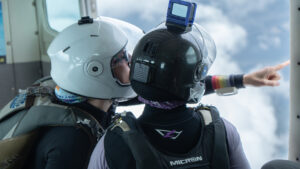
Being discharged from the hospital wasn’t the end. The world was much bigger and faster than the hospital, and I knew that for my sake, I had to jump again. Skydiving wasn’t about proving anything; it was about reclaiming my life on my terms.
But the stigma of breaking my neck followed me. Most people had decided for me that I would never skydive again. Friends turned away. Drop zone managers refused. My injuries reminded them of their own mortality. Depression crept back.
Only one person stood up: Shauna Finley, owner of Skydive Shenandoah. She risked everything to give me a shot. I called her up and asked for help. Shauna acted like a true leader and agreed to jump with me, and I am forever grateful. Four weeks later, I was in Virginia, still unable to tie my shoes, button my shirts, pants, or hold a fork properly, but ready.
I had done that jump hundreds of times in my mind, while lying motionless in that hospital bed. We boarded the plane. Quiet and with resolve. We jumped; freefall went well. I deployed my canopy; it opened. My neck was okay. Relief flooded in. My life changed again.

108 Jumps Later
Since that day, I’ve logged 108 more jumps. I still have limitations. My body reminds me with constant pain. So what! I jump anyway. Because skydiving for me is more than jumping out of a plane, it’s confirmation that I’m alive.
Skydiving gave me back my fight. It stripped away excuses. No more victimhood. No more pity. Just the raw truth: if I can jump out of a plane two miles high after I broke my neck, couldn’t move, couldn’t feel. I can do anything; Accidents take. Recovery gives. Mine gave me perspective, humility, and a second chance. I wish it never happened, but I’d be a fool not to use the gifts it left behind.
We can’t change the past, but the past can change our future. It can drag you down like an anchor or guide you like a compass. The choice is ours. I chose to jump. And I’ll keep jumping. As human beings, we sell ourselves short. We underestimate our ability to persevere through extreme hardship. When we think we can’t take anymore, of course we can.
Survival is a mindset, a decision, not a wish. When you decide you’re gonna achieve your goals or die trying, you become unstoppable. Before you can win in life, you first have to win the battle in your mind. Control your mind, and you control your destiny. Crossing the finish line takes discipline, mental toughness, and an absolute belief that it’s possible. Surviving requires courage, resilience, and an absolute refusal to quit.
The great boxer Jack Dempsey said it best: “A Champion is someone who gets up when they can’t.” I urge you to find the champion inside yourself and never stop fighting. I could rebuild…You can rebuild.