




How Mason Corby sets goals as a skydiver, and how he used this method to build his entire career
Goal setting in skydiving gets talked about a lot, but not many people actually do it in a structured way. Most people know what they want, but they don’t know how to break it down, how to measure it, or how to be honest about where they currently are on the path.
For me, this process has shaped my entire flying career. From the early days when there were no tunnels in Australia, to competing, coaching, creating events, running Downunder Dynamics, and eventually building my name internationally. I didn’t get here because I was naturally talented. I got here because I learned how to set goals properly.
Here’s how I do it.

Photo by Cam Puttee
Start With the Big Goal
The first thing I do is picture the end state. Not a trick, not a move, and not something vague like “get better.” I define what kind of flyer I want to become.
A long-term goal for me has looked like this:
I want to be a flyer who can manage complex group flying calmly and predictably.
I want to become the best coach and organiser I can possibly be.
I want the ability to fly in any position, in any environment, with anyone.
Long-term goals are about identity and capability. They are about who you become, not what move you can do. You can’t set a path until you know the destination.
Break the Big Goal Into Smaller Steps
Most people know they should break big goals into smaller ones, but this is where the first major mistake happens.
Short-term goals only work if you know exactly where you stand right now, and most people skip that part.
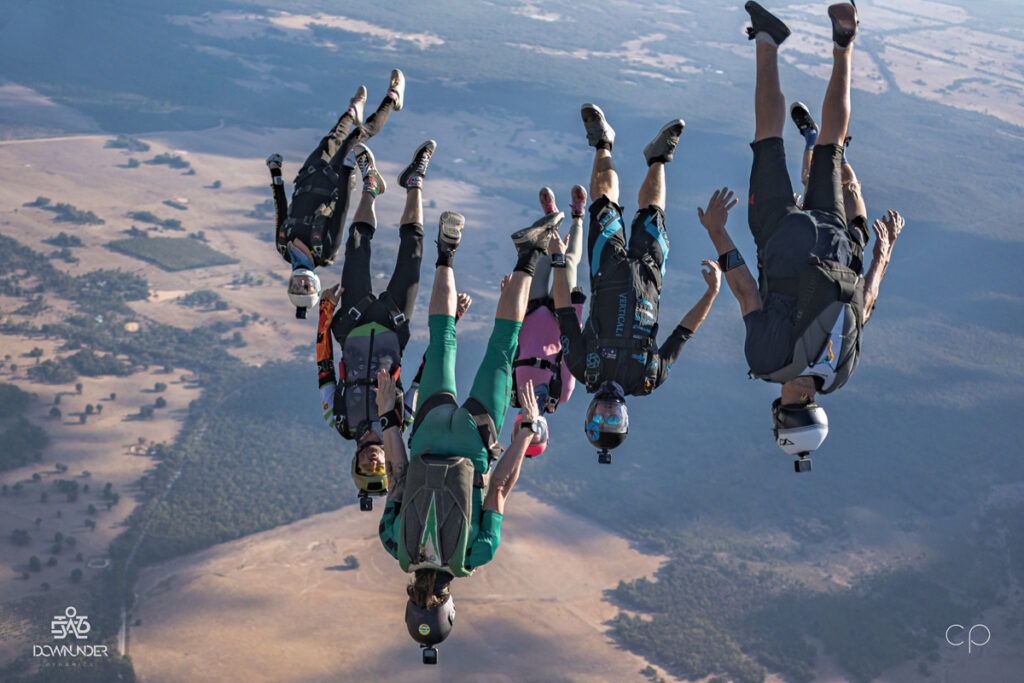
Photo by Cam Puttee
The Step People Miss: Honest Self-Assessment
This is the one that makes or breaks everything.
People ask what they need to do to reach their goals. The real question is where they actually are right now. Most jumpers overestimate their position on the path. If you don’t understand your current level, your plan won’t start in the right place. You can’t build a house if you don’t know which floor you’re standing on.
How I Did It Back When There Was No Tunnel in Australia
In the early days, going through the vert was not common and definitely not easy. It wasn’t even called “through the vert.” We used to call it an “all abouty.” To fly it properly you needed strong fundamentals: head-down, back angles, belly angles, awareness, discipline, and repeatability.
I thought I had all that until I got chewed out for doing the wrong thing and realised I wasn’t as far along as I believed. That moment forced me to reassess honestly and rebuild the right way.

My Multi-Year Progression Plan
Once I accepted where I actually was, I broke my development into years, not weeks or months.
Year 1 was angles. Mostly back angles because back angles and head-down support each other and build natural control and awareness.
Year 2 was head-down. I spent almost a full year working on nothing but clean head-down, solid headings, stability, and control.
Year 3 was belly angles and leading. This is where I learned what real leadership feels like in the sky.
Only after all of that did I finally go through the vert. Not because I forced it, but because the foundation was ready. Did I stick to the plan perfectly? No. I took breaks and did fun jumps every 10 or so jumps, but no more than 2 jumps off the chosen sub discipline’s path. Everyone needs variety. But the structure kept me progressing even when I wasn’t motivated.
The Breakthroughs Happen When You’re Struggling
Any time I plateaued, I knew a breakthrough was coming. Most people bail out at that exact moment because it feels boring or frustrating. But boredom is where mastery hides. Struggle is where refinement happens. Repetition builds the flyer you rely on under pressure.
If you don’t abandon those moments, they reward you with massive jumps in skill.

After Vert, My Next Phase Was Base jumping
I spent a full year focusing on being a strong base jumper. 6 months of ground crew before being even able to jump, Close work with mentors and learning everything about equiptment, progression, and managing fear and the ego. It became a platform for everything I did afterward.
Then I Levelled Up: Travel, Tunnel, All In
After building a real foundation, I started travelling out of Australia and took tunnel seriously. I trained then lived overseas, surrounded myself with the best coaches at the time and threw myself fully into tunnel flying.
In the beginning I gave myself two full years dedicated to just in the tunnel with minimal skydiving only on the 2nd year. I trained, competed, coached, learned, and improved every part of my flying. This was the transition from a good flyer to a professional one.
Then I Evolved Again: Events, Competitions, Teaching, Legacy
After tunnel immersion, my focus changed. It wasn’t just about personal flying skills anymore. It was about giving back and building my legacy. I created competitions, coaching events, Downunder Dynamics, Body Piloting Championship’s, Object Boogie and ways for the Australian freefly scene to grow. My goals became community-driven, not just performance-driven.
And that created a completely new long-term path.
Burnout: The Higher You Climb, The Wider Your Foundations Must Be
One thing I figured out pretty early on is that progression only works if your foundation is solid. Climbing fast without it feels good for a while, but eventually you topple, and when you do, the fall is a lot bigger than you expect.
Burnout isn’t just being tired. I’ve hit it myself plenty of times, and I’ve watched even more people around me hit it so hard they never came back. Burnout doesn’t just fry your body or your mind. It strips away the illusion. It forces you to confront questions most people avoid.
Questions like:
Why am I doing this?
What did I expect this to feel like?
Was my goal driven by passion, or was it driven by ego?
When your goals come from ego, burnout exposes that quickly. When they come from your core, from something deeper and more honest, you bounce back stronger. When they don’t, your soul pulls you in a different direction, and if you ignore that, you end up stuck in a loop of doubt and exhaustion.
The key is recognising the signs early and easing off before you hit the wall. You have to understand what drives you, not just what you want to achieve. Once you know your “why,” you can protect it.
Douggs once told me something that stuck with me for life. He said you can operate at full capacity, but not forever. If you sit at one hundred percent for too long, mistakes creep in. Systems start to fail.
It’s healthier to live around seventy percent. That gives you room to slow down, room to accelerate, and room to adapt. You can push to one hundred when it’s needed, then taper back and recover. That rhythm is what kept me progressing without burning out completely.
Where I Am Now
Right now I’m in the phase of maintaining my fundamentals, refining my teaching, protecting my longevity, and setting myself up to keep improving into older age. Currently Im at 75% and ramping up after I’ve spent the last 6 months rebuilding my strength and mind after operating at 110% for some time. I’m enjoying the downtime but looking forward to a change in direction and putting my foot on the peddle again.
The most important part of progression at this stage is simple. Know yourself and Know your limits, so you can push them properly and get the best out of yourself for as long as you can.