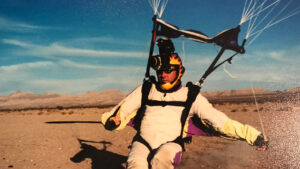




Long-time jump pilot Dean Ricci takes you through a full day flying at a busy DZ.
Being a pilot at a mid-sized or large dropzone, it’s pretty easy to be invisible. You’re the arm up front. Perhaps an ear. Occasionally, you’re the glint off a pair of Ray-Bans as you glance over your shoulder to see why the door hasn’t opened as the green light comes on. It’s not hard for people to ignore the girl or guy up front, especially, and this is key, when everything is running smoothly.
It’s even easier to understand why a lot of jumpers have no real grasp of what’s going on in the cockpit. That being said, how about we take a look at a day in the life of a jump pilot at a busy turbine operation, and get a glimpse of how it all flows from the seat up front.
Preflight: Catch It Before It Happens
You as jumpers have heard it (hopefully) a million times or more: gear check, gear check, gear check. It’s a simple mantra every skydiver should use. One of the most valuable lessons I ever learned in skydiving was that the easiest way to deal with a malfunction is to catch it on the ground before it ever happens, and it’s exactly the same with the aircraft.
For the sake of this conversation, the aircraft I’ll reference throughout this article will be the Twin Otter. It’s the bird I have the most time and experience in, and as far as turbine jump ships go, it’s probably the most popular and widely used one out there.

Photo by Raymond Adams
Walkaround: Every Detail Matters
As you’re starting your day, getting that morning coffee and making your way toward the DZ, your pilot (or pilots) is most likely already at the aircraft, performing what should be a meticulous preflight of their bird. Usually done with a coffee in hand, I would always start on the outside of the Otter at the captain’s door and work my way clockwise around the aircraft, checking not only the general condition of the bird as a whole but also a detailed inspection of all the important components.=
The nosewheel, steering linkage, and locking pin that connects the lower arm to the upper for steering on the ground are especially important. I’ve had that locking pin fail on me, work its way out on load seven of the day, and throw me into a serious situation on touchdown as I worked to bring the Otter to a stop with a nosewheel behaving like a wonky shopping cart wheel…all with water on both sides of a narrow runway. It was an interesting landing that thankfully worked out well.
Systems Check: Inside the Cockpit
Just like checking your rig, your pilot is looking at everything. Are the propellers ready? Is there any previously unseen damage from a bird strike? Are the propeller blades dinged from FOD (Foreign Object Debris)? Do the flaps extend and retract properly? Does the door open and close?
The exterior walkaround is usually a solid fifteen to twenty minutes, especially if you weren’t the last pilot to fly the aircraft that day. Once inside, it’s much the same. Now you’re powering up and checking all systems that can be tested without the engines running.
Once the turbines begin to spin, the next set of checks begins. That’s when your pilot is increasing engine power, making the props cycle, and verifying everything is operating correctly before committing to flight.

Photo by Coell Studios
Takeoff: Go or No-Go
From the moment the turbines spool up, your pilot is constantly thinking: go or no-go, continue or abort.
Is the power coming up correctly? Okay, go.
Are the pressures and temperatures where they should be? Okay, go.
Is anything or anyone on the runway? Okay, go.
The entire takeoff roll is a continuous decision-making process. It’s far better to abort on the ground than deal with a problem in the air. This phase of flight is critical, and from takeoff through the first thousand feet, it’s never a good idea to distract your pilot. They’re fully loaded.
Climb: Controlled Chaos
During the climb, especially on load one, the pilot is managing multiple inputs at once. They’re checking winds aloft, scanning for traffic, communicating with ATC, coordinating with manifest, and possibly talking with other aircraft.
It’s busy, but it’s a controlled kind of busy—and for many pilots, a fun one.
Jump Run: Timing, Awareness, and Experience
Preparing for jump run involves checking ground speed, setting lights, monitoring jumpers, and coordinating with the ground. Once the green light comes on, it becomes a balancing act of aircraft control and exit awareness.
The pilot knows the load. They know there are solos, belly groups, freeflyers, AFF students, and tandems. They know who’s fast, who hesitates, and who takes forever. Chances are, the person up front knows more about your exit than you do.

Photo by Coell Studios
Descent: Still Not Relaxed
After the last exit, the job isn’t done. The pilot begins descent while continuing to monitor systems, communicate on the radio, and scan for traffic. As they descend into canopy airspace, vigilance increases. Unexpected openings, cutaways, or traffic conflicts are always possible.
Then it’s land, reset, check paperwork, and do it all again.
High-Volume Operations: Repetion With Total Awareness
At larger dropzones, this cycle repeats twenty to forty times a day. Each load demands the same level of focus and discipline.
On formation days, the complexity increases. Pilots coordinate with other aircraft, adjust for performance differences, and maintain precise positioning. It becomes a coordinated aerial system, not just a single flight.
The Bigger Picture: Consistency Is Safety
There’s a real dance happening up front. The pilot is just one part of the system, but a critical one. The way they handle normal operations shapes the day. The way they handle abnormal situations can define it.
The best compliment I ever received was from a jumper who said they had no idea who was flying the plane all day. That meant consistency. That meant predictability. That meant safety. No one showing off. No one making it about themselves. Just steady, consistent flying: safe, vigilant, and aware.