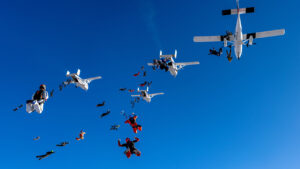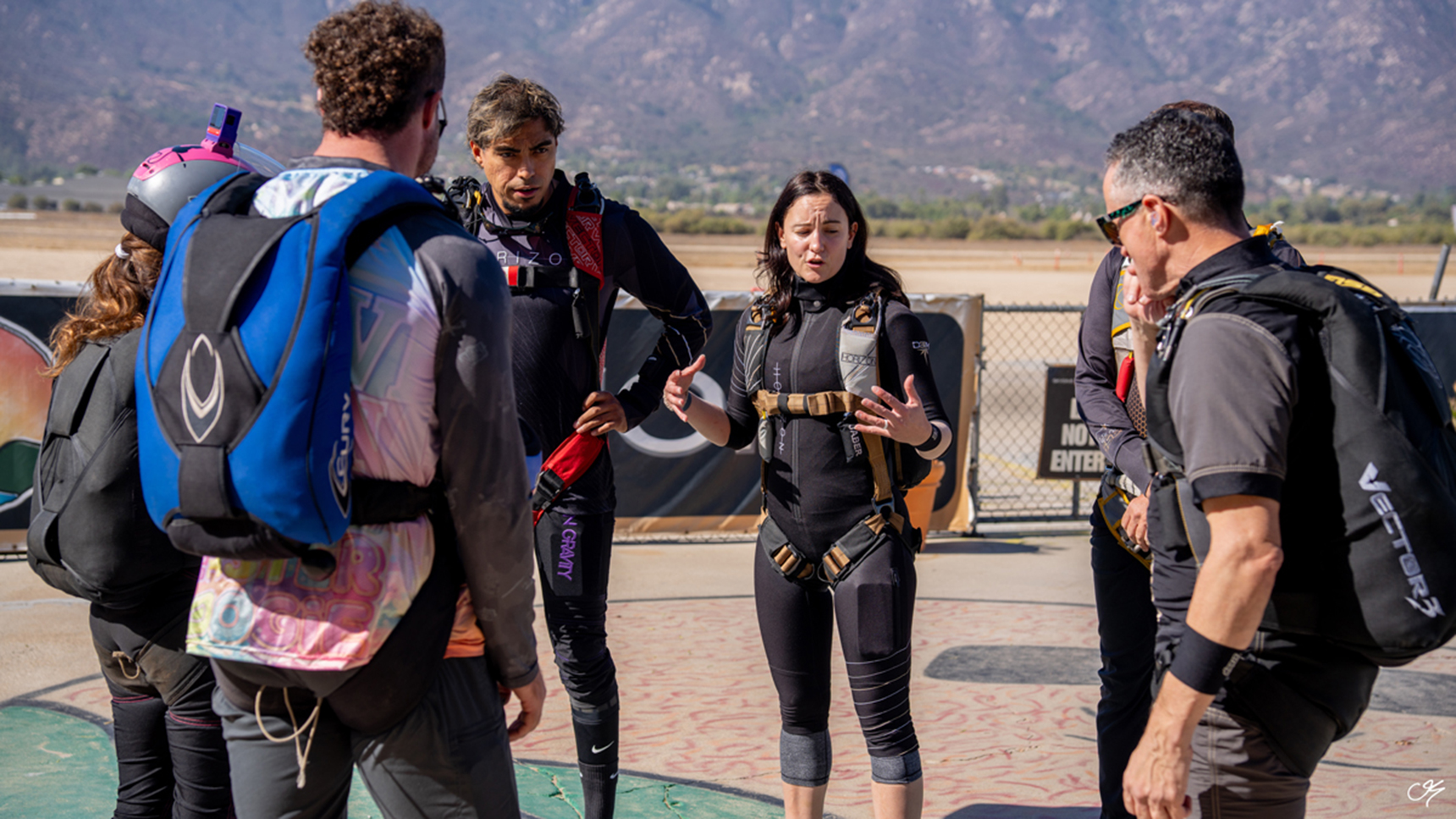




From finding a rig that fits to keeping up in freefall and choosing the right canopy, smaller skydivers face challenges that aren’t always obvious to their larger peers. Emma Jaber shares what she’s learned about making her size work for her in the sky.
Hi I’m Emma Jaber. I’m 50kg or 110pounds. I’ve been skydiving since 2018 and have learned a lot about succeeding in a sport where most people are bigger than me.
Being a smaller human comes with a unique set of challenges and I’ve had to navigate the best pathway for myself. From finding equipment that actually fits, to keeping up with larger humans in freefall and understanding how my size affects canopy performance.
Being small doesn’t have to hold you back. You just need to understand how to work with your body size. Here are some considerations and tips to help you on your skydiving journey.

Gear Fit
Gear fit is super important! If your rig is too large, it can shift around on your body during freefall, deployment and canopy flight. Any movement can affect stability, accessibility of handles and overall control of your equipment.
When a container doesn’t fit you, you may find yourself changing your body position to counteract the way it’s pulling you. Got a tendency to always slide to the right? It might be your rig taking you for a ride!
As a smaller human, most containers will be relatively large on your body, even new gear that is made for you. Wearing a belly band or having a container re-harnessed to your size are cheaper options that can help resolve gear fit issues. It’s important to work with a qualified rigger and follow the manufacturer’s recommendations to determine whether a belly band or a re-harness is appropriate for your equipment.
It can be difficult to find second hand gear that fits perfectly. Don’t compromise on harness fit simply because you’ve found a good deal. Look into whether it’s possible, and worth the cost, to re-harness a second hand container before you purchase it. Finding a rig that fits your canopy sizes and fits your body are both equally important.
When purchasing a new rig, look at the width and length measurements of the containers suitable for your canopy sizes and choose one that fits your body best. Manufacturers offer different shapes and sizes for this exact reason. Start by looking at containers that fit your main and reserve sizes, suitable to your skill level, and then select the best container shape for your body. Ask your rigger or contact the manufacturer to discuss additional options, like lateral placement, to help get the best possible fit.
All skydivers should consider how their equipment fits during different types of skydives. A rig that feels reasonably secure in a belly to earth position might behave differently when participating in back flying, sit flying, head down or movement jumps. Only participate in skydives that your rig is suitable for. If your rig is moving around or affecting your flying in any way, focus on a different discipline until you have a container that fits you properly.
Your gear should support your progression, not introduce unnecessary risks.

Body Flight
Differences in body size, weight, surface area and equipment all influence how we move through the air. Understanding these differences can help you become a more efficient flyer.
You weigh less than your peers, that’s just facts! Due to the lack of weight, you may find it harder to build up speed or maintain momentum. But there are things you can do to help stay with the formation.
Dressing for success is one of the easiest ways to help manage your freefall speeds. If you’re a smaller human, wearing less drag is going to help you increase your fall rate. Think about the type of flying you’re doing and the people you’re flying with before choosing your outfit for the day. On certain jumps, you may need to wear a weight belt. Depending on the type of skydive, a weight belt can be a huge advantage in giving you range with your freefall speeds. There isn’t one perfect outfit for every discipline, but understanding how clothing affects your performance gives you another tool to work with.
What you look like in freefall is going to be very different to larger humans. You may be heavily arched on your belly while someone else is as flat and stretched out as they can be. You might be in full speed on a track/angle while others are using brakes. Don’t worry about comparing what you look like. Do what you need to do to be on the skydive.
One technique to consider during free fall is cutting corners. This can help keep you on a skydive. It isn’t about taking shortcuts at the expense of safety or cutting across another jumper’s flight path. You just may not have the range to fly the exact same parallel line as the leader and still stay with the formation. So make your line shorter. Keep moves as small and as vertical as possible, relative to the jump plan. When walking the jump, walk like you want to fly it. For particular sections your moves and your line might need to be smaller or shorter than the rest of the formation to keep you in it.
Positioning yourself to an advantageous place within the formation is another way to shorten your line. Always think about where the formation is going and the best place to be for each move. If you are a smaller human and the formation is about to go into a diving move, you definitely don’t want to be higher than the leader! It’s easy to become focused on completing a transition, turn or maneuver, only to discover you’ve lost your place in the formation. Understand where the skydive is going and position yourself efficiently while respecting the jump plan and assigned slots.
Timing matters! You don’t have the same ability to generate speed or maintain momentum as someone with a bigger body size. When the leader gives a key, it’s important that you are not only positioned advantageously but that you react quickly. Falling behind only makes it harder, as it can take you longer to build speed again. Practice improving your reaction time on the ground and even outside of skydiving. When you visualize the jump, focus on the parts where you need to be quick.
Understand what can influence how you fly relative to others and fly to your body size.

Canopy
Canopy design, size, flight characteristics, environmental conditions and experience all play significant roles in how well you land your canopy. Being a lighter skydiver can also affect your canopy flight. Understanding how these factors relate to you will help you make better decisions when landing.
Canopies respond differently depending on how they are loaded (how much weight is underneath them). Two skydivers flying the same canopy model can experience very different flight characteristics depending on their wing loading. Smaller humans often find themselves flying at lower wing loadings than their peers, particularly when flying larger canopies appropriate for their experience level.
At lighter wing loadings, a canopy may feel less responsive in certain maneuvers, like a harness turn. Your canopy may have different turn characteristics, dive behavior and recovery. The flare can also feel different when compared with the same model flown at a higher wing loading. Research canopies that are suitable for your wing loading. Manufacturers provide recommended wing loading ranges for different canopy models, and some designs perform better at lighter wing loadings than others. Take the time to understand these differences and choose a canopy that works well for your weight, experience and flying style. If you’re unsure, reach out to the manufacturer or a reputable canopy coach for advice.
A smaller human may have less forward ground speed when flying into stronger winds. Gusts, turbulence or changing wind directions can make landing more challenging for someone with a low wing loading. Don’t assume that because other people are jumping, the conditions are appropriate for you. Establish personal wind and condition limits based on your experience, equipment (including reserve size) and available landing area. Due to your lower wing loading you may need to stop jumping before others. Know your personal limit and stick to it!
Having a low wing loading is not a reason to downsize! I cannot stress this enough!! A smaller canopy is not necessarily going to solve your landing troubles. In fact, it may make them worse. Your bad habits only become more obvious, and you have less margin for error. Smaller canopies can behave differently from larger versions of the same model. They may be less forgiving of certain piloting errors due to shorter line lengths and less fabric contributing to more aggressive handling characteristics. It’s beneficial to become a better canopy pilot on the one you already have.
Your experience, consistency, awareness, landing accuracy and ability to handle challenging situations are what you should consider before downsizing. Any decision to downsize should be made with guidance from an experienced canopy coach who understands your current skills and equipment. Find a reputable coach that has experience coaching smaller humans. And remember there is absolutely nothing wrong with staying on a larger canopy.
Understand your canopy’s full performance range and develop the skills to fly it confidently. Make canopy training a part of your progression, not something you only do when you’re thinking about down sizing. Be the boss of your canopy!

Conclusion
Ultimately, being a smaller human does create some unique challenges in skydiving, but none of them prevent you from becoming an exceptional skydiver.
Find gear that fits properly. Learn how to use your body efficiently. Develop the awareness to anticipate movement rather than constantly reacting to it. And make canopy decisions based on your skills and situation rather than comparing yourself with others.
Being small doesn’t mean you can’t keep up. It just means you might need to approach things a little differently.