
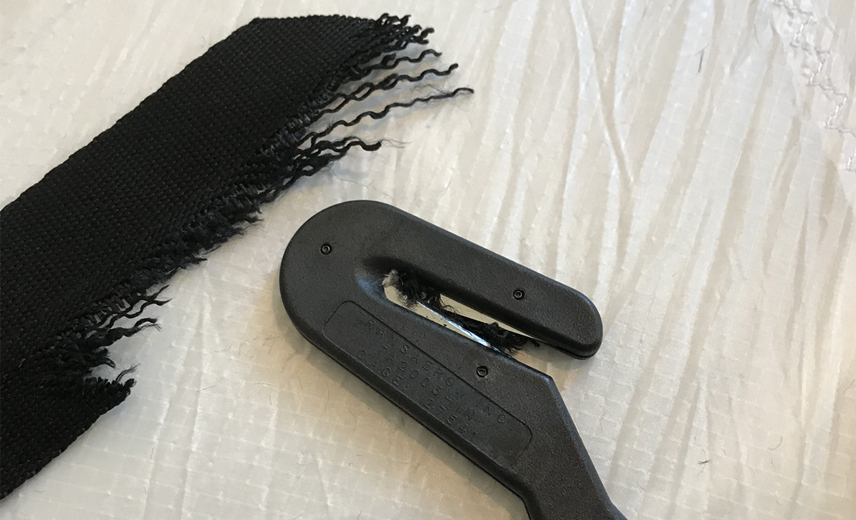





Luis Adolfo Lopez Mendez explains why the hook knife is safety equipment and how it saves lives
I see more and more skydivers jumping without a hook knife. When I ask them why, 99.9 percent answer that they lost it and didn’t want to buy another, fearing they’d lose it again.
So the question is: are hook knives a crucial component of your equipment? For me, the answer is indisputably yes, and I’d like to share why.
Your skydiving rig is composed of many parts, including risers and lines from both your main and reserve parachutes. Any of these can create an entanglement that may need to be cut in order to save your life or the life of someone else.
There is plenty of data and real-world footage showing how a simple tool that costs around $40 can save a life. We spend huge amounts of money on jumps, containers, canopies, reserves, AADs, helmets, suits, and more, yet we hesitate to replace a lost hook knife.
If you’re thinking, “When would I really need a hook knife?” here are several real-life scenarios that have already happened.

Line or equipment entanglements
- Lines can get caught on a helmet, camera mount, rig, around your body, another jumper, or the aircraft itself. This can happen during a normal or unexpected deployment.
- A wingsuit, camera suit, or jumpsuit can get caught on the aircraft.
- A line-over can occur on a reserve.
- Another jumper can become entangled on the door or tail of an aircraft, especially smaller planes with more snag points.
Risers getting jammed
The cutaway cable can become jammed, and cutting a riser may be the only way to safely deploy the reserve.

Aircraft emergencies
In a plane emergency, a hook knife may be needed to quickly cut a seatbelt, exit the aircraft, or free someone else.
All of these scenarios have happened in real life. Recently, many of us saw footage of a jumper whose reserve deployed at the door at full altitude and wrapped around the tail of the aircraft, leaving the jumper entangled and stuck. The hook knife used to free himself undoubtedly saved both the jumper and the aircraft. Without it, the outcome could have been catastrophic.
I can’t think of a reason that justifies jumping without a hook knife. In my opinion, it should be mandatory, just like an AAD. To move toward that standard, we need more awareness.
Instructors, coaches, leaders in the sport, and experienced jumpers all play a critical role. Newer jumpers look up to you and copy your behavior. Lead by example. Carry a hook knife. Show that you care about your equipment and emergency procedures. Thinking you don’t need a hook knife because you’ve never needed one before is the same logic as jumping without an AAD because you’ve never needed one in the past. That mindset is complacency and underestimates how quickly things can go wrong.

Photo by Gustavo Cabana
Hook Knife Placement Matters
If you don’t have a hook knife, order one. If the placement on your rig causes you to lose it, ask your rigger to change the location. I have over 23,000 jumps and have lost only one hook knife because I chose the right placement.
Better to have a hook knife and not need it than to need it and not have it.


