




Tandem, AFF, and your A-licence: the complete cost breakdown
Most people who are curious about skydiving run the same search at some point. They want to know how much it’s going to cost before they commit, and yet almost every result they find either gives a vague range, focuses on one country, or buries the real number in small print.
So here it is, straight: if you want to go from your very first tandem jump to a fully licensed skydiver, you’re looking at somewhere between $2,500 and $4,500 USD all in, depending on where you train, how quickly you progress, and what extras you add along the way.
That’s a big range, and that range is exactly what this article unpacks. We’ll walk through the cost of a one-off tandem, the full AFF training program, and the final steps to your USPA A-license. We’ll also look at global price differences, what your money actually buys, and the hidden costs that most guides forget to mention.
| Quick summary: the numbers at a glance |
| One tandem skydive (USA): $200–$350 |
| One tandem skydive (UK/Europe): £150–£250 / €170–€280 |
| One tandem skydive (Australia): AUD $250–$400 |
| Full AFF course through A-license (USA): $1,800–$3,000 |
| Total beginner to licensed (all in): approx. $2,500–$4,500 |
| All prices are approximate 2026 figures. Always confirm with your dropzone. |

Your first tandem: what does it actually cost?
A tandem skydive is the most common starting point, and for good reason. You’re harnessed to a fully qualified instructor who handles everything, your ground training takes around 20 minutes, and within a few hours you’re freefalling from altitude. It’s the fastest, most accessible way to find out whether skydiving is for you.
Prices vary quite a bit depending on where in the world you jump:
| Region | Typical range | What affects the price |
| USA | $200–$350 | Altitude (8,000–14,000 ft), location, group rates |
| UK | £150–£260 | Altitude, charity jumps differ |
| Europe | €170–€280 | Country, facility, season |
| Australia | AUD $250–$400 | Coastal/scenic locations command premium prices |
| Dubai | $450–$600 USD | Palm DZ is a premium experience |
A few things worth knowing before you book:
- Altitude matters. A jump from 10,000 ft gives you roughly 30 seconds of freefall. From 14,000–15,000 ft you get closer to 60 seconds. Many dropzones offer the lower altitude at a base price and charge extra to go higher.
- Video and photos are almost always extra. Budget an additional $80–$150 USD if you want footage. It’s worth it!
- Group rates are common. If you’re booking with friends, ask about discounts before you pay individually.
- Weekday vs weekend pricing. Some dropzones charge more on weekends due to demand. Jumping midweek can save $20–40.
A tandem skydive isn’t just a bucket-list tick. It’s also the best way to answer the question: do I want to do this for real?
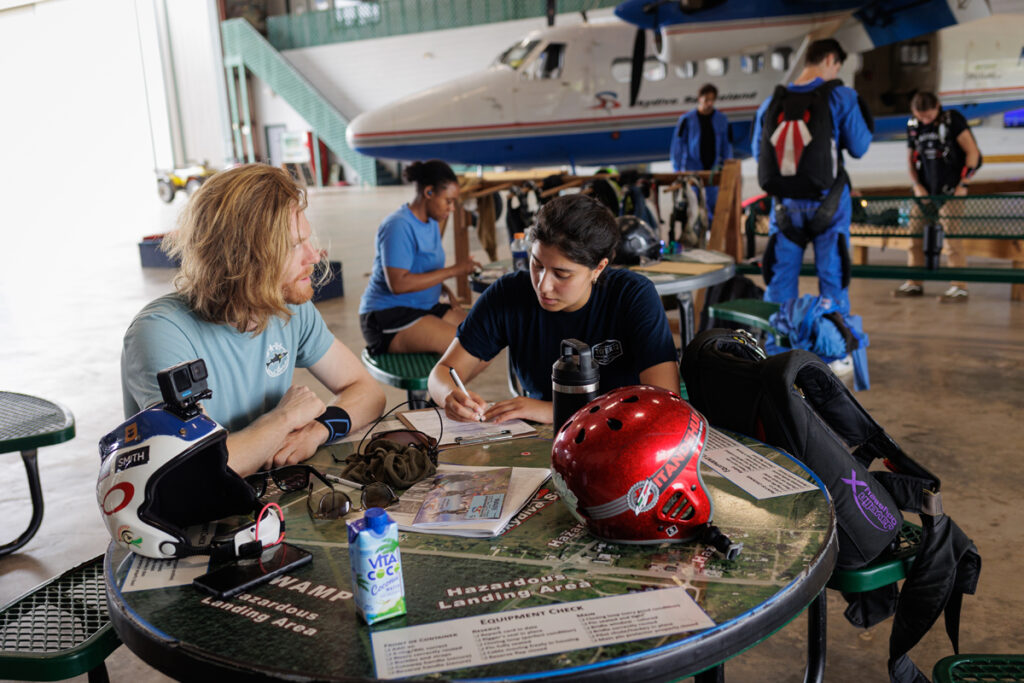
Photo shared by Skydive Spaceland
The AFF course: what it costs to learn to skydive properly
AFF, Accelerated Freefall, is the internationally recognized training program that takes you from complete beginner to solo skydiver. It’s made up of structured jump levels, each building on the last. In the early levels, two instructors jump with you and hold onto you in freefall. By the final levels, you’re flying solo while an instructor flies alongside you. In all of these levels, you deploy your parachute and land your canopy alone. Although, for many levels, your instructor will be able to guide you via radio safely back to the landing area.
After completing all the structured levels and reaching a total of 25 logged jumps, you qualify to take the USPA A-license exam, which is a written and practical assessment that, once passed, lets you jump independently at USPA-affiliated dropzones anywhere in the world.
AFF costs in the USA (2026)
In the United States, AFF programs are typically priced in one of two ways: pay-as-you-go per level, or a bundled package that covers the full 25-jump curriculum upfront.
| What you’re paying for | Pay-as-you-go | Bundled package |
| Ground school / first jump course | $150–$200 | Included |
| Levels 1–3 (two instructors) | $250–$280 each | Included |
| Levels 4–7 (one instructor) | $200–$250 each | Included |
| Consolidation solo jumps (8–25) | $50–$85 each | Included |
| Gear rental (throughout) | Usually included | Included |
| USPA membership (annual) | ~$85 | Sometimes extra |
| A-license application fee | ~$25 | ~$25 |
| Typical total | $2,000–$3,000 | $1,800–$2,500 |
The bundled package is almost always better value if you’re committed to getting licensed. One AFF bootcamp, for example, covers the first seven jumps for $1,838, with solo jumps completed at your own pace after that. Pay-as-you-go works better if you’re not sure you’ll finish, or if you need to spread the cost over a full season.
AFF costs outside the USA
The AFF model is used globally, but pricing and structure differ between countries:
- United Kingdom: Expect £1,500–£2,200 for a full AFF program through to A-license. BPA membership (£100–£130) is required and is separate from jump costs at most British dropzones.
- Europe: Programs typically run €1,400–€2,500, with Eastern European dropzones (Poland, Czech Republic) often offering significantly lower pricing for equivalent quality.
- Australia: AUD $1,500–$2,500 for AFF through to license, depending on location and whether tunnel time is included in the program.
- New Zealand: Similar to Australia. Coastal scenic locations (Queenstown, Wanaka) cost more but offer extraordinary views throughout training.
| Can I do AFF without doing a tandem first? |
| Most dropzones strongly recommend at least one tandem before starting AFF. |
| Some require it; others allow you to go straight in. |
| If a tandem is built into your AFF program (common in the USA), it may count as your Level 1 jump. |
| The practical benefit: a tandem answers ‘can I handle this?’ before you pay for the full course. |
Hidden costs: what the headline price usually leaves out
This is where most cost guides fall short. Here’s what to budget for beyond the jump fees:
- Repeat jumps. Most students need to repeat at least one AFF level. Build in a 10–20% contingency on your AFF budget.
- Currency gaps. If you let more than 30 days pass between jumps, most dropzones require a refresher jump (≈$70–$100) before you can continue.
- Packing fees. Your main parachute needs repacking after every jump. This is sometimes included in student fees, sometimes not. Ask your dropzone. Typically $5–10 per pack job.
- Tunnel time. Many coaches recommend wind tunnel time to build freefall skills faster. An hour in a tunnel costs $500–$900 USD but can save you multiple repeat AFF levels. Optional, but worth knowing about.
- Gear for post-license jumping. Once you’re licensed, you’ll want your own rig eventually. Second-hand complete setups start around $3,000–5,000. New gear runs $8,000–15,000+. But this is a post-license decision, not a beginner cost. You can rent gear in the meantime.
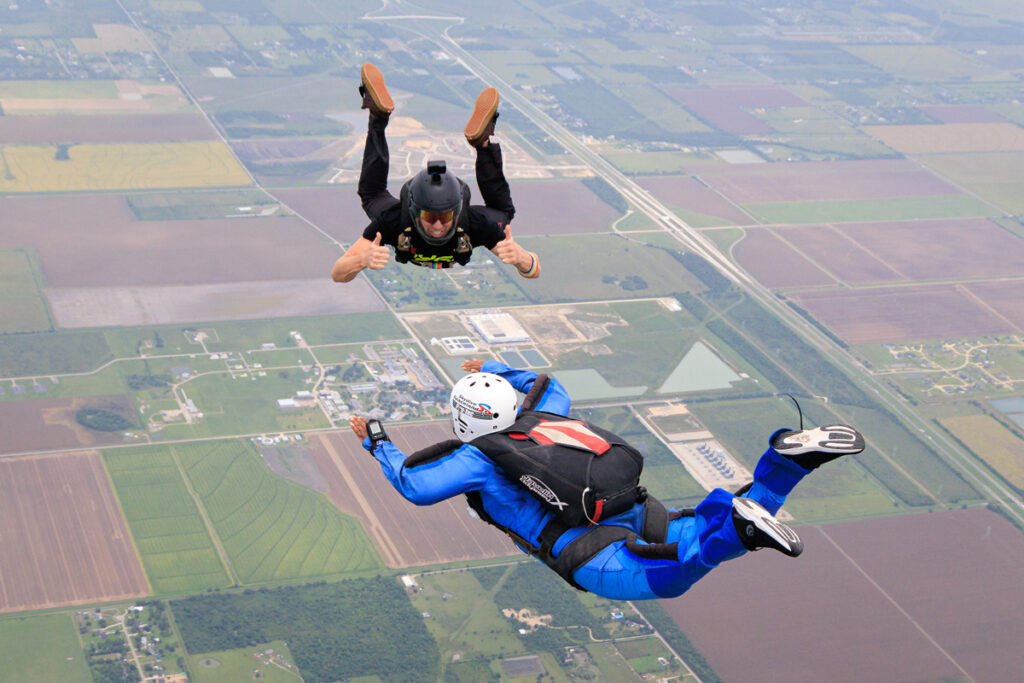
Photo courtesy of Skydive Spaceland
The full cost: tandem to A-license, all in
| Stage | USA (USD) | UK (GBP) | Australia (AUD) |
| One tandem skydive | $220–$300 | £160–£220 | AUD $270–$380 |
| AFF ground school | $150–$200 | Incl. in prog. | Incl. in prog. |
| AFF Levels 1–7 | $1,200–$1,800 | £900–£1,400 | AUD $1,200–$1,900 |
| Solo consolidation jumps (8–25) | $500–$900 | £400–£700 | AUD $500–$850 |
| Membership fees (annual) | $85 (USPA) | £120 (BPA) | AUD $80 (APF) |
| A-license application | $25 | £20–£30 | Incl. or ~AUD $50 |
| Video on tandem (optional) | $80–$150 | £60–£120 | AUD $100–$180 |
| TOTAL (excl. optional) | $2,160–$3,285 | £1,600–£2,470 | AUD $2,050–$3,260 |
These are ranges based on real 2026 dropzone pricing. Your actual total depends on progression speed, location, and the specific dropzone you choose. Always ask your dropzone for a full program breakdown before you start.
Is it worth it?
That depends entirely on what you’re chasing. If you want a single experience to tick off a bucket list, a tandem is $200–$350 and it will be one of the most memorable days of your life!
If you want to become a skydiver, someone who can show up at any dropzone in the world, jump with others, and build genuine skills in freefall, the AFF route to an A-license is the only real answer. And compared to learning to fly a plane, getting a motorcycle license, or picking up scuba diving, the all-in cost is actually reasonable for a lifetime skill, experience and sport.
The skydivers who get the most from the money they spend are usually the ones who commit to a plan before they start: pick a dropzone, understand the full cost, and build in time and budget to complete the program without long gaps between jumps.
What to do next
- Read: Your First Tandem – What To Expect.
- Read: What’s in an AFF course?
- Read: How to choose a dropzone for your first jump.
- Subscribe to Skydive Mag’s monthly newsletter for skydivers at every level.