




What Patrick Lencioni’s teamwork pyramid can teach us about building safer and stronger large formations
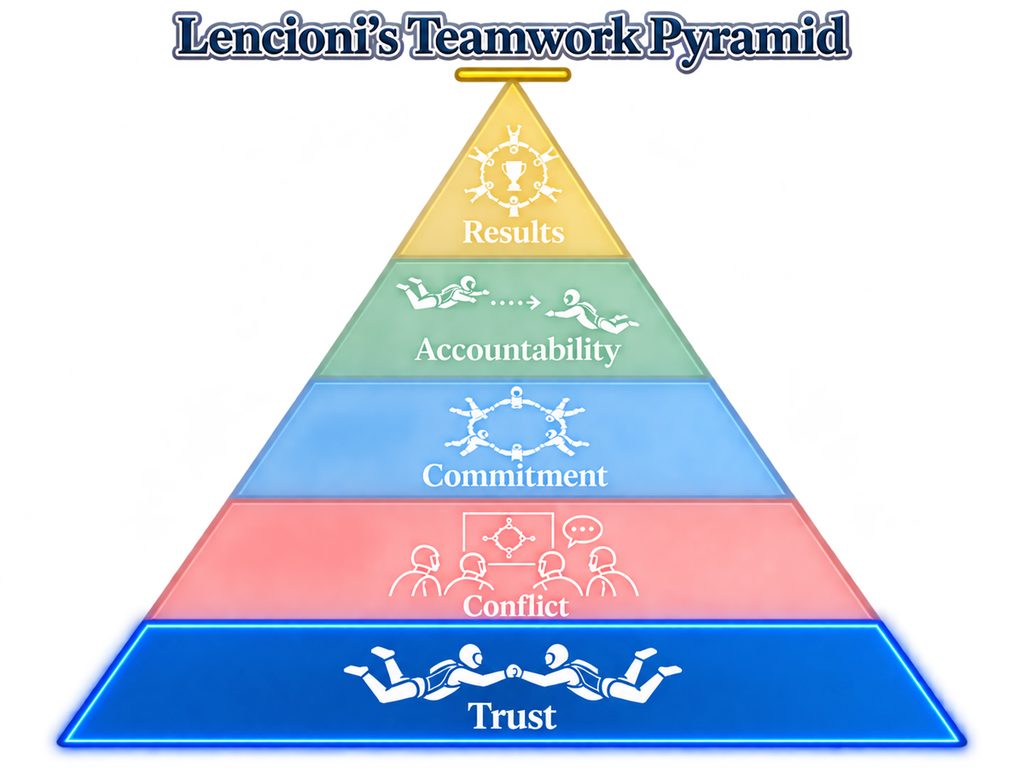
Patrick Lencioni developed his model of five team dysfunctions for organizations, but there is the logic behind it useful far beyond the meeting room. In its positive form, the model describes five conditions that build on each other: Trust, Productive Conflict, Commitment, Accountability and Team Results.
Trust provides the foundation. Without it, people avoid difficult conversations; without open discussion, commitment becomes weaker; without commitment, accountability is difficult; and without accountability, attention easily shifts away from the common result.
Bigway skydiving makes this sequence unusually visible. A large formation brings together many individuals who must prepare, decide, communicate and then execute different tasks inside one shared plan, often with very little possibility to correct someone else’s mistake once the jump has started. The model therefore gives us a useful way to look beyond flying skills and examine the teamwork that makes a bigway safe and successful.
Level 1
Trust: The Formation Starts Before Exit
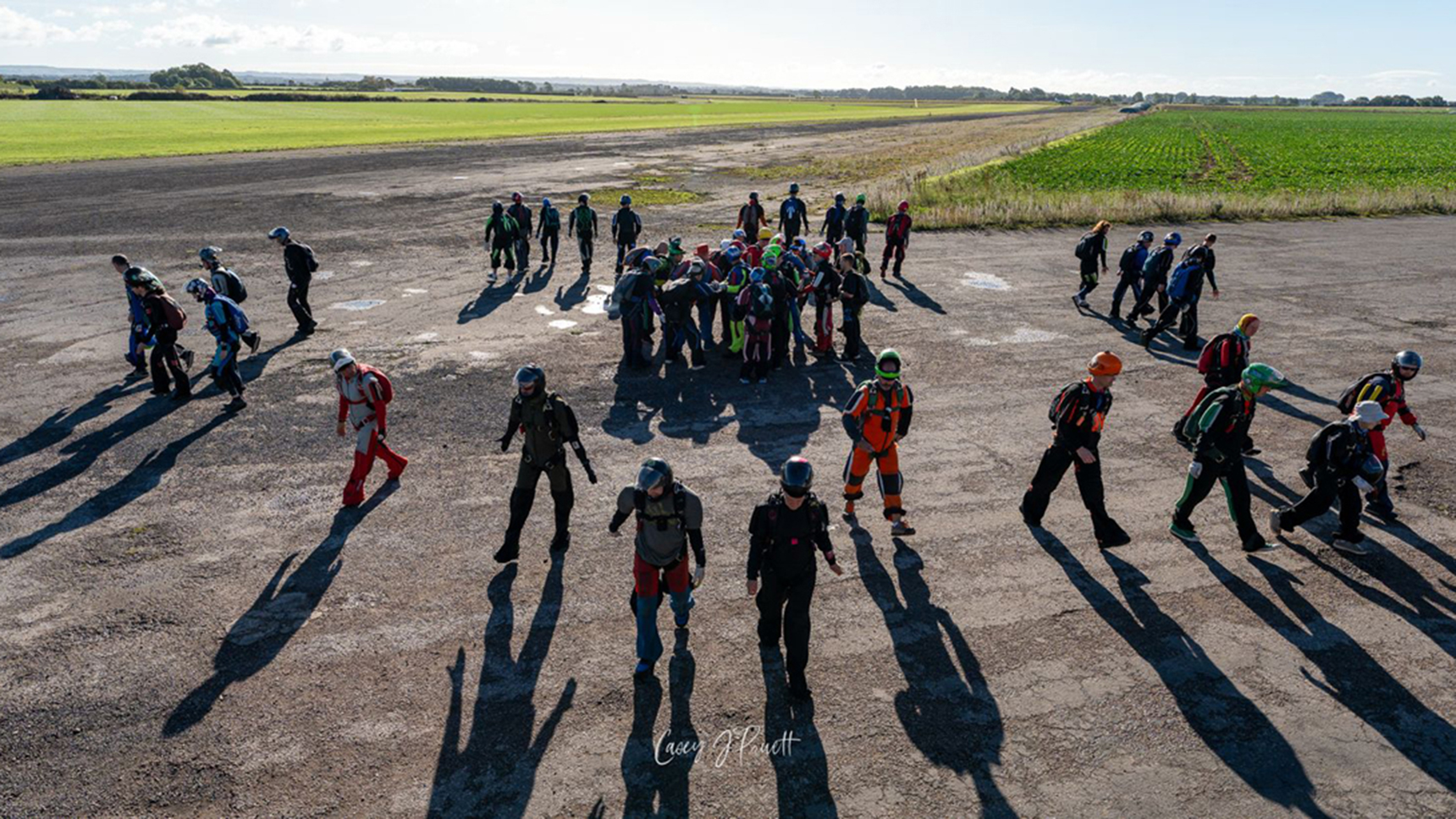
After more than 25 years in skydiving, I still find bigway events slightly strange. We spend hours on the ground preparing something that, if everything goes well, exists for only a few seconds. Organizers design the formation, plane and sector captains work with their groups, pilots prepare the aircraft procedures, camera flyers plan their positions, and jumpers repeatedly study the same diagrams, exits, radials, approach patterns and break-off plan. Then we board several aircraft, separate from one another, and somehow expect dozens or even hundreds of people to arrive at precisely defined places in the sky.
It works only because we trust people we cannot control. Once I leave the aircraft, I cannot fly somebody else’s slot. I cannot make another jumper track in the correct direction, open at the correct altitude or follow the landing pattern. By that point, most of the important work on trust has already been done.
This is why I find Patrick Lencioni’s teamwork model so relevant to bigway skydiving. He puts trust at the bottom of his pyramid, below conflict, commitment, accountability and results. That makes sense to me, although for understanding trust itself I prefer another model that I have used for many years in my professional work: the Trust Equation developed by David H. Maister, Charles H. Green and Robert M. Galford.
Their equation is:
Trustworthiness = (Credibility + Reliability + Intimacy) / Self-Orientation
I did not originally learn this model for skydiving. I used it in leadership and team development, and only later did I start noticing how accurately it describes the people we want around us on a big-way.
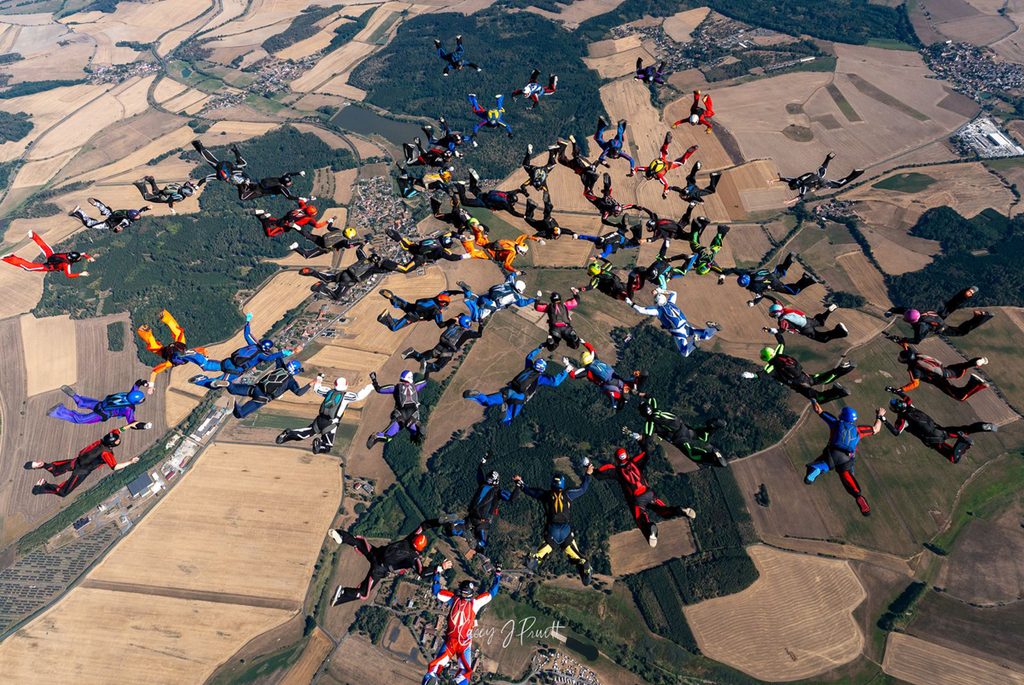
Photo by Casey Pruett
Credibility: Do you really know what you are doing?
In skydiving, credibility becomes visible very quickly. Someone can tell you how many jumps they have, which events they attended and which names they know, but the important information starts appearing when the door opens.
Bigway credibility requires much more than stable belly flying. A jumper needs to understand the language of the event, know the formation, understand the exit order and be able to perform from different positions, whether floating, diving or working close to the base.
Then comes orientation, which is where many technically decent skydivers discover that a big-way is a different problem. You need to know your quadrant and your radial, have reference points inside the formation, and know who is closer to the center, who is outside you, who should already be there when you arrive and what the formation should look like from your direction. Simply aiming for your grip is usually not enough.
The last part of the approach is micro-positioning. You arrive in the area, reduce speed, match the level of the formation, stop in the correct place and only then take the grip. If you use the grip to stop yourself, you arrived too fast. I have always liked the simple test: if the grips disappeared, would you still remain in roughly the same place? That tells me more than a firm handshake after landing.
Credibility also continues after break-off. Tracking, separation, deployment altitude, canopy awareness, predictable pattern and safe landing are not secondary skills added after the interesting part of the jump. On a large formation they are part of the qualification. A jumper who is excellent during the formation and unpredictable after break-off is not fully competent for that environment.
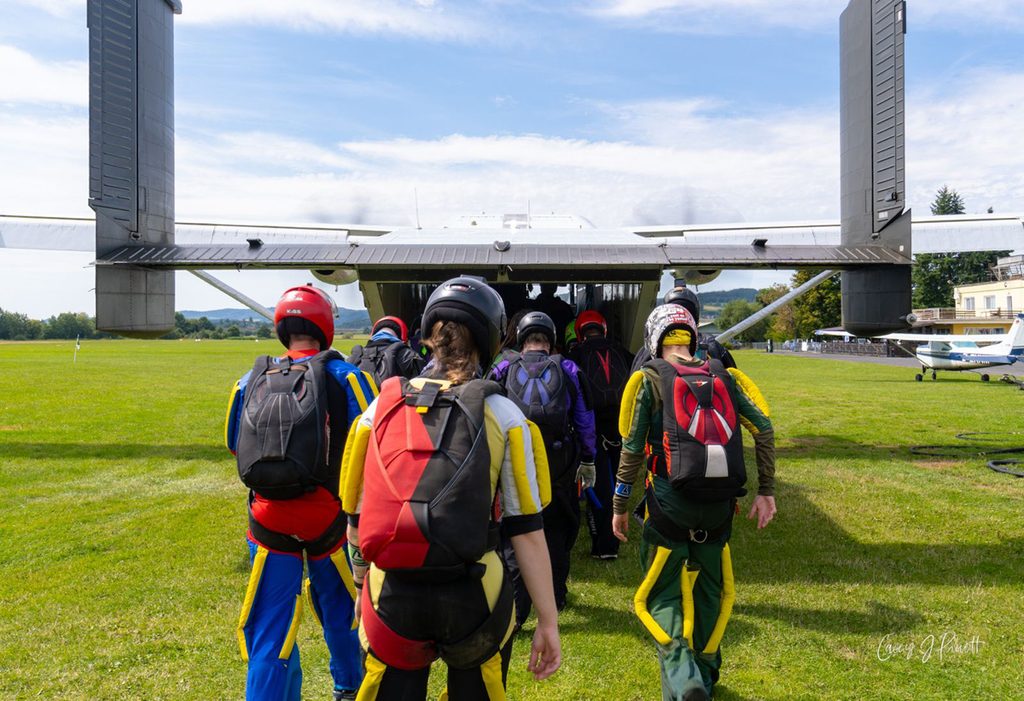
Photo by Casey Pruett
Reliability: Can the rest of us predict your behavior?
Reliability is different. You may have the skills, but will you behave as expected?
For me, reliability starts with ordinary things that do not look impressive on video: arriving on time, listening during the briefing, remembering changes, being ready when the group moves to the aircraft, checking your equipment, helping someone when you said you would and taking reasonable care of your body during a demanding event.
Bigway events can be long. After several days, tiredness begins to show. People sleep less, eat badly, forget to drink enough and sometimes want the next attempt too much. At that point self-management becomes team management.
In the air, reliability is mostly predictability. I want to know that the jumper beside me will fly the slot we briefed, that the person on my tracking line will leave at the agreed altitude, that nobody will suddenly invent a different tracking direction, and that I will not meet an unexpected canopy above or below me because somebody decided to improvise. The most spectacular skydiver is not always the jumper I want closest to me; I prefer the one whose behavior I can predict.
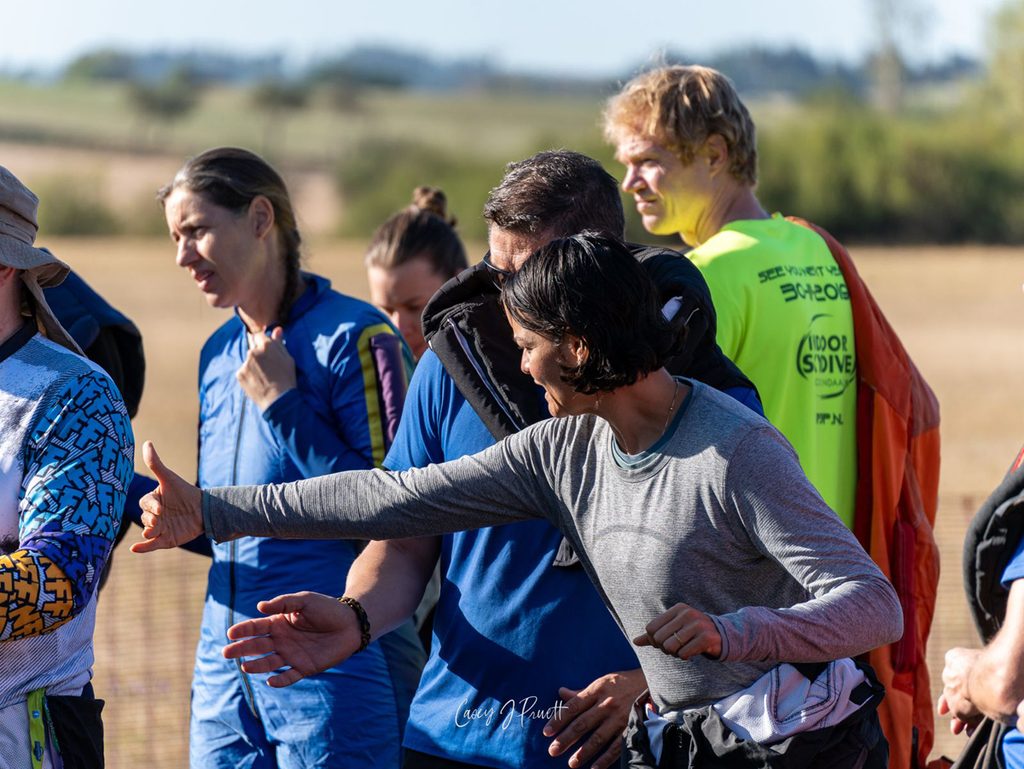
Photo by Casey Pruett
Intimacy: Can you say that something is wrong?
The word intimacy sounds unusual in a skydiving, but in the Trust Equation it has a very practical meaning. It describes whether people feel safe enough to speak openly.
For a bigway team, that matters. Can a jumper tell the sector captain, “I don’t understand the approach”? Can someone say, “I am more tired than I should be”? Can an experienced flyer admit, “I am not comfortable with this slot”? Can a captain tell an organizer, “This part of the plan is not working”?
If the answer is no, we have a problem even if everybody is smiling. I have seen the same pattern in management teams. People appear polite, meetings are calm, nobody openly disagrees, and afterwards the real conversations begin in corridors. In skydiving the consequences can come faster and can be deadly.
Intimacy also includes understanding what is happening emotionally around us. A jumper may be frustrated after several failed attempts, a sector captain may be trying to keep a large group focused while receiving new instructions from the organizers, pilots have their own pressures, camera flyers need their airspace, and manifest and DZ staff are trying to keep the entire operation moving. You do not need to become everybody’s therapist, but you do need enough awareness to recognize that your own experience is not the only one taking place.
Sometimes it is enough to communicate: I understand the situation you are in.
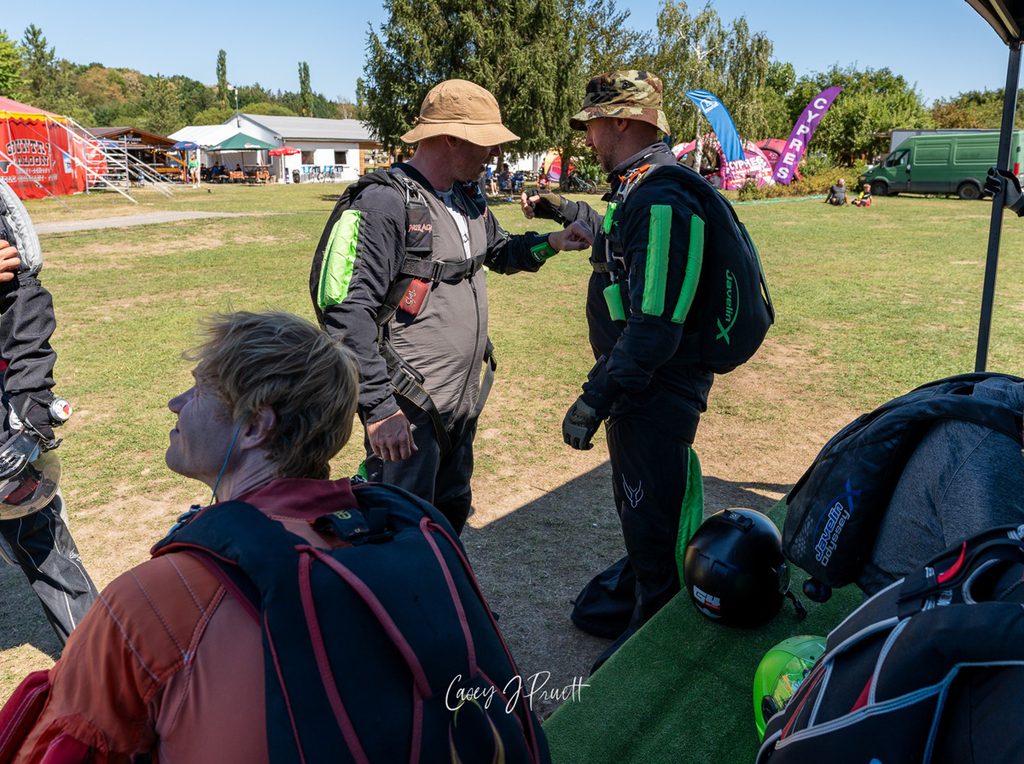
Photo by Casey Pruett
Self-Orientation: How much of this jump is about you?
This is the part of the Trust Equation I find most interesting. Credibility, reliability and intimacy are in the numerator. Self-Orientation is in the denominator, which means that the more everything becomes about me, the less trustworthy I become.
Bigway events are good at exposing this. Most of us enjoy recognition. We like a good slot, we like being on the successful jump, and we like the photograph, the record, the T-shirt and the story afterwards. There is nothing wrong with that.
The problem starts when protecting my position becomes more important than building the formation. Maybe somebody else is better suited to my slot. Maybe I need to accept a position farther outside. Maybe my job today is to help another jumper understand the dive, or take a moment to check that someone beside me is ready, rather than spend all my time thinking about my own performance.
Occasionally, maybe the best contribution I can make to the event is to sit down. That is a difficult decision in a sport where we invest money, time, travel and emotion to be there. But big-way skydiving is unforgiving toward ego because the formation does not care about our personal history. It only shows what we did on that jump.
This is where trust starts becoming useful. Once people believe that those around them are credible, reliable, safe to communicate with and focused on the common objective, disagreement becomes much easier, and disagreement is exactly what we need next.
In part two of this series, we’ll discuss conflict, harmony and commitment.