



Tracking and angle flying have quickly become the go-to disciplines in our sport, not only for experienced skydivers but also for newly licensed jumpers. Over the years, body flight efficiency has improved, the distance covered across the ground is greater than ever, and it’s now common to see multiple movement groups on a single load. This means the average jumper carries more responsibility than ever, and towards the top of the list is knowing your canopy holding area.
The Leader’s Role: More Than Just the Skydive
Being a movement leader comes with huge responsibility; it’s much bigger than just leading a dive flow. One of the most important things a leader should plan for is the safety of the group after opening. To accomplish this, you must:
- Understand upper and lower wind conditions.
- Lead the group to an opening area that allows everyone to return to the DZ safely.
- Prevent overlaps with other groups’ opening zones.
One of the simplest and most effective safety measures is briefing your group’s post-opening holding area. This includes:
- Your intended opening location.
- Predicted opening locations of others on the load.
- The specific canopy holding area for the group to fly to after opening.
- Adjustments for short or long spots.
Clear communication here means that if someone opens out of place, they already know where to fly to avoid conflicts with other groups.

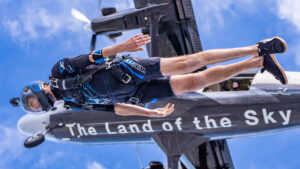
Photo by Beau Kahler
The Follower’s Responsibility: Be Just as Informed
It’s not enough to simply follow in freefall; you are equally responsible for knowing the following:
- Where to fly your canopy after opening.
- How drift and wind patterns will affect other groups.
- Where your group’s designated holding area is.
Too often, jumpers open unaware of their surroundings and end up flying into another group’s airspace or straight back into jump run. Being a heads-up skydiver means seeing the big picture, anticipating where others will be, and deliberately flying to the safest area for yourself and others on the load.
Why This Matters
The more aware everyone is on a load, the safer the entire skydive becomes. Having designated canopy holding areas for movement groups helps:
- Keep landings on the DZ.
- Separate groups vertically and horizontally after opening.
- Maintain visual contact with your group before entering the landing pattern.
High-level movement skill camps already apply this principle of group canopy holding areas, and it’s something that should become standard at every DZ around the world.

The Bottom Line
Safety is cool. In fact, it’s one of the coolest directions our sport is heading. Whether you’re leading or following, knowing your canopy holding area is part of being a safe and responsible skydiver. It’s not about overcomplicating the jump; it’s about building habits that keep everyone safe and make the whole skydive more enjoyable.