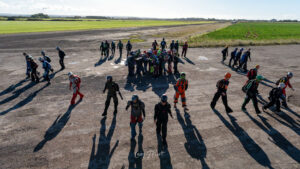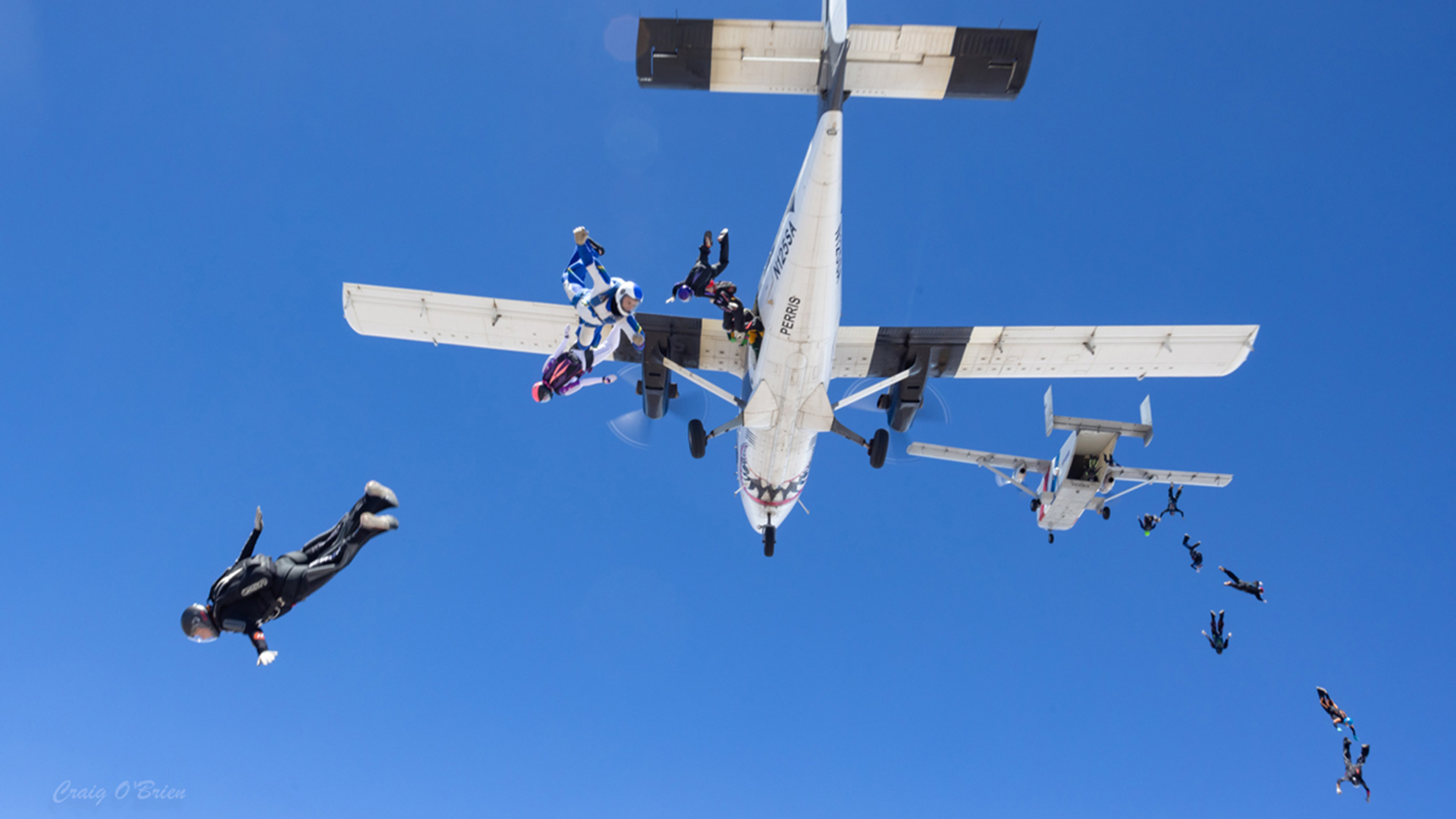




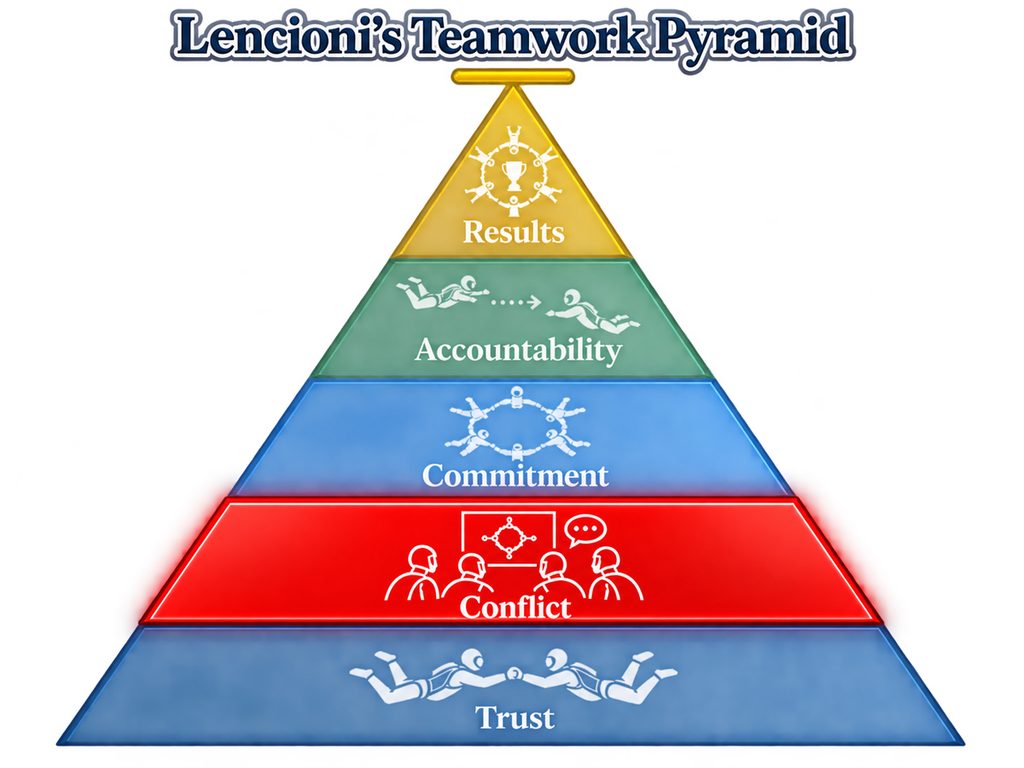
In part two of our this series, Roman applies Patrick Lencioni’s teamwork pyramid to bigways: how trust on the ground helps flyers speak up, work together and build safer formations in the air.
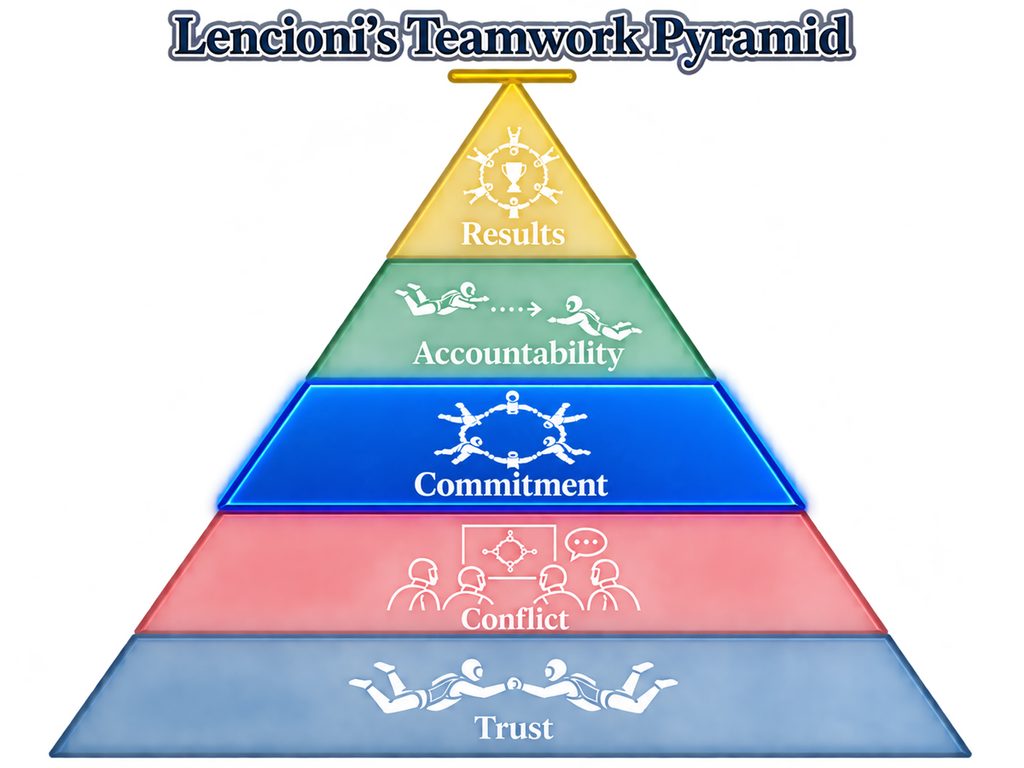
In Part 1 of this series, I looked at what makes us trust the people around us on a bigway. That trust matters when a jumper needs to admit uncertainty or a captain needs to question the plan. Now we have to use it. The next two levels of Lencioni’s pyramid concern speaking openly while the plan can still change, then committing to the decision even when we preferred another solution.
Level 2
Conflict: The Best Bigways Are Built Through Disagreement
In the first level of this pyramid, we have looked at trust, because without it people hide information. A jumper who does not trust the captain may stay quiet about a slot he does not understand, while a captain who does not trust the organizer may complain later instead of challenging the plan while it can still be changed. People protect themselves. That is inside comfort zone for the individual, but at the same time with no benefit for team success.
Lencioni puts fear of conflict directly above absence of trust in his pyramid, and this part of the model is particularly easy to recognize around big-way events. I am not talking about personal arguments. I am talking about disagreement about the skydive.
Somebody has to challenge the bigway first plan
Before a bigway exists in the sky, it exists as a proposal. Someone decides how the base will be built, how many sectors there will be, who goes where, who floats, who dives, who leads each sector, which radials people use, how docking progresses, where the aircraft fly, when break-off begins and how the tracking groups separate.
That first proposal may be excellent, but it is still only the first proposal. Other organizers see different risks. Sector captains know their people. A camera flyer may see a problem with the geometry. A pilot may introduce an operational limitation. Someone looking at the formation may simply notice that part of the plan is unnecessarily complicated.
The useful question is not, “Who is right?” It is, “What are we missing?”
If nobody challenges anything, I become suspicious. Either the plan is exceptionally good, or people do not feel comfortable enough to speak. The second explanation is usually more likely.
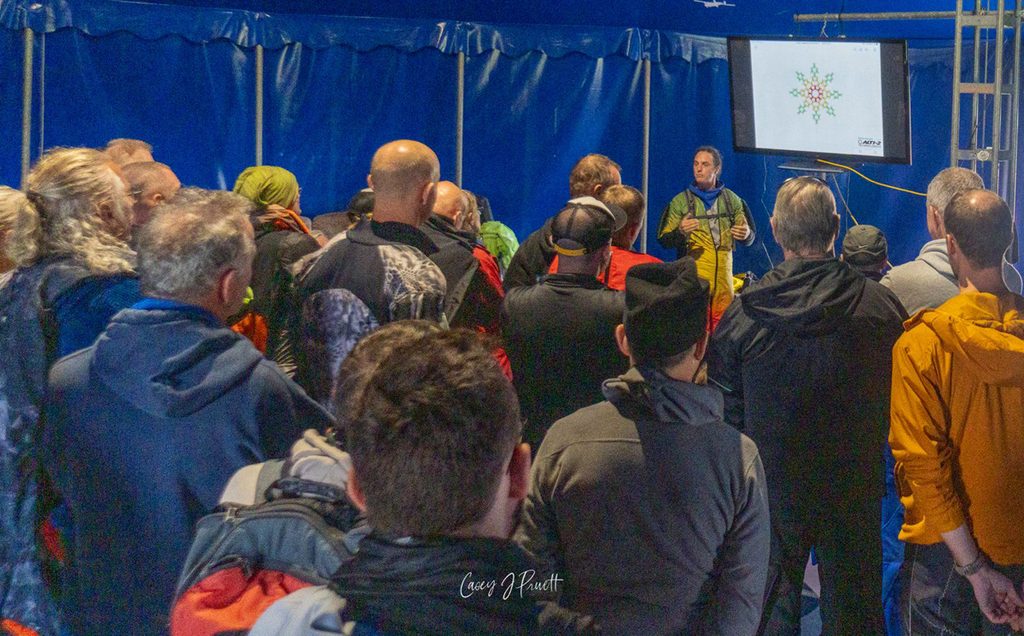
Photo by Casey Pruett
“I disagree” is not a personal attack
This is one of the reasons trust had to come first. If we trust each other, I can say that I disagree with your idea without saying anything about your value as a person.
“I think this radial is overloaded.”
“The sequence looks too slow.”
“I would change the break-off.”
“I don’t think I can fly that slot safely.”
Those are useful sentences. They become difficult only when ego gets involved. Skydivers are not immune to status. Experience matters in our sport, and it should. The judgment of someone who has organized many complex formations deserves weight, but experience should improve an idea; it should not make the idea immune to challenge.
The same applies to the jumper who receives the slot. If you know that the position is outside your current ability, say it before boarding. That conversation may cost you the slot. It may also save the jump.
Artificial harmony is not teamwork
I have seen this often enough in professional teams that I notice it immediately: everyone agrees in the room, then the real meeting starts after the meeting. Skydivers do it too. The briefing finishes, people walk away and somebody says quietly, “This will never work.”
My question is always the same: why was that not said five minutes earlier? Silence is sometimes mistaken for commitment. It is not. If the concern is relevant and the plan can still be changed, say it where the people making the decision can hear it. Organizers also carry responsibility here. If questioning the plan is consistently met with defensiveness or dismissal, people quickly learn to keep their concerns to themselves. Then the organizer gets exactly what was unintentionally requested: silence.
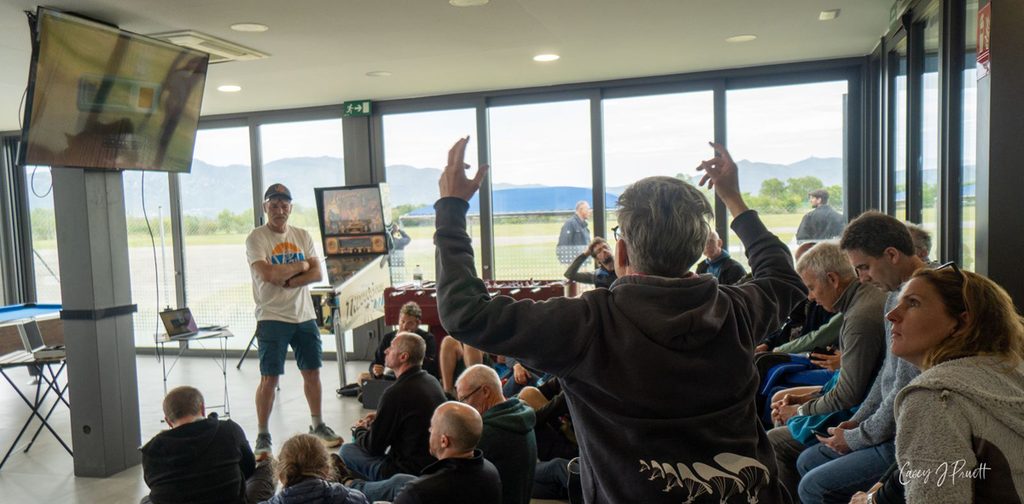
Photo by Casey Pruett
Video makes the argument less personal
Bigway skydiving has one enormous advantage over many business teams: we usually have video.
The camera has no interest in seniority, reputation or explanation. It shows the base moving, the late approach, the low jumper, the person cutting the radial, the grip taken before the body stopped, the tension created in the formation or the poor break-off. That gives the team something concrete to discuss.
A good debrief is not a courtroom. We do not need a guilty person after every unsuccessful jump; we need to understand what happened. Sometimes the answer is technical, sometimes the design was wrong, sometimes the execution was wrong, and sometimes the same jumper makes the same mistake several times and the discussion becomes less comfortable. Productive conflict is not supposed to be comfortable all the time. The important point is that we argue about what will improve the next skydive.
Conflict has an end
There is also a moment when disagreement has to stop. Before the decision, I want people to challenge, question and propose alternatives. After the decision, continuing the same argument damages execution.
At some point the organizer decides. You may still prefer your solution, but the formation cannot contain several competing plans at the same time.
Before the decision: speak.
After the decision: commit.
That is the discipline. When people have genuinely had the opportunity to contribute, commitment becomes easier because the final plan is no longer something simply handed down from above. It becomes something the team understands, and that difference matters once the door opens.
Level 3
Commitment: From Your Plan to Our Skydive
The previous segment ended with a decision. People had the opportunity to question the plan, alternatives were discussed and someone finally said, in effect, “This is what we are going to do.”
Now comes a difficult transition. You may not have received the slot you wanted. Your suggestion may not have been accepted. The organizer may have chosen another solution. The discussion is over anyway.
Lencioni calls the next level commitment, and I think bigway skydiving gives us a very clean way to understand what he means. Commitment is not the same as agreement.
You do not need to love the plan
I have worked with many leadership teams in which people confused commitment with consensus. They wanted everyone to agree before moving forward, and that often produces very slow decisions.
Bigway organizers cannot work like that. A 100-way is not designed by referendum. Different people will have different preferences. One captain likes another docking order. Another organizer would build the base differently. A jumper believes he could perform a more demanding slot. Those views can be discussed, but eventually somebody has to decide. Commitment begins when I stop executing the version I preferred and start executing the version the team chose.
That is the difference between your plan and our skydive.
The formation has to exist in your head first
In practical big-way terms, commitment requires clarity. Before I get into the aircraft I should know much more than the location of my grip.
I need the exit picture. I need to know who is before me, who is after me and what I should see once I am outside. I need my quadrant and radial, my reference points, the people closer to the center, the jumpers around my slot and the docking sequence.
I should also know what happens after the formation is complete:
When do I leave?
Who leaves with me?
Which direction do I track?
Where should the next tracking group be?
What is my deployment altitude?
What canopy pattern did we agree?
If any of those answers are unclear, the briefing is not finished for me. Visualization matters because the jump moves too fast to invent it in freefall. By the time something feels confusing at 120 mph, you are already late. For me, a good dirt dive is partly a test of shared understanding. Hundreds of people may be standing on the ground, but mentally they should be building the same event.
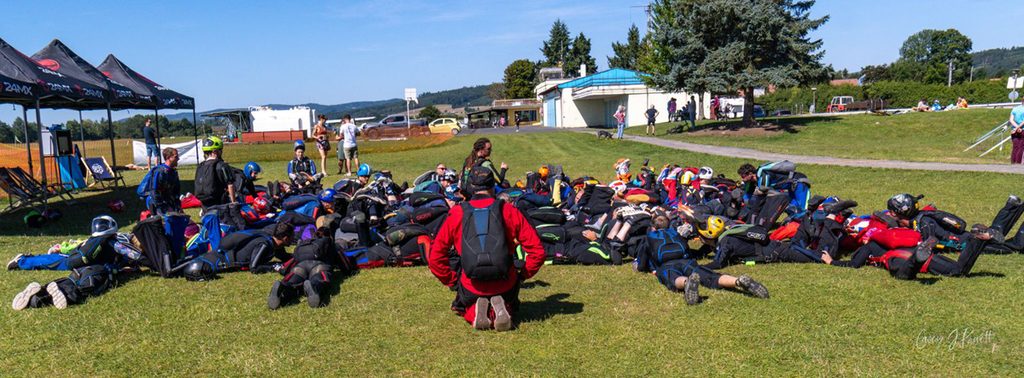
Photo by Casey Pruett
“Yes, I understand” can mean very little
Anyone who coaches knows this. You explain something, ask whether it is clear, and the person says yes. Then you ask them to show it, and suddenly it is less clear.
For big-way preparation, I prefer behavior over confirmation. Show me where you go. Show me who you follow. Point to your reference. Walk the break-off. Tell me what you expect to see.
If a jumper can describe and visualize the whole sequence, commitment has something solid underneath it. If the knowledge ends at the grip, the picture is incomplete.
The jump does not finish at break-off
This is worth repeating because large formations produce a particular temptation: we invest so much attention in completing the formation that break-off can feel like the end. It is not.
Some of the highest-risk parts of a big-way happen afterwards. Tracking is organized airspace management. Deployment altitude matters because other people are using the vertical separation around you. Canopy procedures matter because suddenly a very large number of parachutes occupy the same general area. The landing matters.
I do not consider somebody fully committed to the plan if they execute the formation perfectly and then invent their own procedure after break-off. The agreement covers the whole jump.
There is a moment when thinking changes into doing
On the ground I want questions. I want someone to say, “Show me that again.” I want uncertainty exposed while we can still work with it.
In the aircraft there is less room for discussion, and after exit there is none. By then I need three things to be clear:
I know the plan.
I know my role.
I will do it.
Commitment sounds psychological until the green light comes on. Then it becomes behavior, and that is where accountability starts.
Stay tuned for part three of this series by Roman Pavlovic.