



Alethia Austin shares a coach’s perspective on distracted preparation, destructive self-talk and the questions left unasked.
First of all, I want to preface this with, my experience is only in angle flying and vertical flying students. For the past 8 years I have been working full time around the world as an angle coach and a vertical bigway coach for all levels and for many different goals. But what I will share are some of the common things I see getting in the way of progression.
Not really training all the parts
If you’ve ever seen competitors or high level athletes in our sport train for something, you’ll see there is a real sharp focus and unshakeable drive to train it well. Whether it’s the athletes at Operation VK walking their approaches on those bigway formations, or Matt Fry leading a team on 200-way attempts, the top athletes in our sport are taking advantage of training time.
It’s fairly common to see people walking a jump half-present, sort of just following the walk but not really walking the jump. The set up to walk a jump isn’t some kind of performative act. It’s a true moment in your training where you get to walk it like you want to fly it; your focal point, how close to the leader you’re committing to, how you’ll approach, how you’ll fly the moves, how fast and hard you’ll track away on breakoff, how you’ll head switch to continue to clear your airspace for deployment. The walk, and it’s part in your training, in your day and in your progression is something meant to hold weight in it. The top athletes use it. Bring this into your practice and walk those jumps 100% present, with fire, like you want to fly it.
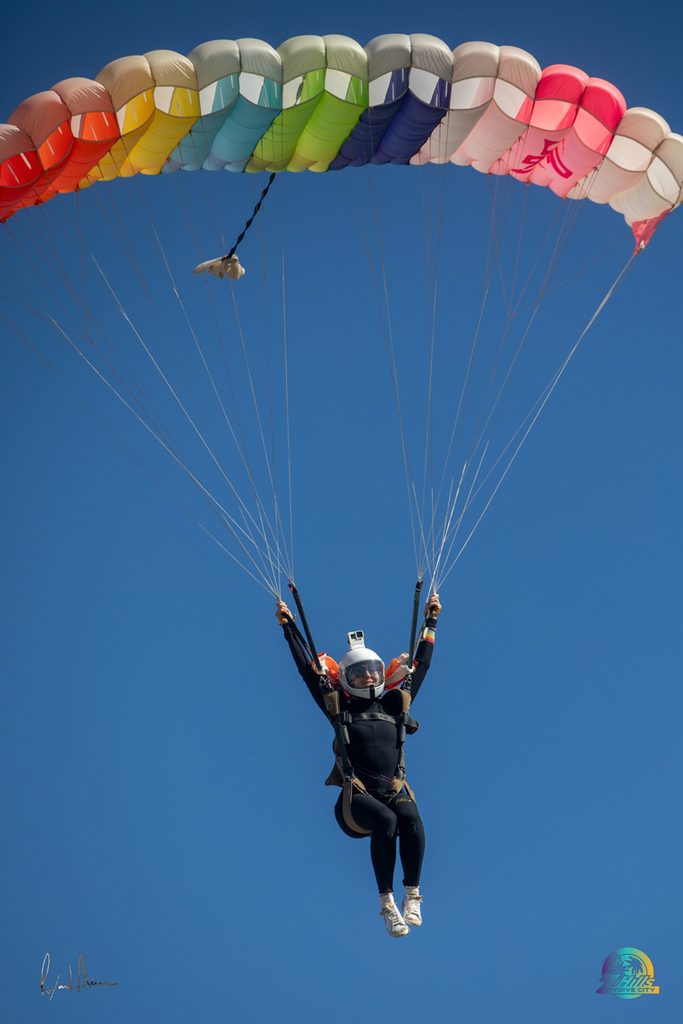
Photo by Raymond Adams
Convincingly Poor Self Talk
Not everyone has poor self talk but those who do can be totally deflated by it. I’ve seen someone’s agony of the story they’ve told about their flying, their capability, or them as a human based on their flying totally destroy a day of coaching. Once every mistake becomes evidence that you’re not good enough, it gets harder to use the feedback. If you’re a good flyer..great. If you’re a bad flyer…get more reps in. If you’re a good human, it’s not because you’re a good flyer. If you’re a bad human, it’s not because you’re a bad flyer.
When you show up to train and do hard stuff, you have to allow yourself to be exposed in not being perfect. (Spoiler alert: nobody is perfect in flying). You’ve got to be humble, have humility, be comfortable sucking at something so that you can learn how to be good at something, and not allow yourself to weave all of that into your identity.
Roadblock: Nat Asking Questions
Don’t be that person at 10,000 feet who asks “How do you do a layout?”
There’s time on the ground. There’s time on the walk. There’s anytime before the jump to go over the details. Some jump plans are rushed. But, keep asking. Let the conversation be on the ground as thorough as it needs to be. Keep the conversation going if you still have questions. The feeling of someone asking that question at 10k can totally zap the group of any confidence.
When you’re pushing your skills in new ways with dynamic moves or whether you’re just simply hammering the fundamentals, it’s all the same: ask questions. Get clear. A lot of what shows up on the ground, shows up in the sky. If you’re unsure, insecure, confused on the ground most likely that’ll be the case in the sky. So, ask. Chances are your coach has had a lot of people stuck on that same move in the past. Flying is hard. It’s not uncommon to need to walk things through and tlak things through several times. What isn’t great is a jump that turns into chaos because someone didn’t want to ask an important question.

Body Flight Mistakes
I tell a lot of people “Guess what, that’s not unique!” Something about a mistake they’re making being the 1,000th time I’ve seen it, that it isn’t unique, to me, frees them from personalizing it. In the beginning of belly angle flying, people stay on their knees and tumble out the door. In the beginning of back flying people’s lower legs tend to be offline, on exits they extend too soon and end up vertical with that desperate swimming arm motion. I could list so many other things most people do in the beginning when learning to angle fly, freeflly, learn dynamic lines, etc. The thing is, it’s just not unique. We’ve all been walking, running, crawling, jumping, swimming, etc. on the Earth since we were babies. So, introducing a whole new set of systems of movements, while also in the midst of essentially a hurricane of wind, tends to bring out some similar interpretations in people.
The agony over a new angle flyer not nailing an exit should be immediately pushed aside as “Yep, seen it. It’s common. Here’s what’s happening.” If you can truly buy into the idea that you’re just not that unique in how you’re learning, that’ll help you stop personalizing things and start looking harder at what to do instead. You’re spending precious tokens on the agony and personalization when what’ll help you faster is focusing on doing the thing. Listen to the cues of your coach, study your videos and the videos of flyers who do it exceptionally well. Then keep repping it out. It’s that easy.