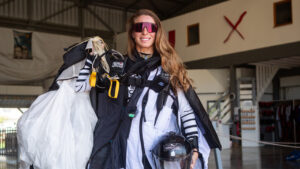




Wingsuit coach, hypnotherapist and mom: Marine Descols passionately shares the mental side of flying, how she became a wingsuit coach and the juggling of a baby as a professional in our sport.
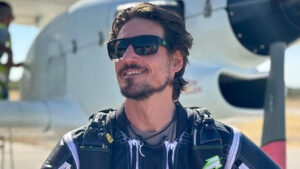
I first met Marine Descols on a tour bus in Egypt, where we’d both been invited to lead jumps over the iconic pyramids of Giza. With my deep interest in the mental side of coaching, I was immediately intrigued by Marine. From the moment we started talking, her passion was clear. Marine and her husband, Vincent, were at the forefront of innovating wingsuit tandem skydiving, and Marine herself was carving out a unique role as both a wingsuit coach and a hypnotherapist for athletes. Over the course of that week in Egypt, my admiration for her deepened. Her calm presence, vibrant energy, and genuine passion for being fully present in the art of flying left a lasting impression on me.
Can you share a bit about your journey into our beautiful sport? What drew you to it initially, and what keeps you passionate about it now?
I did my first tandem when I was 12 and loved it. After my second tandem at 17, I started my AFF in Reunion Island a few months later. I met Vincent (my husband) on a boogie in 2011. Two years after we met, a new wingsuit brand named Squirrel offered him a sponsorship.
I had never done a wingsuit jump before, and to be honest, wasn’t super excited to be bundled up while flying. With Vincent’s sponsorship, Squirrel sent me one too, to “make Vincent happy”. I also wanted to make Vincent happy. Since I had a suit, I gave it a try. I actually really enjoyed it and eventually became a wingsuit coach organizing camps all year long.
In 2020, we founded Skyvibration and developed the wingsuit tandem for non-skydivers. Sharing these adventures around the world with the people I love is the primary reason I continue flying 20 years later. I can find a thousand more reasons every time I fly just for fun.

Photo by Anthony Gavend
What were some of the biggest challenges you faced as you progressed, and how did those shape you as both an athlete and a person?
Regarding performance, it’s mainly my shape that affects me as an athlete. I am a tiny wingsuiter. However, because of this I now have a few tricks to share with short flying humans!
More seriously, a few years ago, I lost many friends to BASE jumping. Around the same time, I had a collision during a skydive that triggered my CYPRES AAD. I woke up hanging in a tree under my reserve parachute, miraculously alive. These events forced me to question my life choices. Should I continue these sports? If so, why and how? How can I keep flying without being overwhelmed, stressed, or putting myself and others in danger?
Traumas impact your life on many levels. Healing isn’t just about overcoming fears that arise; it’s about rediscovering light and joy after chaos. It has been a significant challenge, and though flying was initially the source of my struggles, it ultimately became the path to my solution, and it was beautiful!
I can’t list all the lessons these challenges have taught me, but they certainly led me to test many of the tools I now use as a mental coach and therapist.
Can you talk a bit about your experience as a mental coach?
Before COVID, I organized tunnel camps with Jenny and Alex Aimard, Vincent Cotte, Domi Kiger and others, where I provided the mental coaching for the students. Three years ago, I became a mental coach instructor at the French Sports and Olympics Committee, teaching future sports educators the art of mental coaching.
Unlike many coaches, my background is not in competition. I have been a hypnotherapist for over ten years and was previously a physiotherapist, utilizing medical hypnosis with my patients. Helping someone overcome an addiction or fear by focusing on their resources and solutions can be incredibly useful in the pursuit of performance. These tools are versatile and can be easily adapted to achieve various goals. Additionally, I consistently use these techniques as a wingsuit coach.
How has your background in mental coaching/therapy influenced your approach to training and flying?
I am always struck by how our way of flying mirrors our mindset. It serves as an excellent laboratory to observe people’s minds in action. With this awareness, I have closely monitored my own behavior and reactions during training and performances.
Over the years, the most significant evolution I’ve noticed in myself is my tolerance for mistakes. Initially, I would become upset when I failed to master something new and struggled with frustration. Recognizing this made a tremendous difference: allowing frustration to take over was unhelpful. Instead, maintaining enjoyment of the process and staying curious about the strategy proved far more beneficial. The mental coach in me is happy with the strategy. And so is the therapist who knows that practicing self-love and acceptance makes a huge difference and eases the path to success.
What are some common mental challenges athletes face, especially in high-pressure situations, and how do you recommend dealing with them?
To provide an effective tool, we must first understand the sources of pressure. While feeling stressed about a competition or a record may seem normal, each performer is unique and has their own reasons for experiencing stress. These reasons can include:
- A lack of training or experience
- A need to prove oneself
- A need to focus despite loops of thoughts
- A need to handle external pressure
And so on. Common tools can help manage pressure, but the most effective approach is a deep understanding of one’s own mechanisms and needs. This is my primary role as a coach: asking the right questions to uncover these individual sources of stress, and provide the most adapted tool to the situation.

Photo by Vincent Descols
Are there any mental tools or techniques that you find particularly powerful for athletes?
Firstly, visualization is an incredibly powerful tool, especially in sports where time to perform is limited. But, it has to be used properly. If misused, you can also create bad patterns. You can visualize from both an internal and external perspective, plan responses to unexpected events (like safety procedures), or imagine a symbol of success for reassurance. Visualization is not just about repeating routines. It involves training your imagination, which can be a valuable investment of time and potentially accelerate physical training. Although a detailed discussion would require a dedicated article, in summary, harnessing our brain’s capacity to create mental images is highly beneficial.
Secondly, paying attention to our inner dialogue during action or training is crucial for monitoring our mental state. It is profoundly rewarding to help people understand how self-respect and self-love influence their performance. Witnessing someone empower themselves by changing their internal narrative is truly magical. I was happy to experience that myself and with our students during our camps with Jenny and Alex Aimard.
How do you balance the mental and physical aspects of training, and which do you believe is more crucial to success?
I believe that winning a medal is not a true success if the mental or physical cost is too high. Both mental and physical health are equally important and intrinsically linked.
During my time as a physiotherapist, I encountered a patient who had lost her legs during a trail because she pushed herself beyond her limits. She had traveled from the Philippines, with immense support from her community. The pressure she faced was overwhelming. Despite her strong mental resilience, nothing could restore her legs.
Competition and performance certainly demand focus, time, money, and energy. It is a fascinating journey. However, it is vital to evaluate the sacrifices made, especially when they become excessive.
In discussions with other mental coaches, I have heard the notion of exploiting athletes’ need for attention or self-esteem to drive them towards medals. I disagree with this approach. If a medal takes precedence over an athlete’s physical or mental well-being, then I am not the coach for you. Perhaps my background as a therapist shapes my perspective, but I firmly believe that our culture of success must prioritize a healthy journey in the sport. To me, true success lies in winning with harmony.
True success lies in winning with harmony
Marine Descols
From your perspective, what’s one piece of advice you’d give to athletes about handling setbacks or failures?
The best advice I received came from Alex during one of our tunnel camps: “If you want to succeed, be comfortable with failure.” This mindset shift is crucial for athletes, as it helps them understand that mistakes and failures are an integral part of the journey.
Another important lesson is learning how to give effective feedback — feedback that is objective and quantifiable. There are tools available for this purpose, and using them can greatly enhance performance and growth.

Screenshot by Squirrel
How do you approach the mental aspect of recovery from injury? Do you have strategies for staying positive and motivated?
There are various situations, people, and stages in the recovery process, so I’m not sure about the possibility of a universal truth.
Although, our mental health significantly impacts our physical well-being. While it’s normal to experience lows, we can’t rush the healing process, so let’s utilize any available resources to ease our journey, by being listened to, well surrounded, and active.
Additionally, move forward one step at a time. People often overthink about the long-term future, when the more pertinent question might be, “What is the next best step I can take today?” Even if, of course, it’s nice to visualize a great outcome in a long healing process, the present is the only place where you can take action.
How has becoming a mom influenced your approach to the sport?
I was already quite conservative in my way of flying recently. I don’t think it changed my practice much. I had already made decisions the past three years such as not coaching in big groups anymore, or doing more videos than performing myself, in order to lower the risks.
How do you manage to balance motherhood with the demands of being both an athlete and a mental coach?
This year was Joy’s first year of life. We were living in a van, constantly on the road from one dropzone to another, and she was with us all the time. I managed by doing much less. Like a LOT of parents.
But to be honest, I’m super grateful for this time I have with her. I can work, practice my passions, and spend time with my husband while being with her all day. It’s exhausting. But it’s great.
We plan will hire a skydiver nanny who will follow us during the season. I plan to use this time for my mental coaching activity and my physical health, which are my after-kid priorities!

Photo by Vincent Descols
Are there lessons from your sport that you find important to pass on to your children?
- Enjoy the learning process
- Be comfortable with mistakes
- Keep training your imagination
- Do your procedures before starting anything potentially dangerous
Things like that. But I would mainly try to create situations in which she could experience these things (and others) by herself.
What are some personal rituals or routines you follow daily and that you follow before a big performance?
Before a big day, I visualise the things I need to do. I program my reactions to an outcome not going as planned.
Right before jumping, I always have a mental checklist that calms me dow. These include touching every safety point (chest strap, handles) and saying out loud what I’m supposed to do, exactly as a pilot does before flying a plane. It helps me to feel safe, and therefore clears mental space for the rest.
Has there been a particular moment in your career that stands out as a major turning point or learning experience?
There are two key conversations that changed my perspective:
The first was with Alex Aimard who encouraged me to be comfortable with failure. This completely shifted my approach to learning, and I have had much more fun and pleasure in my practice since.
If you want to succeed, be comfortable with failure
Alex Aimard
During these last 20 years, I was fortunate to be surrounded by very experienced flyers, but this had both positive and negative effects. While I received great advice, I often found myself jumping into situations I wasn’t ready for, just because I was with more experienced people. A common mistake is thinking that the way to overcome fear is by doing the thing that scares you most. However, blindly pushing yourself doesn’t build confidence. Inside, you know you’re not yet prepared, which leads to discomfort and even puts you at risk.
A few years ago, after one base jump I did without feeling ready emotionally (first wingsuit BASE jump,right after one friend’s passing), I had a conversation with Fred Fugen. He essentially told me I needed to make decisions based on what was right for me, and it turned out to be the perfect timing for the lesson.
From that moment on, I decided to take control of my own progression, without being influenced by FOMO or what I thought others expected of me. By using tools to evaluate my own progress, getting to know myself better, and by having fun doing all that, I could practice in a healthier and safer way.
What role do you believe mental resilience plays not only in sports but in other areas of life?
When you train to face situations that don’t necessarily go as expected, you train to face things the way they are and not how you wish they were. I think it can be useful in pretty much all areas of our life. Personally it helped to overcome grief, and big changes that occurred in my life.

Photo by Thibault Guerrier
Looking ahead, what are some goals you have, both personally and professionally, within the sport?
Professionally, the plan is to create more space for my mental coaching and therapy activities. Through remote coaching like I already do, but also through camps, like I used to do before Covid.
I’d love to come back to wingsuit coaching also, but only for one-on-one jumps.
Personally, I just want to take more care of my body and have a physical routine to follow everyday. I need to figure out how to create routines in a life that is constantly moving. That’s a big challenge!
Lastly, what advice would you give to young athletes — or even parents of young athletes — on cultivating a positive mental attitude in sport?
Always keep in mind we are here to have fun!
Who are your sponsors?
Squirrel
Vigil
Upt
Tonfly
Julbo
Flysight