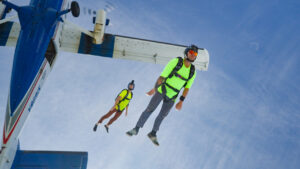




A physical therapist explains how smarter training helps you fly longer, stronger, and with fewer injuries
Every skydive and every tunnel session is a test of your body’s durability. The air doesn’t forgive sloppy technique, weak muscles, or stiff joints—it amplifies them. If you’ve ever struggled to hold a clean arch, stability in a sit, or felt your shoulders screaming after a long day of flying, you already know: bodyflying is not just skill, it’s athleticism. And like any athlete, if you neglect your strength and mobility, your performance will suffer—and so will your body.
As a physical therapist that works with body flyers, I see the same issues again and again: weak stabilization, stiff joints, poor body awareness, and preventable injuries. The good news? Most of these problems are fixable with the right approach to training. If you want more control, more endurance, and fewer “why-does-my-body-hurt” moments, it’s time to treat bodyflying like the sport it truly is. The solution isn’t just flying more—it’s training smarter.

The Common Pain Points during Flying
Flying isn’t impact-heavy like running or contact sports—you’re not pounding your joints into the ground or colliding with other athletes (hopefully). But that doesn’t mean it’s easy on your body. The repetitive demands, awkward positions, and long sessions create their own unique risks. Over time, this adds up, especially if you’re not doing the preventative work outside the tunnel or sky to stay physically healthy.
- Shoulder Issues
- Why they’re at risk: In flying, your arms are constantly out in front, overhead, or locked into static positions against the wind. The rotator cuff and scapular stabilizers are small muscles that tire quickly if undertrained. Add multiple tunnel blocks that last 10–15 minutes straight, a day of jumping and fatigue builds fast.
- What can go wrong: Rotator cuff irritation, impingement, or just chronic soreness that makes it harder to hold clean lines. Weakness here often shows up as arms drifting out of position mid-flight.
- Warning signs: Shoulders burning early in the day, clicking/popping when you raise your arms, or feeling like your arms can’t stay in a position for long.
- Neck
- Why it’s at risk: Flying head-up or in a deep arch requires sustained extension of the neck. Unlike bigger muscles, the smaller stabilizers fatigue quickly, and once they give out, tension shifts into bigger muscles that tighten and ache.
- What can go wrong: Stiffness, headaches, or nerve irritation from prolonged strain. Over time, poor neck endurance limits how long you can hold head-up positions without discomfort. And one hard opening can ground you.
- Warning signs: Neck stiffness after short flying sessions, headaches after tunnel days, or feeling like you’re “craning” your neck to stay in position.
- Low Back
- Why it’s at risk: Many flyers default to arching the lumbar spine to create lift. The problem is that repeated over-extension without strong core engagement strains the small joints and muscles of the spine. Combine that with long tunnel sessions or a day of jumping and the low back often takes a beating.
- What can go wrong: General fatigue, muscle spasms, or chronic soreness after flying. If ignored, this can lead to muscle strains or more serious back issues.
- Warning signs: Soreness in the low back after each block or day, stiffness getting up from a seated position, or feeling like you need to “stretch out” your back constantly.
- Hips
- Why they’re at risk: Flying puts a unique demand on hip rotation and flexibility, especially in arch and sit positions, and transitions. If the hips are tight, the body cheats by compensating with the spine or arms.
- What can go wrong: Poor control and increased strain in an arch or head-up, difficulty holding clean transitions. Restricted hip mobility is one of the biggest hidden performance limitations in flyers.
- Warning signs: compensating with excessive low back extension during arch, difficulty with hip movement during head-up positions
Knowing these areas means you can get ahead of them—strengthen what’s weak, open what’s tight, and build awareness where your body tends to “cheat.”

Strength: Flying Tune-Up
Flying is about controlling your body against and with the force of wind. To do that efficiently, you need strength in the right places. Here are three no-excuse exercises every flyer should start today:
- Face Pulls (Bands or Cable)
- Start at a distance arms are stretched out in front of you holding the band or cable, begin pulling towards nose height, controlled return to the starting position.
- Key for shoulder stability with focus on rotator cuff and upper back
- 3 sets of 12, slow and controlled.
- Hollow Holds
- Start on the floor with arms over head, feet on the floor, simultaneously lift feet & upper back off floor, and breath with a regular cadence
- Crucial for holding a neutral body position.
- 3 sets of 15 sec holds.
- Goblet Squat to over head press
- Stand while holding a weight at chest height, feet at a comfortable width, squat to comfortable depth, then reverse to standing position and lift the weight over head. Lower weight to chest.
- Improves control in transitions and improves ability to absorb landings.
- 3 sets of 8 reps
Mobility: Unlock the Positions You Need
Mobility is the “hidden gear” of body flying. Without it, you’re fighting against yourself before you even hit the air. Here are 3 mobility drills to prepare the body for flight.
- Thoracic Spine Rotation (Thread the Needle)
- Restores mid-back extension and rotation, reducing strain on the low back.
- How: Start on all 4s, reach underneath opposite arm, allowing the upper back to rotate
- Try: 5–8 reps with 10 sec holds before flying.
- 90/90 Hip Rotations
- Improves external and internal hip rotation for sits and carves.
- How: Sit in 90/90 position, rotate both knees side to side with control.
- Try: 2 sets of 8 reps per side, daily if possible.
Shoulder Overhead Opener
Spend 5–10 minutes here before a tunnel session or a day at the DZ and your body will feel primed instead of restricted. Utilize breathing to go deeper into each stretch.

Body Awareness: The True Edge of a Flyer
Strength and mobility are useless if you can’t control them. Body awareness—what we call proprioception—is awareness of our body in space and flying. Elite flyers succeed because they can make subtle, efficient adjustments. Train your proprioception to sharpen control.
Try this:
- Quadruped Hover Holds
- How: Hands under shoulders, knees under hips. Hover knees 2 inches off floor. Keep the spine neutral.
- 3 sets of 20–30 seconds.
- Progression Options
- Lift one hand or foot at a time without shifting.
- Shift weight slightly forward/backward while staying stable.
- Guidance: Incorporate these 2–3 times per week to improve control.
Build the Body That Can Fly for a Lifetime
Bodyflight is an art form, but it’s also an athletic pursuit. The tunnel and the sky demand more from your body than most flyers realize—strength, control, endurance, and the ability to repeat movements with precision over and over without breaking down. Strength and mobility aren’t just about “looking fit”; they’re the foundation that keeps your joints safe, your movements sharp, and your flying career long-lasting.
Truth be told; the time you spend training on the ground is an investment in more minutes flying in the air. If you want to progress faster, fly cleaner, and avoid the pain of being unable to fly, you need to treat your body like part of your gear. Just like you wouldn’t jump with frayed lines or a cracked helmet, you shouldn’t fly with a body that’s unprepared for the demands you’re putting on it. Flyers who train smart don’t just survive long days of jumping at the DZ or multiple tunnel blocks—they thrive in them. They fly with confidence, recover faster, and stay in the game for years instead of seasons.