



Dr. Taylor Wolin is back with part two of the Bodyflier’s Blueprint, and this time he’s zeroing in on the one area that has a huge impact on your flying
In Part 1 of this series, we established that great flying doesn’t start in the sky, it starts on the ground. Strength and mobility aren’t “extra” training for skydivers. They are the foundation that allows control, efficiency, and longevity in flight.
Now it’s time to zoom in on the most underrated control center in bodyflight: your hips.
Ever feel like you’re doing everything right in the tunnel, arms where they should be, legs engaged, yet your body still drifts, yaws, or collapses under pressure? That’s your hips not doing their job.
Your hips drive your body position. When they’re stable and strong, flying feels more effortless. When they’re weak, stiff, or uncoordinated, you end up compensating with everything else. That’s when sloppy flying and injuries show up.

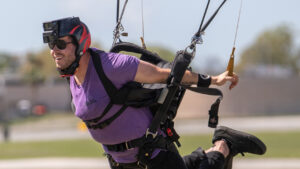
Photo by Raymond Adams
Why the Hips Matter More Than You Think
From a physical therapy and movement science perspective, the hips are the central hub of the kinetic chain. They are your center of mass, connecting your lower body to your core and spine, and dictating how force is transferred through your entire system.
In flight, your hips control pitch changes (arch vs. de-arch), stability in belly, back, and sit, power generation for transitions, and efficiency during prolonged tunnel time.
If your hips lack strength, you collapse under load. If they lack mobility, you compensate with your lower back or knees. If they lack control, everything above and below becomes reactive instead of intentional. When hips aren’t working efficiently, flying gets a lot harder than it needs to be.
Common Hip Problems in Skydivers
After working with skydivers and tunnel flyers in both rehab and performance settings, these patterns come up regularly: overactive hip flexors from excessive arching, underactive glutes that fail to stabilize pitch, limited hip rotation affecting carving and transitions, poor single-leg control that shows up during landings, and compensation patterns in the lower back and knees.
None of these get fixed by stretching more. They get fixed by teaching the hips to move and stabilize under control. Tight hip flexors are often weak ones.

The Groundwork: Hip Training That Transfers to Flying
These exercises focus on strength, control, and usable mobility, the kind that actually shows up when the wind is on.
1. Glute Bridge (Progressed Hold) Builds hip extension strength and endurance. Brace your core, lift into a bridge and hold for 10-20 seconds while maintaining a neutral spine, breathing regularly throughout. This helps maintain stable arch positions without overloading the lower back.
2. Hip Airplanes Trains hip stability and rotational control. Balance on one leg, hinge forward slightly, and rotate the pelvis open and closed under control. Improves carving control and single-leg stability for landings.
3. 90/90 Hip Rotations Builds active internal and external hip rotation. Sit on the floor with both knees bent at 90 degrees and rotate side to side while staying tall. Enhances rotational awareness and smoother transitions in freefall.
4. Lateral Band Walks Strengthens lateral hip stabilizers. With a band around your ankles or knees, stay low in a slight squat and step sideways keeping the band under tension. Improves control during side-sliding and dynamic positions.
5. Single-Leg Romanian Deadlift Trains hip hinge, balance, and posterior chain strength. Hold a weight in the opposite hand to your stance leg, hinge at the hips while maintaining a neutral spine, and lift the opposite leg behind you. Builds awareness and control that carries over to both flying and landings.
Homework for Flying
For the next 7-10 days, perform 2-3 rounds of these exercises, 2-3 times per week. Move slowly and deliberately, and focus on feeling the hips do the work rather than the lower back. Then pay attention next time you fly.
Next Up
Part 3 covers shoulders, specifically building the strength and endurance to handle sustained flying and pressure without the rotator cuff paying the price.